Two Communions, One Claim: On the Name We Share and the Burden We Bear
How can two Christian families, divided for over fifteen centuries, both still call themselves Orthodox–and what does that weighty claim ask of us?
“The Church, though dispersed throughout the whole world, even to the ends of the earth, has received from the apostles and their disciples this faith…carefully preserves it. She also believes these points [of doctrine] just as if she had but one soul, and one and the same heart, and she proclaims them, and teaches them, and hands them down.”
—St. Irenaeus of Lyon, Against Heresies I.10.1 & 2 (c. AD 180)
“My sheep hear My voice, and I know them, and they follow Me. And I give them eternal life, and they shall never perish; neither shall anyone snatch them out of my hand. My Father, who has given them to Me, is greater than all; and no one is able to snatch them out of my Father’s hand. I and My Father are one.”
—John 10:27-30 (NKJV)
“A new commandment I give to you, that you love one another; as I have loved you, that you also love one another. By this all will know that you are My disciples, if you have love for one another.”
—John 13:34-35 (NKJV)
*Please note that this lay-level blog post is not intended to assert any dogmatic or ecclesiological claims contrary to Orthodox teaching, tradition, or modern dialogue among hierarchs. For any questions or concerns, please contact info@syndoxia.com.
In every Orthodox Divine Liturgy, in every tongue–Greek and Coptic, Georgian and Armenian, Syriac and Slavonic, Malayalam and English–the one Lord Jesus Christ is confessed, the one Holy Trinity is glorified, the one bloodless sacrificed is offered on behalf of all and for all 1. Different languages, different melodies, different traditions. The same Lord Jesus ChristWho, for us man, and for our salvation, was incarnate…suffered and was buried…and on the third day, rose from the dead 2.
And yet, two families of ancient churches, ecclesially separated for more than fifteen centuries, continue to this day to call themselves by the same name: Orthodox. Neither side has set it down. Neither has asked to be called by something else. Neither has removed this qualifier from its ancient rites and rituals.
This can come as news to many of us. It can even provoke many reactions in us. It may surprise us that two ancient churches, separated in sacramental communion, each insist on the same confessional name. It could perhaps also encourage us, in a landscape thick with heterodoxies, to find familiar kin. But, if we take the name seriously–it can, and perhaps should, also alarm us to some degree.
Few Christian words carry as much weight as the word Orthodox. It is not a brand, not a denominational label in the modern sense, not an inherited decoration, and not simply the name of a single homogenous tradition. It is a confession: a claim to the correct faith and right worship, to fidelity to the apostolic inheritance of the Church. That is what makes the existence of both Eastern and Oriental Orthodox churches so striking. If two communions not in sacramental communion both hold this name, one of the following must be true:
- One side has preserved Orthodoxy and the other has departed from it.
- One side has, even while being Orthodox in character, split as a schismatic group.
- Both are merely denominational fragments–artifacts claiming the same ancient title.
- The word Orthodox names a deeper apostolic inheritance that has survived on both sides of a tragic and unresolved rupture.ion.
Undeniably, the wound is deeper than any single apology or dialogue and must be addressed in humility and sincerity. None of these possibilities is comfortable, since it has implications reaching up to the salvation of millions. Both claim that there is no salvation outside the [Orthodox] Church 3. Despite this, St. Paul’s question to the Corinthians comes back with unsettling force: Is Christ divided? (1 Cor. 1:13).
Thus, if two communions are separated, and both insist on calling themselves truly Orthodox, the issue is not just semantic. It becomes a theological, historical, and spiritual problem that the faithful cannot responsibly ignore; it becomes a problem that Christendom begs to resolve.
The visible witness of the Church, on this question, answers with either a cacophony of hard-lined opinions, naive optimism, or troubling silence,
At first glance, the problem seems irrelevant for lay members of either church to become acquainted with. However, Orthodox Christianity has never treated Truth as something infinitely elastic, nor as something that can be contradicted without consequence. Christ calls Himself The Way, the Truth, and the Life 4. Falsehood belongs to the Devil, the “Father of Lies”5. Moreover, the Church proclaims herself to be One, Holy, Catholic, and Apostolic in its confession of faith6. Relativism has no place in authentic Christianity.7
The Church ought to be One because Christ is one8, and the faith of the Church is one because the Truth handed down from the apostles is one9. Where each tradition can recognize in the other genuine piety, ancient liturgy, unbroken episcopal succession, and lives manifestly shaped by holiness, this cannot be dismissed without reflection–though neither can it alone resolve the Christological and conciliar questions that remain between them10.
This question deserves more than just slogans or slurs. Many laypeople receive the issue prepackaged: “that Church is plainly heretical“, or “it was all politics and language misunderstandings which no longer matters.“11 Neither account is satisfying. If the division was only political or semantic, why did generations of bishops, monks, saints, and martyrs treat it as a matter worth suffering for–both by pen and by sword? Yet if one side simply loved truth and the other rejected it, why have conversations, past and present, between the two families often discovered substantial (albeit contested and hotly-debated) convergence on the very questions that were thought to divide them? Additionally, why have both loyally maintained nearly identical forms of worship while remaining separated for such a long time?
To begin answering these questions, we have to begin with the word itself.
Summary
Both the Eastern Orthodox and Oriental Orthodox call themselves Orthodox—meaning right faith and right worship. That creates a serious question, because two families that have been divided for over fifteen centuries over the formulation of Christology cannot simply ignore the tension the shared name creates—especially in a postmodern, digitally-connected age in which the other tradition’s writings are accessible to anyone with a search bar. Thus we must ask: what does it actually mean to be Orthodox, and how can two communions separated from one another both worthily hold the name?
Answering these questions forces Christians to inquire about what Orthodoxy really means, why the split happened, and whether the two sides are actually divided in faith, in language, in history, or in all three.
Two communions divided for centuries over Christological language cannot simply let the shared name pass without examination. The issue demands seriousness, humility, and charity. Do not reduce it to the other side is plainly heretical, nor reduce it to it was all now-irrelevant politics that we can overlook. The tradition of both Churches is too costly for either slogan.
Study the name, the councils, the fathers, and the living communities of both sides before pronouncing on what divides them–or on what, by Gods will, may yet reconcile them.
What “Orthodox” Actually Means
If Orthodoxy means the one apostolic faith rightly believed and rightly worshipped, then the continued separation of two grace-filled communions that both claim it is not a detail to file away. It is a question the Church(es) herself is still called to face.
The term Orthodox comes from the Greek word orthódoxos (ορθόδοξος [adj.]) or orthodoxía (ορθοδοξία [n.]). It is commonly explained as a combination of roots orthos–straight, right, upright–and doxa. For the latter root, the translation matters. Doxa is the word the New Testament uses above all for glory: the glory of the Word made flesh (John 1:14), the glory of God shining in the face of Jesus Christ (2 Cor. 4:6), the glory the Son had with the Father before the world was (John 17:5). However, in Classical Greek and throughout the Patristic era, doxa also carried the meaning of “opinion,” “judgment,” and “belief. Collectively, the Orthodox Church operates on the conviction that right opinion or judgement is naturally followed by right glory and worship given to God. Right belief and right praise are not two things, but one inherited reality. As St. James stated, faith without works is dead (James 2:26).
Not only has the Orthodox Church maintained right belief and right worship together, but has through various terms further clarified herself in order to properly rear her members: right belief (“Orthodoxy”) is maintained with right action (“Orthopraxy“), right articulation (“Orthology“) and right affection (“Orthopathy“). Right belief without right action collapses into abstraction; right action without right belief collapses into performance. Right articulation without right affection collapses into polemic; right affection without right articulation collapses into sentiment. Orthodoxy, faithfully understood, refuses every one of these collapses and expects a balanced walk between all (which, in Christ, is the “narrow way that leads to life”) It is for this reason that Orthodoxy affirms that there is no salvation outside of the Church.
“But the hour is coming, and now is, when the true worshippers will worship the Father in spirit and truth, for the Father is seeking such to worship Him. God is Spirit, and those who worship him must worship in spirit and truth.”
—John 4:23-24 (NKJV)
The Church fathers recognized this early on, witnessing to it across centuries. St. Basil the Great makes precisely this point in his treatise On the Holy Spirit: we cannot separate the doxology of the Church from the faith of the Church. The way we pray to the Holy Trinity is itself a confession of who God is. The Church prays as she believes, and believes as she prays–lex orandi, lex credendi12.
To be truly Orthodox, then, is not merely to assent to a list of correct propositions, to memorize various theological formulas, nor (perhaps rather bold to claim) merely to be submerged three times in the baptismal font. It is to stand within the right worship and right confession of the apostolic Church–what St. Paul called the parathēkē (παραθήκη), the good deposit entrusted to us (1 Tim. 6:20; 2 Tim 1:14), and what St. Jude called the faith once for all delivered to the saints (Jude 1:3); To be truly Orthodox is to actualize its identity as the bride of Christ; and it is only necessary for a bride to recognize her Bridegroom for Who He truly Is.
The sentiment is ancient. St. Ignatius of Antioch, on his way to martyrdom in the early second century, already insisted that the whole life of the Church is ordered around one bishop, one altar, one Eucharist (To the Philadelphians 4; cf. To the Smyrnaeans 8). A hundred years later, St. Irenaeus of Lyons marveled that the Church scattered across the world, in every language, confesses one and the same faith as if she posessed one soul and one and the same heart (Against Heresies I.10.2). St. Vincent of Lérins, who died just before the Council of Chalcedon, gave the definition that has never been improved upon: the catholic [Universal] faith is that which has been believed everywhere, always, and by all (Commonitorium 2).
The word orthodox, in this patristic grammar, was not a party name or denominational affiliation. It was the shape of a One, Holy, Catholic, and Apostolic body of believers.
Both communities now called Eastern Orthodox and Oriental Orthodox have inherited that grammar. Neither invented the claim in modern times. They stand, both of them, within the ancient vocabulary in which orthodoxy named the apostolic faith and the apostolic worship, safeguarded together.
And yet today they are not one communion.
✠ ✠ ✠
Two Families, One Name
The labels Eastern Orthodox and Oriental Orthodox are themselves relatively late conveniences. They are useful shorthand for distinguishing two families of churches, but they should not mislead us into thinking the division is merely geographic (i.e. “East” and “Orient”).
The term “Eastern Orthodox” was not officially bestowed on a particular date; it gradually emerged in Western (especially English-langauge) usage to distinguish this group from Western [Catholic/Prostestant] Christendom; and, ultimately, from other Eastern Christian bodies that were long-forgotten or ignored (including the Oriental Orthodox and the Church of the East). The churches within this communion had always known themselves as Orthodox; what shifted over the early modern period was that outside observers began using the adjective formally as a name. It is clear that by the sixteenth through eighteenth centuries that the term “Orthodox” was firmly used to describe this communion of Christians as a denominational title rather than a confession of faith, which ultimately became the label used by the World Council of Churches’s for this group.
The collective label “Oriental Orthodox”, is likewise modern: the churches of this family came together at the historic Conference of Addis Ababa in January 1965 and formally articulated their shared identity as one family of Orthodox churches in the “Orient”. That was the emergence of the collective designation–not the invention of the term Orthodox among them, with a geographical qualifier distinct from “Eastern” which had already been used by the Chalcedonian Orthodox. In the first few centuries of the early church (including the 5th century), the “Eastern Church” was a designation commonly applied to what would later become those groups (i.e. the Christians of Armenia, Egypt, Ethiopia, and Syria).
Long before Addis Ababa, from the time of the Chalcedonian rupture in A.D. 451 onward, these Churches had not lost their Orthodox identity, as it is expressed in their liturgical texts. For example, the Coptic Orthodox Liturgy of St. Basil has a specific litany for the peace of the One, Holy, Catholic, and apostolic Orthodox Church… and for our Orthodox bishops (which mentions the other patriarchs in communion with it). In the Syriac Orthodox Anaphora of St. James, the priest prays a canon for the Orthodox teachers, concluding with “Keep us O Lord, in the true Orthodox faith, and make us unswerving and without guilt so that we may offer You praise and thanksgiving… Amen.”
Thus, contrary to popular opinion, the word Orthodox is in both Churches a genuine, long-standing self-identifier that expresses a conviction and confession of the fullness of Truth.
But is the Name “Orthodox” Properly Theirs?
A deeper question remains: even granting that the Oriental Orthodox have borne this name for fifteen hundred years in their own voice, was it theirs to hold? That question–whether the Eastern Orthodox critic can responsibly deny them the name in light of fruits, patristics, reception, modern dialogues, and symmetry of polemics/agreements–deserves its own sustained treatment. It will be pursued at length in a companion essay, “Can the Oriental Orthodox Claim the Name Orthodox? Questions the Critics Must Answer”. The remainder of this post returns to the communion-level story: what the fifth-century wound actually was, how the two families distinguish themselves, and what our shared name now asks of us. Briefly, fairness demands that Eastern critics, (and Oriental critics) face uncomfortable questions:
- How do you explain fifteen centuries of the other’s Orthodox saints, martyrs, sacramental validity, and miracles whose holiness your churches recognized?
- If reception is the criterion for ecumenical councils, what does it mean that the entire ancient patriarchates have never received Chalcedon?
- On what ontological grounds is the miaphysite Cyrillian confession of “one incarnate nature” a misreading of Orthodox thought, when a shared church father affirmed it, the Church has always maintained a patristic tradition of synthesizing text with Christological formulae, and from the time of Chalcedon to the present, theologians have denied the heresies they are blamed of falling in?
- Why did Eastern saints, hierarchs, and theologians speak of the Orientals as brothers in the same faith–even to the point, in some jurisdictions, past and present–of communion?
These questions do not settle the schism. They do make it impossible to pronounce confidently that the word Orthodox belongs to one communion alone; that one of the churches do not possess divine grace; and ultimately, that one side cannot and will not be saved unless they join the other. Anyone who wishes to exclude the Oriental Churches from the heritage of Orthodoxy must do more than repeat the watchwords “rejected Chalcedon; monophysite; heretic; schismatic” He must face the history of saints and martyrs, the theology of reception, the shared confession of the Fathers, and the witness of his own hierarchs. Short of that, the accusation of appropriation rings hollow.
This post, and this website, do not claim authority to resolve that question for either party. It is the Church’s to answer, in her own time and by her own means. What we maintain is narrower: that the question is a real one, that it is worth asking rightly, and that neither “they are plainly unorthodox” nor “we are plainly the same” is yet an answer the Church herself has rendered. The goal of this forum is to advocate for a sustained, thoughtful dialogue rather than reductionistic thinking that makes reconciliation a “case-closed” with ultimatums.
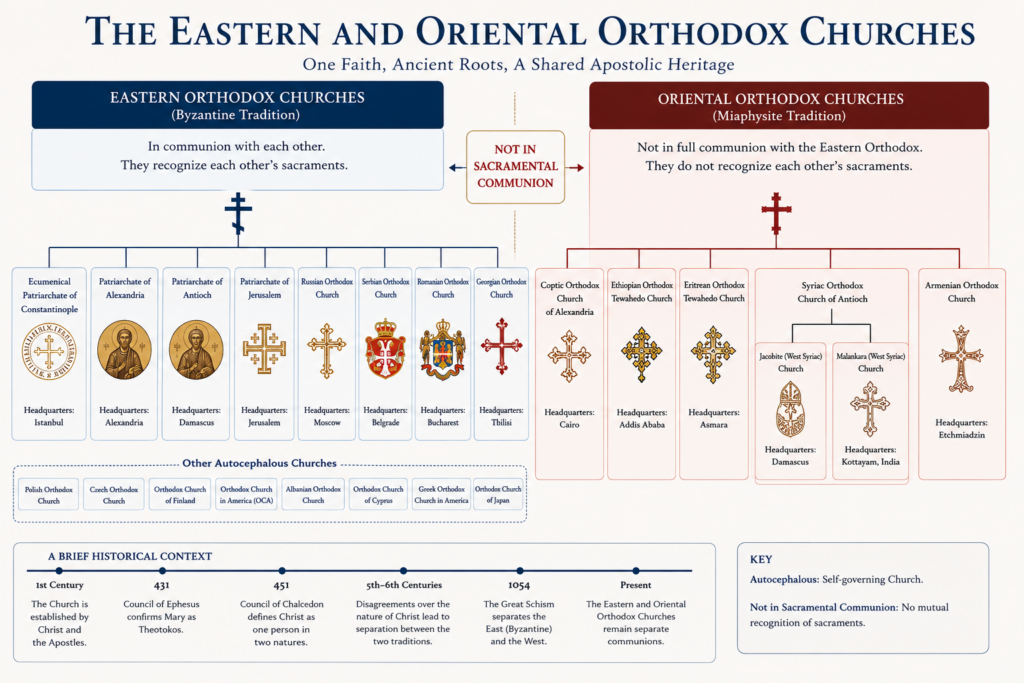
The Eastern Orthodox are the churches that received the Council of Chalcedon in 451 and remained in the Chalcedonian and later Byzantine communion. They include the ancient patriarchiates of Constantinople, Alexandria, Antioch, and Jerusalem, together with the churches of Russia, Serbia, Romania, Bulgaria, Georgia, Greece, and others. They receive seven ecumenical councils, from Nicea I (325 A.D.) through Nicea II (787).
The Oriental Orthodox are the churches that did not receive Chalcedon and continued in the apostolic traditions associated especially with Alexandria, Antioch, Ethiopia, Armenia, Eritrea, and India. They include the Coptic Orthodox Church of Alexandria, the Syriac Orthodox Church, the Armenian Apostolic Church, the Ethiopian Orthodox Tewahedo Church, the Eritrean Orthodox Tewahedo Church, and the Malankara Indian Orthodox Syrian Church (with the other Indian Orthodox Jacobite Syrian Church still considering themselves under the Patriarchate of Antioch). They receive the first three ecumenical councils shared with the Eastern Orthodox, yet do not recognize the rest.
Both families trace unbroken apostolic successions. Both preserve ancient liturgies rooted in the pre-Chalcedonian centuries. Both have canonized saints, raised up martyrs, and given the world fathers whose writings still teach the Church how to pray.
✠ ✠ ✠
The Christological Wound
The break between the Eastern and Oriental Orthodox Churches came in the fifth century, in the storm surrounding the councils of Ephesus (431) and Chalcedon (451). Its substance was Christology–the question of how to confess the one Lord Jesus Christ, crucified for us and risen, truly God and truly man.
It is crucial to see what both sides shared.
Both revere St. Cyril of Alexandria–the Pillar of Faith, the Seal of the Fathers13–whose writings against Nestorius remain the touchstone of Christological orthodoxy in both traditions. Both receive his Twelve Anathemas against any claim that separates Christ’s divinity and humanity in a way that compromises the unity of His person or the integrity of our salvation14. Both confess the Theotokos, the Virgin God-bearer, whose title Cyril defended because it is Christology before it is Mariology: she gave birth not to a god-bearing man but to the one Lord in the flesh15. Both hold that Christ is consubstantial with the Father according to his divinity and consubstantial with us according to his humanity, in all things like his brethren, yet without sin (Heb. 2:17; 4:15)16. Both reject Nestorius, who was understood to divide the one Christ into two subjects. Both reject Eutyches, who was understood to absorb Christ’s humanity into his divinity17.
The disagreement was not over these fundamentals. It was not a misunderstanding in the sense of ignorant confusion. It was over the language in which to guard them.
Those who received Chalcedon (the Chalcedonians) embraced its Definition: the one Christ is to be acknowledged in two natures, without confusion, without change, without division, without separation18. The properties of each nature are preserved as they come together in one prosōpon and one hypostasis19. From within that tradition, St. Maximus the Confessor, two centuries later, gave his tongue and his right hand rather than yield the fullness of this confession–that the complete humanity of Christ, with its own will and its own energy, was not swallowed up in his divinity but assumed, sanctified, and glorified20.
Those who did not receive Chalcedon (the non-Chalcedonians) did not reject the fullness of Christ’s humanity21. They feared that the phrase in two natures, as it was being heard in their context, risked sliding back towards Nestorius–toward a Christ parceled out between two acting subjects. They preferred St. Cyril’s own formula: mia physis tou Theo Logou sesarkōmenē, one incarnate nature of God the Word 22. St Severus of Antioch, the great theologian of the non-Chalcedonian tradition, spent his pen on precisely this: that to say the one incarnate nature is not to deny the complete humanity but to confess the unity of Christ who saves 23. The conditions for partaking of the divine mysteries in the Coptic Orthodox Church to this day include the confession to believe that He [Christ] made it [His body, His humanity] One with his Divinity without mingling, without confusion, and without alteration. and that His divinity parted not from his humanity for a single moment, nor a twinkling of an eye 24.
Each side, in other words, was using the language available to guard what it understood to be the truth of one Christ, truly God and truly man, undivided and unconfused. The tragedy, in St. Paul’s phrase, is that where we now see in a mirror, dimly (1 Cor. 13:12), each came to read the other’s formula as saying something it did not–or at least, something the other would not recognize as its own confession. Perhaps even more dimly, both are trying to articulate the mystery of the incarnation through human language as best as humanely possible.
The wound is not merely a language issue–but neither is it only doctrinal rejection. It is a long entanglement of terminology, polemic, politics, and deep distrust of one another’s formulations and their perceived implications, woven and reinforced across fifteen centuries of separated life.
✠ ✠ ✠
“Monophysite” and “Miaphysite”: A Distinction That Matters
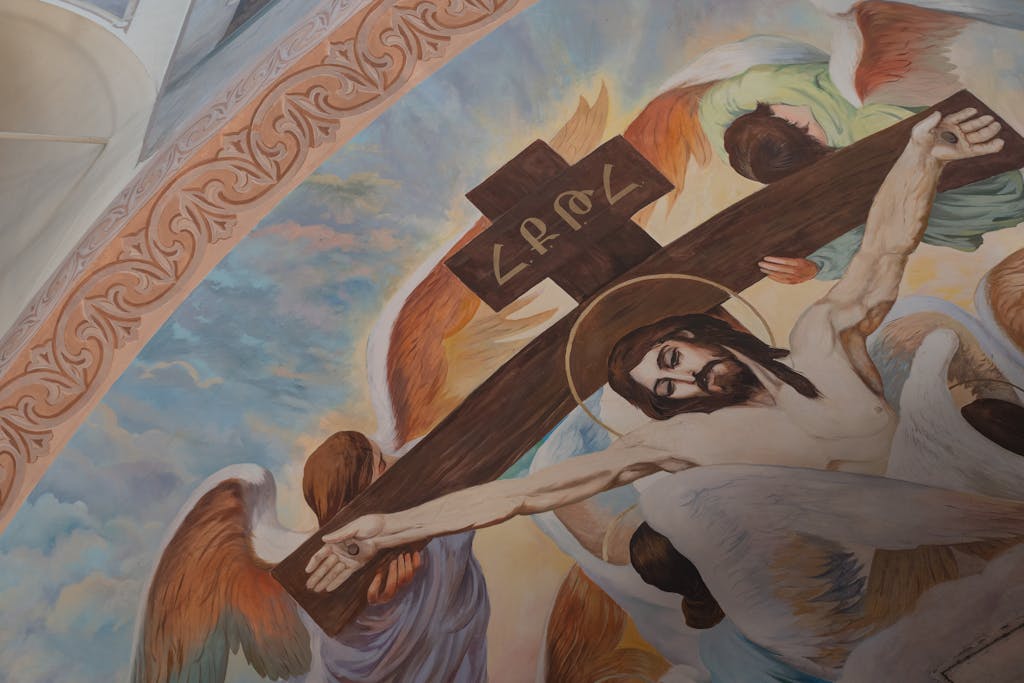
Older readings describe the Oriental Orthodox as monophysite. The label is misleading, and the Oriental Orthodox themselves reject it due to its heresy.
Monophysitism, in its strict historical sense, is the teaching of Eutyches, a presbyter and archimandrite of Constantinople–that Christ’s humanity was so overwhelmed by his divinity as to be effectively absorbed. The Oriental Orthodox have consistently repudiated that teaching. Their fathers have defended, century after century, that Christ’s humanity is complete, integral, consubstantial with ours. St. Gregory the Theologian writing long before the schism, gave the standard that both families still hold: that which has not been assumed has not been healed (Epistle 101). A Christ who is not fully man is not the Savior of men. This thought has been maintained in the Oriental Orthodox Church after Chalcedon as well. Fr. Bishoy Kamel, a contemporary Coptic Priest, writes “The Christian concept of salvation does not consist merely in commandments, or in teachings, or in promises; it is rather the descent of God and his union with us. The Savior then is God who united with us and walks with us”.
The more accurate term is miaphysite– from St. Cyril’s mia physis (μία φύσις): one [composite, united] nature of the incarnate Logos.
The distinction is not pedantic:
- Mono (Μονο)–connotes a single nature that has replaced or swallowed the other.
- Mia (Μία)–connotes a single united reality in which both divinity and humanity remain fully present in the one Christ, without mixture, confusion, or diminishment.
One letter, but a different confession entirely. And here the age we live in presses a responsibility our predecessors did not bear. We live in a digital-information age in which access to information and connectivity is greater than it has ever been. The patristic sources, the original conciliar acts, the liturgies, the living voice of the other tradition’s fathers–all of it is now a search or chat forum away. This is a privilege our forebears did not have; and with the privilege comes a responsibility they did not carry. Inherited confusion about another communion’s confession was, in centuries past, a forgivable condition of its age. Today, increasingly, it is a choice.
To refuse, in this age, the distinction between mono– and mia–, when the Oriental Orthodox have set down their confession in print, in every language, for anyone willing to open the page, is to argue with a caricature rather than with a communion. It is to fail at what Fr. Thomas Hopko, of blessed memory, so clearly emphasized: to speak the truth in love (Eph. 4:15). For those who confess the fullness of the truth, to mis-identify another’s doctrine, and then to build a polemical case against the caricature rather than against the confession actually made, is not faithfulness. It is, at best, an offense against the very seriousness of Orthodoxy we all claim to defend. At worst, it is a species of false witness against the brother (Ex. 20:16)–and a faith whose certainties rest on denial of the truth is a faith whose foundation is already compromised.
“Everyone who hears these sayings of Mine, and does not do them, will be like a foolish man who built his house on the sand” (Matt. 7:26). A spirituality that has heard speak the truth in love and built itself instead on caricature and polemic has heard the Word and not done it. It may look, from the outside, like a house. But when the storm comes–when real encounter, real inquiry, or simply the ordinary testing of a life under pressure arrives, as it does and will–the house will not stand. And great will be its fall.
Honest conversation has to begin with what the other side actually confesses–in their words–not with what polemic has long attributed to it, however painful this may be for either side to hear.
✠ ✠ ✠
When the Two Meet Again
For most of fifteen centuries, the two communions lived largely apart. They developed distinct liturgical languages, calendars of saints, patterns of memory, and inherited suspicions.
Contrary to the opinion that dialogue never occurred before the modern ecumenical movement, there were moments when reconciliation was sought. St. Nersēs IV Shnorhali–the Gracious–the Armenian Catholicos of the twelfth century labored for unity with the Byzantines in correspondence that still reads with an ache. Between 1165 and 1172, Shnorhali exchanged letters with Emperor Manuel I Komnenos and with Patriarch Michael III of Anchialos of Constantinople; his Profession of Faith (1166), composed, at the Emperor’s request, interpreted mia physis in explicitly Cyrilline terms, anathematized Eutychianism, and employed two-natures language where it could be received without confusion. Imperial and patriarchial authorities were evidently persuaded. But Shnorhali died in 1173; Manuel died in 1180 after the crushing defeat of the Byzantines at Myriokephalon in 1176; political conditions collapsed. Full communion did not come.
In the twentieth century, theologians from both families began meeting in serious unofficial consultations–at Aarhus (1964), Bristol (1967), Geneva (1970), and Addis Ababa (1971)–followed by the formal Joint Commission for Theological Dialogue between the Orthodox Church and the Oriental Orthodox Churches, which has held four official meetings: Chambésy I (December 1985), the Monastery of Anba Bishoy in Wadi El Natrun (June 20–24, 1989), Chambésy II (September 23–28, 1990), and Chambésy III (November 1993).
Out of that dialogue came two Agreed Statements on Christology:
- The First, at the Monastery of Anba Bishoy in Wadi Natrun (Scetis), Egypt, 20-24 June 1989.
- The Second, at Chambésy, Switzerland, 23-28 September 1990.
Their burden was this: representatives of both families, examining each other’s formulas, testified that they confess the same Christological faith in the one Lord Jesus Christ; that the difference in terminology does not correspond to a difference in Christological substance; and that both traditions have always rejected Nestorianism and Eutychianism. In the plain words of the Second Agreed Statement: “both families have always loyally maintained the same authentic Orthodox Christological faith, and the unbroken continuity of the apostolic tradition, though they have used Christological terms in different ways.” This is not an accommodation of heresy, but recognition of an ontological unity in diversity of expression; it is unity within legitimate theological pluralism. It is syndoxia in Orthodoxia.
The Agreed Statements have not yielded sacramental communion. Reception is slower than dialogue, and real questions remain–about four later ecumenical councils received by the Eastern Orthodox but not the Oriental Orthodox (Chalcedon, Constantinople II, Constantinople III, and Nicaea II) and the doctrinal content articulated at them; about the saints anathematized on one side and venerated on the other; and about the practical shape of a reconciled ecclesial life. The Statements themselves have drawn serious and well-intentioned criticism from theologians and hierarchs within both communions. Their findings are not a settled ecclesial conclusion but a sober theological proposal that the Church is still weighing.
They have, however, been ratified in specific pastoral acts:
- 12 November 1991: Synodal and Patriarchal Declaration of the Greek Orthodox Patriarchate of Antioch (Ignatius IV Hazim) and the Syriac Orthodox Patriarchate of Antioch (Mor Ignatius Zakka I Iwas)–calling for “complete and mutual respect” between the two churches, providing guidelines for concelebration by clergy and intercommunion of faithful under specified pastoral conditions, and envisaging joint meetings of the two Holy Synods.
- 5 April 2001: Pastoral Agreement on the Sacrament of Matrimony between the Greek Orthodox Patriarchate of Alexandria and All Africa (Petros VII) and the Coptic Orthodox Church (Shenouda III)–building on a prior mutual recognition of baptism, and allowing for marriages between members of the two patriarchates to be celebrated in either church and recognized by both.
- Subsequent decades: Ongoing formal dialogue between the Russian Orthodox Church and the Oriental Orthodox Churches–including the Coptic, Syriac, Armenian, and Ethiopian churches–marked by semi-annual theological consultations, exchange of seminarians and monastics, and joint communiqués.
After decades of careful work by bishops, monks, and theologians on both sides, a simple dismissal of the other communion as heretical becomes harder to sustain in good conscience without genuine engagement with what the other side actually professes. In many official and unofficial conversations, theologians from both sides have argued that the division was sharpened not only by doctrine but by terminology, politics, language barriers, rival ecclesiastical centers, mutual misreadings, available sources, and inherited sentiments. This does not mean the problem was fake. Nor does it mean communion can be restored by ignoring the past. But it does mean that the old split may not be well described by the crude accusation that one side simply denied the truth of Christ.
✠ ✠ ✠
Why the Shared Name Still Matters
If both communions still claim the name Orthodox, and have recognized it in each other for centuries (whether directly or indirectly), what follows?
At minimum, seriousness and maturity. Orthodoxy is not habit, not ethnicity, not aesthetic. It is a confession that claims the whole life of the Church. If both families hold the name honestly, then either recent dialogues are right that there is deeper common ground than fifteen centuries of polemic allowed us to see; or one side, despite apostolic claims and piety, has fallen into real error at the level where Orthodoxy is decided; or centuries of history and polemic have obscured something real on both sides that has not yet been rightly named. None of these possibilities is easy for either party. None should be treated lightly, or with pride.
But this is not only a matter of taxonomy. It is a wound in the Body of Christ–against which He Himself prayed in the upper room on the same night in which He gave Himself up to death of His own will and authority alone.
The division between Eastern and Oriental Orthodox is borne in living communities–in how Christians pray, how they receive one another, how they remember the saints, how they teach their children, how they imagine the unity of the Church. It affects whether separation is regarded as principled faithfulness or as tragic estrangement. It affects whether reconciliation is suspected as betrayal or sought as obedience to the Lord’s own prayer in the upper room.
“…that they all may be one, as You, Father, are in Me, and I in You; that they also may be one in Us, that the world may believe that You sent Me.”
—JOHN 17:21 (NKJV)
The scriptural grammar of unity runs deep. There is one body and one Spirit…one Lord, one faith, one baptism, one God and Father of all (Eph. 4:4–6). The unity of the Church is not a human project; it is the gift of the one Triune God, reflected in the visible fellowship of the baptized.
St. Cyprian of Carthage, long before any of these divisions, wrote that one cannot have God as Father who does not have the Church as Mother (On the Unity of the Catholic Church 6). When that Mother’s visible coherence is fractured, it is not only ecclesial geometry that suffers–something of the world’s sign of the Gospel is dimmed. The Lord’s own prayer, after all, was that the world would believe by our unity.
This should grieve us, especially in an age that is parsing out “religiosity” (i.e., the Church) from “spirituality.” It should grieve us not in a performative way, but in the deep way that grief sits in the heart when we remember what ought to be and is not–a grief that echoes Christ’s own lament over Jerusalem: “how often I wanted to gather your children together, as a hen gathers her chicks under her wings, but you were not willing!” (Matt. 23:37). A grief in knowing that however much we may claim catholicity (universality), however much we proclaim wholeness, we are a family at odds and a body fractured.
The tragedy of Christendom is precisely that the truth of God is still divergently apprehended. What is a sacred treasury for some, is a deplorable superstition for others.… Yet, in spite of all that, all Christians within the Ecumenical Movement and beyond its actual boundaries should pledge themselves to stay together and to profess their common allegiance to the same Lord and Master. It is a paradoxical situation, certainly. Yet it is exactly that paradox that makes the pledge so valuable and promising. They should stay together, exactly because they are divided. The pledge is valuable because it implies pain and tension. We are given the cross of patience to bear; let us glory in that cross. Our Christian pain is a token of recovery, a recovery which is to come from the Lord.
—Fr. Georges Florovsky, Intercommunion: Confessional Loyalty in the Ecumenical Movement
✠ ✠ ✠
Questions a Christian Ought to Ask
For a layperson, all of this can feel overwhelming. Councils, formulas, imperial politics, saintly reputations, polemical traditions, centuries of inherited language–all at once.
There are two temptations here, and each is an escape from the difficulty rather than a way through it.
The first is to retreat into reductionistic polemics–the comfort of certainty without serious or genuine study; the easy heat of online quarrels and “Orthobrotic” name-calling; Chalcedon and Ephesus brandished as passwords rather than pondered as mysteries. The second is the mirror image: a soft indifference that treats the whole question as ancient quarreling, as if the martyrs on both sides of the divide had died for words no longer worth weighing, as if love for one’s neighbor required us to pretend the disagreement was never real, as if an overly-simplistic, sentimental call to “love” can warrant reconciliation as a “Kumbaya.” The first substitutes factionalism for truth; the second substitutes sentimentality for love. Neither is faithfulness. Both spare us the harder work of actually looking–or, if they look, of looking past their own confirmation bias.
But perhaps the best place to begin is where every Christian life begins: at the foot of the Cross, in humility, with eyes fixed on the One who suffered, leaving us an example, that [we] should follow His steps; Who committed no sin, nor was deceit found in His mouth; Who, when He was reviled, did not revile in return; when He suffered, He did not threaten, but committed Himself to Him who judges righteously; Who Himself bore our sins in His own body on the tree, that [we], having died to sins, might live for righteousness — by Whose stripes [we] were healed. For [we] were like sheep going astray, but have now returned to the Shepherd and Overseer of [our] souls. (1 Peter 2:21-25).
Perhaps we should also be asking ourselves the same question that was asked just before this defining moment in our salvation: What is truth?–not with Pilate’s disingenuousness, but with the seriousness of the disciple who wishes to be sanctified in the word of truth (John 17:17).
A Christian who takes this question seriously must be willing to turn the inquiry first upon himself–to ask, without apology, not what the other side owes him, but what honesty, charity, and truth ask of him. The following are offered not as a polemical examination, but as an examen–the kind of questioning a soul conducts in the presence of God.
- Have I encountered the other tradition in its own voice–its Fathers, its liturgies, its living communities–or only through the voice of its critics or with a filtered lens?
- When I name the other communion heretical or schismtic, am I speaking from careful study of what they actually confess, or from inherited assumption that I have not truly, carefully, and fully examined?
- The Holy Spirit has borne visible fruit on both sides of this divide across fifteen centuries–in martyrs, monastics, miracles, sacramental life recognized within each tradition’s own ecclesiology, and saints venerated in common with the undivided Church. What does that fruit ask me to take seriously, even where I cannot yet agree?
- What would it cost of me, in identity or certainty, if the recent dialogues were right that the two traditions confess the one Christ in different grammars? What would it cost me if they were wrong? How would I react, and if I perceive there is a “price” at stake, am I willing to pay that price if that is where the truth leads?
- Am I pained this division, and if so, why? Do I grieve this division for its separation of other Christ-believing, pious, and perhaps equally Orthodox, brethren? Or, am I pained by this division because of what it implies about my own traditions, culture, spiritual journey, or ego?
- Do I grieve this division, or have I quietly made peace (or perhaps, rejoiced) with it as permanent, save for mass conversion or imbalanced submission? Which of these postures, engagements, or attitudes is most substantiated by the will of Christ and by the will of the apostles and their successors?
- Am I ever truthfully willing to admit that I may be wrong about something in this dialogue (both for those in favor or opposed to reconciliation)? Or, will patriarchs, bishops, priests, theologians, and councils that do not support my opinion and those who I associate myself with be the ones who are in err or less credible somehow?
- For those opposed: Am I more attached to being right than to what may be, by the Holy Spirit, be Truth–and have I prayed for the healing of this wound with the same seriousnessness with which I have argued about it?
- What admissions, concessions, or conciliatory statements am I willing to see my hierarchs make, where do I draw the line–and on what basis?
- Have I caused division, perturbed peace, roused anger, cast judgment, or failed to love my neighbor as I ought in my own understanding of defending the faith? “Pursue peace with all people, and holiness, without which no one will see the Lord” (Heb. 12:14).
- If and when I imagine the end of this wound–whether in the Church’s reception of fuller truth or in its fuller clarification of error–do I imagine it as a vindication of my side, or as an act of the Lord I did not predict and cannot control? On what basis would I make that distinction? Which expectation is more Orthodox?
- If my spiritual father (or my most-trusted teacher) read my words and deeds on this question, would he see a soul being formed by Christ, would he see me as a “defender of Orthodoxy”?
- Do the fruits of the Spirit–love, joy, peace, longsuffering, kindness, goodness, faithfulness, gentleness, self-control (Gal. 5:22–23)–grow in me through the way I handle this topic?
- If I were to explain the division of the church, and my opinion about it, to a person outside of the faith, would they admire me as a zealous or see within Orthodoxy a tarnished history of socio-political-religious drama that keeps them away from the Church–and thus from Christ? Is my actions and attitudes evangelistic.
These are not questions of disloyalty. They are questions of faith seeking understanding–of seriousness, and the aim to speak the truth in love, which the East has always prayed in its simplest form: let us commit ourselves and one another and our whole life to Christ our God.
The theologian is the one who prays, and the one who prays is a theologian.
—Evagrius Ponticus (Chapters on Prayer, 61)
“Do not seek to understand God for it is impossible. Simply open the door of your soul so His presence may fill you and illumine your mind and heart, warm your body, and enter your veins. Theology is not a cerebral knowledge but a living knowledge that is directly relevant to man and sustains and possesses even the whole man. A cold, cerebral man cannot know and discourse on divine things, even if in his head contains an entire patristic library. In order to grasp God and be able to talk about Him to others, you must be a poetic soul. It means that you must have a heart that is noble, sensitive, and pure. You must be as an ear that is turned to the whisperings of the Infinite, as an eye that that sees through the bottomless depths while all other eyes see only pitch blackness. It is impossible for timorous souls and stingy hearts to discourse on divine things.“
—Dr. Alexander Kalomiros (Greek Old Calendarist & Medical Doctor Nostalgia for Paradise)
Reconciliation between Eastern and Oriental Orthodox, if and when it comes, will not come from public-relations language or vague gestures of goodwill. Nor will it come from cries to “Submit to Constantinople” or to reject your people and your father’s house (Ps. 45:10). It will come from Christ, the only begotten Son of God…of one essence with the Father, Who was incarnate and became man, suffered, was crucified and buried, and on the third day rose from the dead. It will come from a kenotic-like humility born out of and breeding love–the love that brought the Lord to the Cross. It will come from bishops, priests, monks, and laypeople willing to face old wounds, to dialogue across phronēmata with honesty and love, to honor the other tradition’s witness without abandoning their own, to mourn what has been lost, and to pray without ceasing for the day the Lord Himself sets the table together.
The shared name of Orthodoxy is not a minor curiosity. It is a theological challenge and pastoral summons.
It is painful precisely because both sides have treated the same faith as something worth suffering for–as the martyrs of both families have shown with their own blood, under Roman emperors and Sassanid shahs, Islamic caliphs, and modern totalitarians.
Conclusion
The division between Eastern and Oriental Orthodox is not just an academic dispute from late antiquity. It is a wound carried in living communities. It shapes how Christians pray, how they receive one another, how they remember the saints, how they teach their children, and how they imagine the unity of the Church. It affects whether separation is viewed as principled faithfulness or tragic estrangement. It affects whether reconciliation is seen as betrayal or as obedience to Christ’s desire for unity in truth.
Perhaps the best place to begin is with humility, curiosity, and reflection: not assuming the answer is simple and not pretending that slogans are enough, roused to genuine inquiry, and cognizant of my “positionality” within this dialogue. The name Orthodox is too serious for lazy use. It demands honesty about what the Church is, what truth is, and what division means.
May they all be one. Until that prayer is visibly and providentially affirmed or denied, we are given the grace of watching, waiting, and pressing onwards with faith, hope, and love.
Prayer
Lord Jesus Christ, Who is the Way, the Truth, and the Life; Who is the Great High Priest and Shepherd of all souls; Who is the divine Head and Bridegroom of Your one, holy, catholic, and apostolic Church:
Send down upon all Christians the grace of Your Holy Spirit, that we may seek the truth with all humility and with the fear of God, that we may remember the things of old without rancor or condemnation, and that we may desire peace and unity in a manner worthy of Your truth.
Protect us from pride, vainglory, prejudices, and malice. Teach us to speak the truth in love, to listen with patience and discernment, and to love Your holy Church more than our own opinions, passions, or self-will.
Through the prayers of our holy Fathers and all the saints who have shown forth in their witness to the Orthodox faith–the Seal of the Fathers St. Cyril and the Theologian St. Gregory; St. Severus and St. Maximus the Confessor; St. Nerses the Gracious and St. John of Damascus; all who wrestled well for the right word; and the martyrs of every family under every persecution, then and now–guide us into all truth, heal the wounds of division, and gather into one those who call upon Your holy name in sincerity and faith.
For You are our peace, our wisdom, our hope, our sanctification, and our salvation; and unto You do we send up glory, together with Your good Father and all-holy, good, and life-creating Spirit, now and ever and unto the ages of all ages.
Amen.
☦︎༺♰༻☦︎
For SYNDOXIA–a lay effort toward clarity, charity, and truth in the question of Eastern–Oriental Orthodox reconciliation.
References & Suggestions for Further Reading
SCRIPTURE:
All scriptural citations use the New King James Version (NKJV). Key references in this post: Psalm 34:14; Psalm 45:10; John 1:1, 1:14, 4:23–24, 10:27–30, 13:34–35, 17:5, 17:17, 17:21; 1 Corinthians 1:13, 12:12–14, 13:12; 2 Corinthians 4:6, 5:17–19, 6:14; Galatians 5:22–23; Ephesians 2:14, 17; 4:4–6, 4:15; 1 Timothy 6:20; 2 Timothy 1:14, 3:16; Hebrews 2:17, 4:15, 12:14; James 2:13, 2:26; 1 Peter 2:21–25; Jude 1:3; Matthew 7:26, 23:37; Exodus 20:16.
PATRISTIC SOURCES:
- St. Irenaeus of Lyons, Against Heresies (Adversus Haereses), I.10.1–2; III.16–19 (c. AD 180).
- St. Ignatius of Antioch, Letter to the Philadelphians; Letter to the Smyrnaeans; Letter to the Ephesians; Letter to the Magnesians (early 2nd c.).
- St. Melito of Sardis, On Pascha (2nd c.).
- St. Cyprian of Carthage, On the Unity of the Catholic Church (De Ecclesiae Catholicae Unitate), 6.
- St. Hippolytus of Rome, Against the Heresy of Noetus.
- Synod of Antioch against Paul of Samosata, Letter to Dionysius of Rome (268).
- St. Athanasius of Alexandria, On the Incarnation; Letters to Serapion; Letter to Epictetus.
- St. Ephrem the Syrian, Hymns on the Nativity 8; Hymns on the Faith.
- St. Hilary of Poitiers, De Trinitate.
- St. Gregory the Illuminator (attributed), Teaching of Saint Gregory.
- St. Basil the Great, On the Holy Spirit (De Spiritu Sancto).
- St. Gregory the Theologian (Nazianzen), Epistle 101 to Cledonius; Theological Orations.
- St. Gregory of Nyssa, Great Catechism; Against Eunomius.
- St. John Chrysostom, Homilies on John; Homilies on Hebrews.
- St. Ambrose of Milan, On the Faith (De Fide).
- St. Augustine of Hippo, On the Trinity; Tractates on John.
- St. Proclus of Constantinople, Tome to the Armenians; Homily 1 on the Theotokos.
- St. Cyril of Alexandria, Twelve Anathemas; Second Letter to Nestorius; Third Letter to Nestorius; Letter to John of Antioch (Laetentur Caeli); Second Letter to Succensus; On the Unity of Christ.
- St. Vincent of Lérins, Commonitorium (c. 434).
- St. Severus of Antioch, Philalethes; Letters; Homiliae Cathedrales.
- Philoxenus of Mabbug, Discourses; Letters against Julian of Halicarnassus.
- Timothy Aelurus (Timothy II of Alexandria), Refutation of the Doctrine Defined at the Council of Chalcedon.
- St. Maximus the Confessor, Disputation with Pyrrhus; Ambigua; Opuscula Theologica et Polemica.
- St. John of Damascus, An Exact Exposition of the Orthodox Faith; Against the Jacobites.
- Anastasius of Sinai, Viae Dux (Hodegos).
- St. Nersēs IV Shnorhali (the Gracious), I Confess with Faith; Profession of Faith (1166); Correspondence with Emperor Manuel I Komnenos and Patriarch Michael III of Anchialos (1165–1172); Encyclical Letter (Toukht Enthanrakan).
- Life of Isaac of Alexandria, attributed to Mena of Pshati, Bohairic recension (c. 692).
- Michael the Syrian, Chronicle (12th c.).
- Bar Hebraeus (Gregory Abuʼl-Faraj), Ecclesiastical History; Candelabrum of the Sanctuary (13th c.).
- History of the Patriarchs of the Coptic Church of Alexandria (Sawirus ibn al-Muqaffaʼ and continuators).
- St. Euthymius Zigabenus, Panoplia Dogmatica (c. 1114, commissioned by Alexius I Comnenus).
CONCILIAR TEXTS:
- Canons and Creed of the First Council of Nicaea (325).
- Creed and Canons of the First Council of Constantinople (381).
- Acts of the Council of Ephesus (431) — including Cyril’s Twelve Chapters.
- Definition of the Council of Chalcedon (451).
- Acts of the Second Council of Ephesus (449).
- Canons of the Council in Trullo / Quinisext Council (692) — Canon 95 on reception of those coming from the non-Chalcedonian and other groups.
- Acts of the Fifth Ecumenical Council (Constantinople II, 553).
- The Henotikon of Emperor Zeno (482).
- Letter of the Armenians to the Orthodox in Persia (preserved in the Book of Letters), associated with the Catholicate of Babgen I (c. 490–516).
- Acts of the Council of Dvin (c. 506).
MODERN DIALOGUE & OFFICIAL STATEMENTS:
- First Agreed Statement on Christology, Joint Commission of the Theological Dialogue between the Orthodox Church and the Oriental Orthodox Churches, Monastery of Anba Bishoy (Wadi El Natrun), Egypt, 20–24 June 1989.
- Second Agreed Statement on Christology and on the Lifting of Anathemas, Chambésy, Geneva, 23–28 September 1990.
- Recommendations of the Joint Pastoral Sub-Committee, Anba Bishoy, 31 January – 4 February 1990.
- Unofficial Consultations of Orthodox Theologians: Aarhus (1964), Bristol (1967), Geneva (1970), Addis Ababa (1971). See V. C. Samuel and others in Greek Orthodox Theological Review and Wort und Wahrheit supplements.
- Conference of Addis Ababa (1965)–meeting of heads of the Oriental Orthodox Churches articulating their shared family identity.
- Synodal and Patriarchal Declaration, Greek Orthodox Patriarchate of Antioch (Ignatius IV Hazim) and Syriac Orthodox Patriarchate of Antioch (Mor Ignatius Zakka I Iwas), Damascus, 12 November 1991.
- Pastoral Agreement on the Sacrament of Matrimony, Greek Orthodox Patriarchate of Alexandria and All Africa (Petros VII) and the Coptic Orthodox Church (Shenouda III), Cairo, 5 April 2001.
- Second Statement of the Russian Orthodox Church on the Theological Dialogue, Holy Synod of the Russian Orthodox Church, December 1997.
- Memorandum of the Sacred Community of Mount Athos on the Dialogue with the Non-Chalcedonians (1995).
MODERN ORTHODOX THEOLOGY & PERSPECTIVES:
- Fr. Georges Florovsky, “Intercommunion: Confessional Loyalty in the Ecumenical Movement,” in Collected Works (Nordland/Büchervertriebsanstalt eds.).
- Fr. John Meyendorff, Christ in Eastern Christian Thought (SVS Press, 1975).
- Fr. Thomas Hopko, Speaking the Truth in Love (SVS Press, 2004).
- Fr. John Behr, The Nicene Faith (SVS Press, 2004).
- Fr. John S. Romanides, selected essays on Christology and Chalcedon, including “St. Cyril’s One Physis or Hypostasis of God the Logos Incarnate and Chalcedon.”
- Fr. Lawrence Farley, Skepticism and the Holy Fire; and additional essays at Orthochristian.com. <https://orthochristian.com/153288.html>
- V. C. Samuel, The Council of Chalcedon Re-Examined (1977; repr. 2001).
- Joseph Lebon, Le monophysisme sévérien (Louvain, 1909).
- C. P. Caspari, Alte und neue Quellen zur Geschichte des Taufsymbols (Kristiania, 1879).
- Hans Lietzmann, Apollinaris von Laodicea und seine Schule (Tübingen, 1904).
- Aloys Grillmeier, Christ in Christian Tradition, 2 vols. (Mowbray/Westminster John Knox).
- John A. McGuckin, St. Cyril of Alexandria and the Christological Controversy (SVS Press).
- Johannes van Loon, The Dyophysite Christology of Cyril of Alexandria (Brill, 2009).
- Brian E. Daley, God Visible: Patristic Christology Reconsidered (Oxford, 2018).
- Karekin Sarkissian, The Council of Chalcedon and the Armenian Church (London, 1965).
- Metropolitan Hierotheos (Vlachos), selected essays on ecumenism and the Athonite position.
- Nina G. Garsoïan, L’Église arménienne et le grand schisme d’Orient (Louvain, 1999).
- Protopresbyter Theodore Zisis, essays in Theodromia and speeches on non-Chalcedonian dialogue.
- Fr. Peter Heers, lectures at Orthodox Ethos.
- Fr. John Mahfouz lecture on Roots of Orthodoxy Eastern & Oriental Orthodoxy (What is the Difference). c.f. with Coptic Orthodox Answers Podcast Oriental Orthodoxy and THE Church: A Response to Fr. John Mahfouz.
- Coptic Orthodox Answers Podcast & Roots of Faith Collaborations, lectures on Miaphysitism Explained: The True Christology of the Early Church; The Council of Chalcedon and its Aftermath: An Oriental Orthodox Perspective; The One True Church–An Oriental Orthodox Response; Why We Only Accept the first 3 Councils
LITRGUCAL SOURCES:
- The Divine Liturgy of St. John Chrysostom (Greek Orthodox Archdiocese of America)
- The Divine Liturgy of St. Basil the Great (Coptic Orthodox recension)
- The Anaphora of St. James (Syriac Orthodox recension)
- Haymānota Abaw (“Faith of the Fathers”), Geʼez dogmatic anthology (Ethiopian Orthodox Tewahedo).
- Senkessar / Synaxarium (Ethiopian Orthodox Tewahedo).
- Fetha Nagast (“The Law of Kings”), medieval Geʼez canonical code.
CONTEMPORARY EVENTS, TESTIMONIES, AND ONLINE RESOURCES:
- OCA: Metropolitan Tikhon at Memorial for the 21 Coptic Martyrs (19 February 2015).
- Archons of the Ecumenical Patriarchate: Coptic Christians Remember the 21 Martyrs.
- Orthodox Joint Commission archive.
- Coptic Orthodox Diocese of Los Angeles, “Two Families of Orthodox.”
- Department of Syriac Studies, Syriac Orthodox Patriarchate
- OrthodoxWiki articles on Oriental Orthodox Christianity, Chalcedon, Dioscorus, the Pastoral Agreement of 2001, and related topics.
- Interview with Patriarch Diodoros I of Jerusalem on the Miracle of the Holy Fire.
- Our Lady of Zeitoun — historical documentation and testimonies.
- Apparitions at Assiut (2000–2001) and Warraq (2009) — Coptic Orthodox reports
- 21 Coptic Christian Martyrs of Libya (Feb. 15, 2015)
PAIRING ESSAY:
“Can the Oriental Orthodox Claim the Name Orthodox? Questions the Critics Must Answer,” the companion to this post, takes up the sustained case for Oriental Orthodox fidelity under five main headings: the Fruits question (sanctity and miracles), the Fathers question (patristic inheritance), the Reception question (ecumenical conciliarity), the Dialogues question (modern theological convergence), and the Asymmetry question (mutual and parallel anathematization/recognition). The reader is warmly commended to that essay for the full argument only summarized here (when available).
Glory be to God forever. Amen.
- The phrase on behalf of all and for all is used in the Eastern Orthodox liturgy of St. John Chrysostom. During the Liturgy, the clergy elevates the Holy Gifts and says, “Thine own of Thine own, we offer unto Thee, on behalf of all and for all.” In the context of the Liturgy, this statement is a reminder that God provides the faithful gifts which are then returned to Him in corporate fashion, as His single body. ↩︎
- This excerpt is taken directly from the Niceno-Constantinopolitan Creed which was finalized in the late fourth century and is recited identically by Eastern and Oriental Orthodox Churches during the divine liturgy. ↩︎
- This quote “No salvation outside the church” (Extra Ecclesiam nulla salus) comes from St. Cyprian of Carthage in the 3rd century, asserting that Christ’s Church is the necessary instrument for salvation. The quote was written in the context of the invalidity of baptism conferred by heretics on the basis of their lacking of the Holy Spirit. In the Eastern Orthodox Church, this quote became widely promoted by Bishop Kallistos Ware. ↩︎
- See John 14:6 ↩︎
- See John 8:44 ↩︎
- This excerpt is taken directly from the end of the Niceno-Constantinopolitan Creed: “We believe in one, holy, catholic, and apostolic Church. We confess one baptism for the remission of sins.” In this context, the word Catholic, coming from the Greek word katholikos, means “unversal”, or “whole” to describe that the church is meant for all people across space and time. ↩︎
- Relativism is the philosophical belief that truth, knowledge, and morality are subjective to individuals or groups. Under this view, there are equally valid “truths” based on the subject. There is no single, objective vantage point to judge other beliefs. Relativism is firmly rejected in the Orthodox Church. Orthodoxy teaches that objective, unchanging divine truth exists as revealed by Jesus Christ and preserved in the Church. This is the case at the level of reality, in relation to other religions, and at the level of morality/ethics. ↩︎
- Orthodox tradition teaches that Christ is one Divine Person (Hypostasis) that is fully God and fully man. After the incarnation, Christ is referred to as a theanthropic being (A compound word containing the Greek root theos meaning God, and anthropos meaning [hu]man). In some texts, Christ is referred to as the “God-Man”. Both Churches proclaim that Christ’s divinity and humanity are united without confusion, without change, without division, and without separation. ↩︎
- The Church maintains its validity through “Apostolic Succession” or “Apostolic Continuity.” This principle dictates that an Orthodox Church can trace an unbroken lineage of bishops from the original apostles to the present day, with each generation preserving the “faith once delivered.” This continuous transmission from one hierarch to the next links the contemporary Church directly to the singular apostolic witness of Jesus Christ. Crucially, this unity does not require cultural homogeneity; because every local community is entrusted with the same “Deposit of Faith” (the revealed truths of Scripture and Tradition), they remain unified even while expressing that faith through diverse regional cultures, rites, and rituals. ↩︎
- In numerous ways, the Orthodox faithful and established Churches have recognized (directly and indirectly) some degree of “authentic Christian character” in the other: whether through mutual reading of books, formal dialogues, public statements in times of regional conflict, or lay-level interaction between members. These can not be dismissed, and serve as data for the recognition of the grace in the other. ↩︎
- There are two major camps of opinions with regards to Eastern and Oriental Orthodox ecumenical relations among the clergy, laymen, and catechumens. Those on the most traditional extreme would claim that the other side is heretical, echoing the centuries of polemic against either group that has made its way into liturgical life. On the other end are those who are are staunch advocates eager for reunion and communion. Some of these individuals would claim that a simple linguistic or other fundamental misunderstanding in the 5th century has created a growing rift that modern conveniences such as interconnectedness, technology, and modern dialogue or coalitions are able to revisit and heal. In response to these proponents of ecumenism, some critics would argue that this ecumenical spirit is a modern initiative that contradicts centuries of church tradition (even to the extent of calling ecumenism itself a dangerous heresy). ↩︎
- This Latin term is a maxim which translates to “the law of prayer is the law of belief”, referring to the idea that the way a community worships and prays shapes and thus reflects what they believe to be true about God. This phrase is traditionally attributed to the 5th-century theologian Propser of Aquitaine to argue that the Church’s liturgical prayers establish its doctrinal beliefs, rather than the other way around. ↩︎
- The epithets for St. Cyril of Alexandria “The Seal of the Fathers” (emphasizing dogmatic precision) and “Pillar of Faith” (due to his defense against Nestorian heresy) are shared among Eastern and Oriental Orthodox traditions. ↩︎
- The Twelve Anathemas of St. Cyril of Alexandria, issued in 430 CE within his Third Letter to Nestorius, targeted the teachings of Nestorius, Patriarch of Constantinople, who argued that Christ’s divine and human natures remained distinctly separate. Cyril’s propositions condemn anyone who denies orthodox doctrines such as the Theotokos, the hypostatic union, the undivided natures of Christ, the unity of Scripture, and the suffering of the Word-made-flesh. ↩︎
- St. Cyril argued against the idea of Christ being a God-bearing man (“theophoros anthropos”), which would imply that He would not be any different than a Spirit-filled saint or prophet. Instead, St. Cytil insisted that Christ was not a man carrying God inside of Him, but rather God Himself made incarnate as a man. This has major implications when applied to the term Theotokos for the Virgin Mary, as it affirms herself as the mother of God. Flipped around, the term Theotokos is thus a Christological proclamation reflected in the title of the His Mother. ↩︎
- The word consubstantial means “of the same substance”, “of the same essence”, or “of the same nature”. In the fourth and fifth centuries, it became formalized that Christ is both fully God and fully man. As such, it can be said that He is “double-consubstantial” with both God the Father regarding His divinity and with the rest of mankind regarding His humanity (save for sin only). Christ’s divinity and humanity is affirmed completely in both Churches; as fully man, Christ thus possesses a real human body, soul, and mind. ↩︎
- It is important to understand that both Churches reject Nestorius and Eutyches, heretics that preoccupied the minds of the fathers as they entered of the Council of Chalcedon. On one end, Nestorianism threatened to divide Christ in a way that compromises the “Word made flesh” in a single person; on the other, Eutychianism (ie. monophysitism) ultra-unites the divinity and humanity of Christ so as to create a hybrid being lacking either completely. It is maintained in this article that besides historical and political factors, the schism between the Eastern and Oriental Orthodox was validated in the other sides perceived implications in Christological articulation, where the Eastern Orthodox (confessing two natures of Christ), were defending against Eutychianism but perceived to be Nestorian and the Oriental Orthodox (confessing one composite nature of full divinity and humanity) were defending against Nestorianism but perceived to be Eutychianism. ↩︎
- This phrase comes directly from the Chalcedonian Definition formally adopted by the Churches accepting the Council of Chalcedon in 451 AD. It is important to realize that these qualifiers for Christ’s divinity and humanity are used by the miaphysite (Oriental Orthodox) Churches, even to the point of being confessed in every Liturgy as a condition for partaking in the Eucharist. ↩︎
- This formulation is a direct excerpt from the Chalcedonian Definition (451 AD). It defines the hypostatic union by affirming that Christ’s divine and human attributes remain fully intact and unaltered (the properties of each nature are preserved). Rather than blending into a composite nature, they coexist perfectly within a single concrete, individual person (prosōpon) and shared objective reality (hypostasis). ↩︎
- St. Maximus the Confessor was a sixth/seventh-century saint in the Eastern Orthodox Church. Following Chalcedon, imperial authorities attempted to enforce political unity through compromised formulas known as Monoenergism and Monotheletism. Maximus argued that if Christ lacked a distinct human will and energy, his human nature would be incomplete. For refusing to agree with imperial edicts, Maximus was tried and tortured in the seventh century. His tongue was uprooted and his right hand was amputated–the literal “instruments of his confession” before he died in exile. ↩︎
- The Chalcedonian critique of the Miaphysite formula argues that it: (1) is semantically ambiguous; (2) risks echoing Eutychianism; (3) obscures the ability to attribute Christ’s actions distinctly to His divinity or humanity; and (4) logically leads to Monothelitism and Monoenergism, which Chalcedonians argue denies Christ a distinct, free human will capable of cooperating with the divine for human salvation. Consequently, polemicists historically accused the Oriental Orthodox of denying Christ’s full humanity—and by extension, human redemption, according to the Gregorian axiom, “What is not assumed is not healed.” Conversely, Oriental Orthodox Christology explicitly affirms Christ’s full humanity and the subsequent healing of mankind, rendering the accusation of crypto-Monophysitism historically inaccurate. This dynamic illustrates a recurring theme in ecumenical polemics: theological nuances are frequently flattened by historical biases, transforming semantic differences into mutual accusations of heresy. ↩︎
- This phrase refers to St. Cyril of Alexandria’s famous formula: mia physis tou theou logou sesarkomenē (“one incarnate nature of God the Word”) which became the staple formula for Oriental Orthodox Christology. Cyril championed this phrase during the 5th-century Nestorian controversy to safeguard the absolute, organic unity of Christ’s person against any attempt to split Him into two separate agents. The subsequent centuries of schism stem from a fundamental divergence in how the term nature (physis) is interpreted by each tradition. The Miaphysite (Oriental Orthodox) tradition interprets the formula with strict fidelity to Cyril’s original context, where physis functions as a synonym for an individual, concrete reality or person (hypostasis). For this tradition, “one nature” does not imply the destruction of Christ’s humanity, but rather underscores the absolute personal unity of the incarnate Word, guarding against any Nestorian separation of the human and divine. The Chalcedonian (Eastern Orthodox/Roman Catholic) tradition, conversely, reads the formula through the strict philosophical lexicon established at the Council of Chalcedon (451 CE), where physis was redefined to mean an abstract set of natural properties or essence (ousia). From this perspective, insisting on “one nature” after the union risks collapsing the distinction between divinity and humanity, potentially opening the door to Eutychianism and compromising Christ’s true consubstantiality with mankind. Modern ecumenical scholarship and joint theological declarations (such as the 1989 Chambésy agreements) broadly recognize this historic impasse as a linguistic tragedy of mismatched terminology rather than a divergence in core apostolic faith, concluding that both traditions firmly affirm Christ to be simultaneously fully divine and fully human. ↩︎
- Severus of Antioch spent his theological career clarifying that non-Chalcedonian Christology does not blend or diminish Christ’s humanity. He maintained that while the divine and human attributes remain entirely distinct in contemplation (theōria), they are inextricably united in reality. Consequently, he argued that terms like “two natures” conceptually split the single, unified subject of Christ, whereas St. Cyril’s “one incarnate nature” safely confesses a single divine-human agent who acts, suffers, and saves as one. ↩︎
- See the Coptic Liturgies according to Sts. Cyril, Basil, and Gregory. ↩︎