Can the Oriental Orthodox Claim the Name Orthodox? Questions the Critics Must Answer
“Beware of false prophets, which come to you in sheep’s clothing, but inwardly they are ravening wolves. Ye shall know them by their fruits. Do men gather grapes of thorns, or figs of thistles?”
–Matthew 7:15–16
“In the light of our Agreed Statement on Christology as well as of the above common affirmations, we have now clearly understood that both families have always loyally maintained the same authentic Orthodox Christological faith, and the unbroken continuity of the apostolic tradition, though they have used Christological terms in different ways.”
–Second Agreed Statement of the Joint Commission, Chambésy, Switzerland, 23–28 September 1990, §9
*Please note that this lay-level blog post is not intended to assert any dogmatic or ecclesiological claims contrary to Orthodox teaching, tradition, or modern dialogue. For any questions or concerns, please contact info@syndoxia.com.
On the evening of Tuesday, April 2nd, 1968, three Muslim mechanics finishing their shift at the Public Transport garage on Tomanbey Street in the Zeitoun district of Cairo looked across the road at the Coptic Orthodox Church of Saint Mary and saw, on the central dome, a woman in white.
One of them, Farouk Mohammed Atwa, thirty-one years old, had a bandaged finger. The finger was gangrenous; he was scheduled for amputation the following morning at Demerdash Hospital. Seeing the figure on the dome, Farouk thought a young woman was about to throw herself from the building. He pointed his bandaged hand at her and shouted, in Arabic, that she should be careful. His coworkers — Hussein Awwad and Yacout Ali Mocamoun—saw what he saw. So did the trainer of public transport drivers, Mamoun Afifi, who came running out into the street when the garage guard cried out, “A light above the dome!” So did two women passing on the sidewalk.
The figure remained on the dome for several minutes. She walked. She bowed toward the cross at the summit. She appeared to bless the gathering crowd. And then she was gone.
The next morning, when Farouk arrived at Demerdash Hospital for the amputation, his surgeon could not find the gangrene. The finger was whole. This was the first of the healings recorded at Zeitoun—and it had happened, the doctors noted, to a Muslim man who had not yet understood whom he had seen.
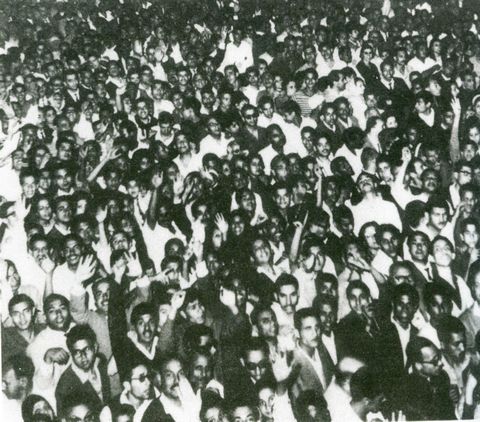
Exactly one week later, on the night of April 9th, she appeared again. And a week after that. And again, and again, for three years. The apparitions continued from 2 April 1968 until 29 May 1971. They were photographed thousands of times by Wagih Rizk, by Al-Ahram, by Reuters, by the New York Times. They were preceded by phenomena the witnesses called “rains of diamonds”—silent showers of light over the church —and accompanied by “doves of light”, luminous bird-like figures which flew above the domes “with astonishing swiftness without moving their wings,” arranging themselves in formations no flock makes by nature, sometimes lining up in the shape of a cross. The air around the church often filled with the fragrance of incense, though no censer was lit.
The witnesses, by the time the apparitions ended, numbered in the millions. They included Coptic Orthodox faithful, of course—for whom the apparitions confirmed a private prophecy His Holiness Pope Kyrillos VI of Alexandria had received, and which he kept silent until his repose, telling only his confessor and the chairman of the Papal Committee that the Virgin had told him personally, “Be ready!” But the witnesses also included Muslims by the tens of thousands, including the police sent to disperse them and the avowedly secular Nasserist government, whose Minister of Information Dr. Hafez Ghanem publicly testified to the authenticity of the phenomenon after the state had ruled out every possibility of fraud. They included Jews of the Cairo Jewish community. They included the head of the Egyptian Evangelical Church and President of the Synod of All Protestant Churches in Egypt, the Reverend Dr. Ibrahim Said. They included Roman Catholic religious—Sister Paula de Mofalo, the Sacred Heart Sisters, the Jesuit Fr. Henry Habib Ayrout—and the Coptic Catholic Patriarch Cardinal Stephanos I Sidarous. They included Pope Paul VI of Rome, who sent two observers and whose Pro-Nuncio in Cairo, Archbishop Lino Zanini, made public the Holy See’s posture: “The Holy See respects in this matter the authority of the local Church and defers to its judgment.” They included President Gamal Abdel Nasser himself.
On 4 May 1968, having appointed a fact-finding commission of Coptic bishops and priests headed by Bishop Gregorios, and having received their report — which the bishops themselves had verified by their own eyes — His Holiness Pope Kyrillos VI of Alexandria issued the formal authentication. The text, published the following day in Al-Ahram, in The Times of London, in The New York Times, and in Le Figaro, reads in part:
“The Patriarchal See declares with complete faith, great joy, and humble gratitude to the Almighty, that the Blessed Virgin Mary has appeared repeatedly in clear and stable forms, during many nights and for varying periods, lasting up to more than two hours, since April 2, 1968 until now, above the Coptic Orthodox Church of Zeitoun, Cairo, on the road to Matarieh, where the Holy Family passed during its stay in Egypt, as tradition reports.”
Pope Kyrillos VI of Alexandria, 5 May 1968
The Coptic Orthodox Church added the feast of the Transfiguration of the Virgin Mary in Zeitoun to her Synaxarion. The entry, kept on the 24th day of the Coptic month of Barmahat—that is, on April 2—records this:
“Since that night the pure Virgin transfigured in different spiritual views in front of thousands of masses, Egyptians and foreigners, Christians and non-Christians, men, women, and children. Spiritual beings formed like doves would appear before, during, and after the transfiguration, zooming through the sky in a way raising the human from a materialistic to a heavenly atmosphere.”
— Coptic Orthodox Synaxarion, entry for 24 Barmahat (April 2)
The Question Zeitoun Poses
The reader is invited to sit with what has just been described. The historical facts are documentary; the photographs are extant; the press archives are available; the medical records are filed; the Coptic Orthodox synodical authentication is signed. The Mother of God spent, by the testimony of her Coptic son who served as Pope of Alexandria, three years hovering above the central dome of an Oriental Orthodox parish church in a working-class Cairo neighborhood. She did not solely appear over the cathedrals of Constantinople, Athens, or Moscow. She did not solely appear over the Vatican. She did not solely appear over Lambeth or Geneva. She appeared above a Coptic Orthodox church—the church belonging, in the strict construction of certain rigorist Eastern Orthodox polemics, to a communion declared outside the Church, lacking valid sacraments, severed from the Body of her Son.
This is the allegory the present essay must work from. It is not, primarily, an argument. It is a datum offered to the conscience. Either the apparition over the church at Zeitoun was not what hundreds of thousands of witnesses, the Coptic Patriarchate, the Evangelical Synod of Egypt, the Coptic Catholic Patriarchate, the Sacred Heart Sisters, the observers of Pope Paul VI, and the Egyptian state itself discerned it to be—or those rigorist constructions of the ecclesial question that place the Oriental Orthodox outside the Church need to be examined with greater care than the rigorist mode usually invites. The Theotokos does not, on any account the Church has ever given of her, choose to manifest the glory of her Son above a building empty of him. The question, then, is what Zeitoun says—and what it requires the Eastern Orthodox conscience to consider.
The Church has always glorified the most holy Mother of God as the Protectress and Defender of the Christian people, entreating, by her intercession, God’s loving-kindness towards us sinners.
Bishop Nikolai Velimirovich, The Prologue From Ochrid
The five questions which follow are, in their entirety, expansions of the question Zeitoun pressed upon the witnesses who saw her there.
A Word on the Posture of This Essay
This essay poses five questions. It does not resolve them; each man must do that for himself before the Lord, and in quiet with his own conscience. But the asking is arguably not optional in an age of increased dialogue between the two Orthodox families; for critics, one is still encouraged to ask if two Orthodoxies ought to exist. If the Oriental Orthodox—Copts, Armenians, Ethiopians, Eritreans, Syriacs, Malankara Indians, sixty to seventy million souls—are deemed by Eastern Orthodox to be not of the Church, then some account must be given of what the Spirit has been doing among them these fifteen centuries, and what the Theotokos has been doing above the domes of one of their parish churches. And if they are of the Church, some account must be given of why we have not yet received them. There is no quiet place of non-engagement here. The questions stand, and also must be asked of the reverse.
This is not written as a verdict, nor as an attempt to settle what properly belongs to bishops, councils, and the mind of the Church. It is written from the limited place of a lay observer trying to look honestly at a wound that has endured for fifteen centuries, and at the arguments now being made about whether that wound is still necessary. The goal is not to flatten the differences between the Eastern and Oriental Orthodox, nor to treat reunion as obvious simply because it is desirable. The goal is more modest: to ask whether our inherited explanations still bear the full weight we place on them, whether the evidence has been handled fairly, and whether charity and truth together require a more serious reckoning than slogans on either side usually allow.
✣ ✣ ✣
The Fruits Question
“You will know them by their fruits.”
— Matthew 7:16
Our Lord gave us a test, and He did not give it as a suggestion. The test is empirical. It does not ask what confession a man recites; it asks what grows on the tree. By this test—and it is His test, not an ecumenical innovation—what has grown on the Oriental Orthodox tree?
The Martyrs
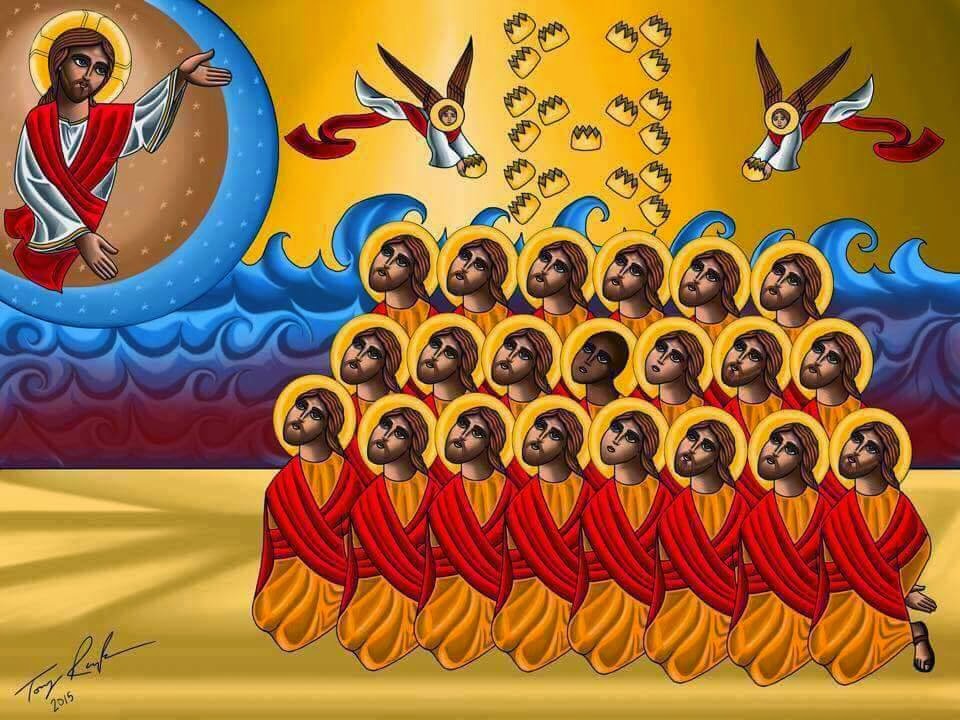
On the 15th of February 2015, twenty-one men were beheaded on a Libyan beach. They were Coptic Christians (twenty from Egypt and one from Ghana who, seeing what was happening, professed Christ and died with his brothers). They died reciting the Name of Jesus. The Archons of the Ecumenical Patriarchate of Constantinople publicly likened them to “the 42 Martyrs of Amorion in Phrygia”— a group canonized by the Eastern Orthodox Church. Metropolitan Tikhon of the Orthodox Church in America, in his public address at the Coptic Cathedral in New York on 19 February 2015, requested of the faithful of the Orthodox Church in America that they offer commemorations for the souls of the twenty-one, and described them as bearing the character of true believers filled with the light of the Resurrection. The Coptic Orthodox Church formally added the twenty-one to its Synaxarion on 21 February 2015.
These are not statements a Church makes about what it judges to be a defunct or heretical body. These are statements a Church makes about its own.
The Ascetics the Philokalia Could Not Afford to Lose
Consider St. Isaac the Syrian (d. c. 700), a bishop of the Assyrian Church of the East—a church that remained, in its own self-understanding, outside both the Eastern and Oriental Orthodox communions, and was historically labelled “Nestorian” by Byzantine polemic. And yet the Philokalia, the Greek ascetic Bible of the Eastern Orthodox tradition, carries St. Isaac among its voices. His Ascetical Homilies have been read aloud in Athonite refectories for centuries.
St. Paisios the Athonite (d. 1994, canonized by the Ecumenical Patriarchate in 2015) loved St. Isaac with particular intensity. According to his biographer Hieromonk Isaac of the Holy Resurrection Kalyva, Elder Paisios was granted a vision in which St. Isaac appeared to him, turned toward him, and said: “Yes, I lived in a Nestorian atmosphere; there were heretics in my province, but I was Orthodox, and I opposed them.” Elder Paisios then proclaimed emphatically: “Abba Isaac was an Orthodox Christian to the core!” In his Menaion, at January 28 — where the feast of St. Ephraim the Syrian is listed—Paisios added, in his own hand, “and Isaac the great Hesychast and much-wronged Saint.”
Paisios commissioned the hymnographer Fr. Gerasimos Mikragiannanites (d. 2002) to compose a formal service to St. Isaac, and chose September 28th for its celebration. The first church in the world dedicated to St. Isaac was built on Mount Athos, at Kapsala, by a monk of Paisios’s brotherhood.
This is striking, but it is only half the story. A much larger scholarly labour—at the level of the contemporary Russian Orthodox hierarchy—confirms the pattern. Metropolitan Hilarion (Alfeyev) of Volokolamsk, longtime chairman of the Department of External Church Relations of the Moscow Patriarchate, earned his doctorate at Oxford under Sebastian Brock (the world’s leading scholar of Syriac Christianity) on precisely this topic. His book The Spiritual World of Isaac the Syrian (Cistercian Publications, 2000), with a Foreword by Metropolitan Kallistos Ware, presents St. Isaac as an Orthodox voice of the first rank. Metropolitan Kallistos puts it plainly: “Over the centuries and in all parts of Christendom, Isaac’s works have been read and recommended as unquestionably orthodox.” Metropolitan Hilarion subsequently edited the conference volume Saint Isaac the Syrian and His Spiritual Legacy (St. Vladimir’s Seminary Press, 2015), gathering papers from the 2013 Moscow patristics conference. The project stands under a senior Russian Orthodox hierarch; the conclusion is not that the Eastern Orthodox Church tolerates Isaac as a borderline case, but that the Church has received him as one of her own—and by means of a thoroughly Eastern Orthodox scholarly apparatus.
The point: the Church that canonized Isaac did not pause to resolve the ecclesial question of his hierarchy first. She heard his voice and recognized the Spirit in it. That recognition is itself a theological datum.
If Isaac—a bishop of a church not in communion with the Orthodox, writing in a region of condemned hierarchs—can be received by Athos and by the Russian Synod, then the principle on which he is received is not jurisdictional. It is the principle by which the Church discerns Orthodox voice. St. Constantine the Great, equal-to-the-apostles, remained formally outside the sacramental Church for most of his life, was tolerant of Arians in the name of imperial unity, recalled Arius from exile, and was baptized on his deathbed by Eusebius of Nicomedia—an Arian-leaning bishop. The Church did not subtract any of that from her calendar. She judged what the Spirit had done with him and named him “Great.”
Armenian Hierarchs the Byzantines Knew as Orthodox
In the twelfth century, St. Nersēs IV Shnorhali (“the Gracious”, d. 1173), Catholicos of All Armenians, corresponded with Emperor Manuel I Komnenos and Patriarch Michael III of Anchialos of Constantinople. He reinterpreted the Armenian formula of “one nature” in Cyrilline terms, explicitly anathematized Eutychianism, and used the language of two natures where it could be received without confusion. The Emperor and the Patriarch accepted his profession of faith and did not judge the Armenian Church heretical. The failure of the formal union was political, not doctrinal: Shnorhali died in 1173, Manuel suffered a crushing defeat at Myriokephalon in 1176 and died in 1180, and the Byzantine political capacity to consummate the reconciliation collapsed.
What this shows is that the highest Byzantine authorities of their day—in the generation just after Constantinople had reached its peak of ecclesial self-confidenc once evaluated the Armenian confession by its substance and found it Orthodox. The polemical categorization “Monophysite” was not, at the hierarchical level, treated as the last word.
Two Patriarchs of Alexandria Trying to Reunite
In the eighth century, the Greek Orthodox Patriarch of Alexandria Cosmas I (727–768), according to the Chronographia of the Confessor St. Theophanes, “returned to orthodoxy from the error of the Monothelites”–the Monothelite heresy having been imposed in Alexandria by the imperial policy of Emperor Heraclius after the Arab conquest. Cosmas’s reign also witnesses, per the scholarly history compiled from the Coptic patriarchal records, an attempt at reconciliation with the Coptic Patriarchate.
A full millennium later, the Greek Orthodox Patriarch Callinicus of Alexandria (Kyparissis, 1858–1861) made a formal second attempt: he “attempted to restore unity with the Coptic Church,” in coordination with the Coptic Pope Cyril IV (1854–1861, remembered in the Coptic tradition as the “Father of Reform”). The plan collapsed for political reasons (both patriarchs died in 1861 before the project could be implemented), not for theological ones. That the plan existed—at two different points, separated by eleven centuries—is the datum. Ancient throne-holders of Alexandria, on the Greek side, independently of one another, judged the Coptic confession reconcilable.
The Holy Fire—Even the Traditionalist Patriarch Lit His Candle From It
On Great Saturday at the Church of the Holy Sepulchre in Jerusalem, the Greek Orthodox Patriarch enters the Aedicule alone. When he emerges with the Holy Fire, tradition holds that he first passes the flame to the Armenian Patriarch and then to the Coptic metropolitan.
This is striking when one considers who performed this rite in the late twentieth century: Patriarch Diodoros I of Jerusalem (1981–2000), by every available measure a traditionalist of the strictest observance. In Session 65 (May 9/22, 1989) and Session 88 (February 23/March 7, 1992) of his Holy Synod, Diodoros formally suspended theological dialogue with the Non-Chalcedonians; he reiterated this stance into the official record at the Synaxis of Orthodox Primates at the Phanar on the Sunday of Orthodoxy 1992, declaring that for the heterodox to be received they must “fully accept—without any exception—the teaching of the One, Holy, Catholic and Apostolic Church, which is formulated in the definitions and decisions of the Ecumenical Synods”; and in his letter of 17 May 1997 to Patriarch Ignatios IV of Antioch he reaffirmed the refusal, condemning the inclusion of the Non-Chalcedonians as a violation of Orthodox Tradition and warning that any softening would “weaken her healthy body.” He did not relent until his repose.
And yet—by his own account, given in interview shortly before his death—when he emerged from the Tomb on Great Saturday with the Holy Fire in hand, his immediate act was unambiguous: “I go out and give the fire first to the Armenian Patriarch and then to the Coptic. Thereafter I give the flame to all people present in the Church.” Whatever Diodoros maintained at the level of synodal declaration and patriarchal correspondence, his liturgical practice at the most sacred moment of the Orthodox year placed the Armenian and Coptic hierarchs immediately after himself and before all others—a hierarchy of reception that the Greek Orthodox Patriarch of Jerusalem did not invent, but inherited, perpetuated, and personally executed.
The Patriarch who most firmly opposed the theological ecumenical dialogue with the Oriental Orthodox, nevertheless, at the most charged liturgical moment of the Orthodox year, gave the supernatural fire of the Lord’s Resurrection first to them. This is not a contradiction he ever explained, but it is a datum. The hand that refused the signature did not refuse the flame that is seen as the validation of the true faith.
The Marian Apparitions: Zeitoun and Warraq
The story of Zeitoun, recounted at the head of this essay, is not a one-time event in Coptic Marian history. It is the head of a pattern. From 2 April 1968 until 29 May 1971, the Theotokos appeared above the central dome of the Coptic Orthodox Church of Saint Mary in Zeitoun, Cairo, witnessed by millions, authenticated on 4 May 1968 by His Holiness Pope Kyrillos VI of Alexandria following a fact-finding commission of bishops who saw the apparitions themselves. Forty-one years later—on Friday, 11 December 2009, during the early hours from 1:00 a.m. until 4:00 a.m., the first week of the Coptic month of Kiahk (the Nativity Fast, in which the Coptic Church specifically observes Midnight Praises dedicated to the Theotokos and the Incarnation)—it happened again.
The setting was the Coptic Orthodox Church of the Virgin Mary and the Archangel Michael in Warraq al-Hadar, a small Nile island in the Giza governorate of Greater Cairo, one of the poorer districts of the city. The first witness was once again a Muslim—Hassan, the proprietor of a coffee shop across the street, who in the late evening saw a strong light coming from the church and a bird circling above it. By the early hours of the morning, the Theotokos was visible to the gathering crowd in full height above the middle dome, in pure white robes with a royal blue belt, a crown upon her head, with the cross of the dome positioned above the crown. The crosses on the domes and towers of the church glowed brightly. She moved between the domes and to the top of the gate between the twin towers. Luminous doves flew above the church at night—which, as Bishop Theodosius of Giza, who himself kept vigil and personally witnessed the phenomenon, publicly observed: “It is uncommon for doves to fly at night.” A bright star travelled some two hundred metres across the sky and disappeared. The first night was witnessed by some three thousand people in the street; within two weeks the witnesses numbered more than two hundred thousand, Christians and Muslims.
On 15 December 2009 the Bishopric of Giza, on the authority of Anba Dumadius (Archbishop of Giza), under the patronage of His Holiness Pope Shenouda III of Alexandria, issued the formal authentication: “The Bishopric of Giza announces that the Holy Virgin has appeared in a transfiguration at the Church named after her in Warraq al-Hadar, Giza, in the early hours of Friday 11 December 2009 at 1:00 a.m… All of the local residents saw her.” What had happened above the domes of Zeitoun under one Coptic Pope had happened again above the domes of Warraq under his successor. The Theotokos had come twice to Coptic parishes—across two generations, two pontificates, two different working-class Cairo neighbourhoods—and the Coptic Holy Synod had, in each instance, after sober investigation, confirmed her presence.
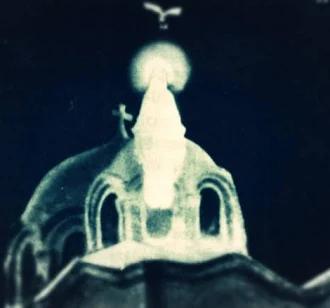
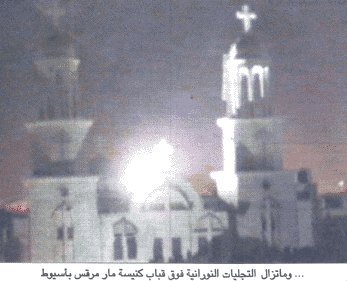
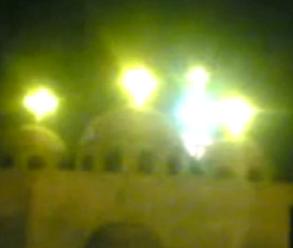
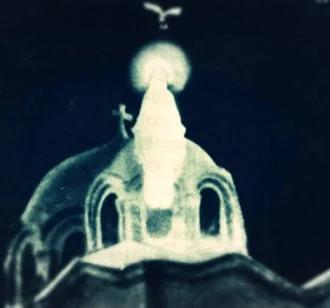
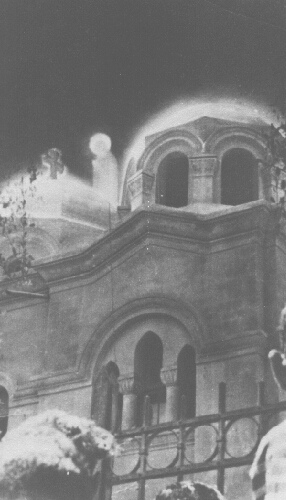
Photographs of three Marian apparitions in Egypt in the last century: (Left) the apparition of the Theotokos on the domes of the Coptic Church of St. Mary in Zeitoun, Cairo (1968-1971).(Middle) the apparition of the Virgin Mary in Assiut, Egypt over the Church of St. Mark from 2000-2001. (Right) the apparition of the Theotokos at Warraq al-Hadar, 11 December 2009;
The Eastern Orthodox Reception of Zeitoun
What is striking for the present question is how Eastern Orthodox voices have engaged the Coptic apparitions, and Zeitoun in particular. The website OrthodoxInfo.com—known not for ecumenism but for its rigorist editorial line—assesses Zeitoun in these terms: “In many ways the appearances over the Coptic Church of St Mary at Zeitoun, Cairo, were the most interesting and the most credible. They concerned not the Roman Church, but the Coptic Church, and Coptic bishops, including the Coptic Patriarch’s representative, were among the millions of Christians, Muslims, Jews and non-believers, who many times witnessed the apparitions over a period of three years, from 1968–1971.” A judgment from within the tradition that is least inclined to see Coptic piety as legitimate, acknowledging an apparition of the Theotokos over an Oriental Orthodox church, investigated and confirmed by an Oriental Orthodox Pope.
More striking still is the institutional reception. In August 2024, St. Vladimir’s Seminary Press—the flagship academic publishing house of the Orthodox Church in America and the principal English-language Eastern Orthodox theological press of the past half-century—published Travis Dumsday’s The Marian Apparitions at Zeitoun: An Evidential Inquiry. Dr. Dumsday, Chair of Philosophy and Religious Studies at Concordia University of Edmonton and an Eastern Orthodox philosopher previously published by Cambridge University Press and Bloomsbury Academic, conducts a sustained scholarly examination of the documentary record at Zeitoun and a systematic evaluation of every naturalistic explanation offered for the phenomena—tectonic strain hypotheses, mass-hallucination theories, Freudian and Jungian projection accounts, Carroll’s social-stress hypothesis, ufological alternatives. His conclusion is that each of the naturalistic accounts fails to account for the data, and that “the Marian apparitions at Zeitoun constitute powerful evidence for the reality of the supernatural.” Dumsday frames the Zeitoun apparitions, on the documentary evidence, as “the largest mass religious experiences in recorded history outside of Scripture.”
The reader is asked to sit with what this means. St. Vladimir’s Seminary Press—whose publications are reviewed by Eastern Orthodox theologians, whose patron is the Russian-rooted Orthodox Church in America, whose imprint is recognized as authoritative in mainstream Eastern Orthodox academic discourse—published in 2024 a book-length philosophical defense of the supernatural reality of a Marian apparition over a Coptic Oriental Orthodox parish church. A publishing house under any rigorist construction would not—could not—release such a book. Such a book defends, by the very nature of what it argues, the proposition that the Mother of God manifested the glory of her Son above a building that, on the strictest rigorist reading, is empty of him. SVS Press’s act of publication is therefore itself a judgment of the Eastern Orthodox academic mainstream. It is a judgment that the Coptic Orthodox sanctuary at Zeitoun was, in the years 1968 through 1971, honored in a manner that the Mother of God does not honor buildings outside the Body of her Son.
Pastoral Acts of Partial Communion
The 1991 Damascus Declaration between the Greek Orthodox Patriarchate of Antioch (Ignatios IV Hazim) and the Syriac Orthodox Patriarchate of Antioch (Ignatios Zakka I Iwas) called for “complete and mutual respect” between the two churches, provided guidelines for concelebration by clergy and intercommunion of the faithful under specified pastoral conditions, and envisaged joint meetings of the two Holy Synods. The 2001 Alexandria Pastoral Agreement between the Greek Orthodox Patriarchate of Alexandria (Petros VII) and the Coptic Orthodox Church (Shenouda III) went further still: building on mutual recognition of baptism, it permitted marriages between members of the two patriarchates to be celebrated in either Church and recognized by both, on the basis — as the 2001 document itself states—that “both families have always loyally maintained the same authentic Orthodox Christological faith, and the unbroken continuity of Apostolic tradition.”
The signatories on the Eastern Orthodox side were not ecumenical outliers. They were the sitting primates of two of the five ancient apostolic thrones. If their judgment is to be set aside as pastorally wrong, an account is owed of whose judgment stands instead.
What the Fruits Would Have to Mean
The Lord gave the fruits test as a test. He did not promise that every tree with good fruit must be formally inside the visible Church. But He did warn that a tree which habitually produced bad fruit could not be sound, and He extended the principle to the discernment of prophets and teachers.
The Oriental Orthodox tree has produced, and is still producing:
- fifteen centuries of martyrs, including mass martyrdoms in Egypt, Ethiopia, Armenia, and the Middle East in every generation;
- the Philokalic voice of those echoing Isaac of Syria, received by Athos and by the Russian Synod;
- the patristic voice of St. Severus of Antioch, of St. Nersēs Shnorhali, of St. Cyril of Alexandria himself (venerated by both families);
- Shenoute the Archimandrite, the Ethiopian Nine Saints, St. Yared the Hymnographer, the Kebra Nagast tradition;
- the apparitions of Zeitoun;
- the continuous liturgical life — in Coptic, Ge’ez, Classical Armenian, Classical Syriac — with pre-Chalcedonian texts the Eastern Orthodox tradition has no surviving parallel for.
To hold that all of this is the work of a spirit other than the Holy Spirit is a claim. The observer does not say it is a claim no one can make. The observer says it is a claim that requires its maker to specify which spirit has been doing all of this, for all this long, across all these peoples.
✣ ✣ ✣
The Patristic Question
“Hold fast the pattern of sound words which you have heard from me, in faith and love which are in Christ Jesus. That good thing which was committed to you, keep by the Holy Spirit who dwells in us.”
— 2 Timothy 1:13-14
“The fathers of Chalcedon were profuse in their professions of loyalty to Cyril. Even when judging the Tome of Pope Leo (the great western Christological statement, formally approved at Chalcedon) their criterion of orthodoxy remained agreement with Cyril; this is clear throughout the lengthy discussion of the Tome in the fourth session.”
— Richard Price, Introduction to The Acts of the Council of Chalcedon (Liverpool University Press, 2005), I.65
The second question is not about Cyril alone. It is about the whole mind of the Fathers—phronema patrum — and whether the miaphysite confession preserves or departs from it. This question has to be asked carefully, because the rigorist Eastern Orthodox case often assumes that miaphysite Christology is a fifth-century innovation wrongly attached to Cyril, while Chalcedonian Christology is the natural outgrowth of the patristic consensus. That picture is not what the historical evidence supports. The picture the historical evidence supports is, in important respects, the reverse. The observer will argue it in three movements.
1. The Alexandrian Vocabulary Was Archaic, Not Aberrant
Before Chalcedon, the technical vocabulary of Greek Christian theology was not yet stabilized. The words ousia (essence/substance), hypostasis (individual existence), physis (nature), prosopon (person, literally “face”), and eidos (form, kind) had histories in Platonic and Aristotelian philosophy that did not map cleanly onto Christian doctrine. Different Fathers used the terms differently. St. Athanasius uses hypostasis and ousia interchangeably in some passages. The Cappadocians, later, distinguished them sharply. The pre-Chalcedonian world has no single fixed technical usage.
In the Alexandrian tradition, physis could sometimes function in a concrete or hypostatic sense. This is not a peculiarity. John Henry Newman, in his 1858 patristic essay On St. Cyril’s Formula, argued this at length: physis in the Alexandrian idiom functioned as a term for the concrete, individual, subsistent reality — much as hypostasis did in Cappadocian Trinitarian grammar. When St. Cyril of Alexandria said mia physis tou Theou Logou sesarkōmenē — “one incarnate nature of God the Word”—he was using physis in this inherited Alexandrian sense. He was saying, in effect: one concrete subsisting reality of the Word of God, now enfleshed. He was not denying the reality of Christ’s humanity. He was denying that Christ is two distinct subjects (much relevant in the refutation of Nestorius).
St. John McGuckin, whose St. Cyril of Alexandria: The Christological Controversy (Brill, 1994) remains the standard scholarly monograph, puts the matter unambiguously: in Cyril’s mia physis formula, the word physis functions archaically — equivalent in sense to hypostasis as Chalcedon would later use it. On this basis, “the Mia physis can coexist as an important (and common element of universal Christian Orthodoxy) along with the dyo physeis, without being logically contradictory.”
This is a crucial historical datum, and it runs against the ordinary rigorist assumption. The miaphysite formula is not a fifth-century novelty. It is the older way of speaking—the way Alexandrian Christian theology had spoken since at least the third century. What is new after Chalcedon is not the Alexandrian usage; what is new is the standardization of a different technical vocabulary (two physeis, one hypostasis) that distinguished nature and hypostasis more sharply. The rigorist claim that the miaphysites refused to “update” their language, and thus departed from the tradition, inverts the actual historical movement. It was the miaphysites who preserved the older idiom; it was the Chalcedonian Definition that formalized the newer one.
2. Cyril Inherited Mia Physis; He Did Not Invent It
The formula mia physis tou Theou Logou sesarkōmenē does not originate with Cyril. The precise verbal form comes from a text Cyril received as Athanasian—the Letter to Jovian (now known to be a forgery by the Apollinarian circle). Cyril cites the formula twice in his pre-433 writings, in both instances as a quotation from what he believed was St. Athanasius, and uses it independently only once before the Reunion of 433 (in Contra Nestorium, where he immediately glosses it with the body-soul analogy).
The rigorist turn of the last century seized on this as a weapon: “The formula is Apollinarian! It was smuggled into Orthodox use under a false attribution!” But the weapon does not cut the way the rigorist thinks.
Two considerations are decisive. First: the substance of the formula—one subsisting Word who became incarnate—is not a forgery. It is the common faith of the Fathers, from St. Ignatius of Antioch’s letters (early second century) through St. Irenaeus, through St. Athanasius’s genuine corpus, through the Cappadocians. The verbal phrase may have been canonized by a pseudepigraph; the theology the phrase compresses is pre-Apollinarian, pre-Nicene, and apostolic. Second: Cyril himself, in his First Letter to Succensus, explicitly attributes the formula to the holy Fathers (οἱ ἅγιοι Πατέρες). He did not invent it. He received it. And if he received it (as he thought) from Athanasius, he was receiving it through the Alexandrian chain of transmission that had carried his tradition’s vocabulary for generations.
Even Pope St. Leo’s Tome—formally approved at Chalcedon—acknowledges the theological substance of the Alexandrian concern: that in the Incarnation, one and the same is true God and true man, not two sons juxtaposed, not a man connected with the Word. Leo’s Latin formula (“agit enim utraque forma cum alterius communione quod proprium est” — “each form acts in communion with the other doing what is proper to it”) differs in rhetorical cast from Cyril’s mia physis, but it does not differ in substance. It is the same mystery, sung in another key.
3. What Does the Patristic Tradition Itself Say?
The deeper question is whether the mia physis confession preserves the wider patristic mind, or whether it represents a later narrowing of that mind. Here the evidence is more complicated than slogans usually allow. It would be anachronistic to call Ignatius, Irenaeus, Athanasius, or Gregory Nazianzen “miaphysite” in the later confessional sense. They were not writing after Chalcedon, nor were they answering the exact disputes of the fifth and sixth centuries. But it is equally misleading to speak as though Cyril’s grammar arose from nowhere. Long before the phrase mia physis tou Theou Logou sesarkōmenē became controversial, the Fathers repeatedly confessed the same basic pattern: the incarnate Lord is one and the same Son, truly divine and truly human, not a human person joined externally to the Word, and not a divine subject whose humanity is unreal or swallowed up.
St. Ignatius of Antioch (died c. 107)
Already in St. Ignatius of Antioch, the grammar of unity is unmistakable. In his Epistle to the Ephesians, he writes: “There is one Physician” who is “both of flesh and spirit,” “God existing in flesh,” “both of Mary and of God,” “first passible and then impassible — even Jesus Christ our Lord.”
The point is not that Ignatius possesses later terminology. He does not speak in the language of physis, hypostasis, or Chalcedonian distinction. But his syntax is already deeply unitive. The Physician is one. Around this one subject Ignatius gathers predicates that later controversy would learn to distinguish more carefully: flesh and spirit, divine and human, passible and impassible, from Mary and from God. He does not divide these predicates between two subjects. He does not say one is born of Mary while another is Son of God, or one suffers while another remains untouched. The same Jesus Christ is confessed through the paradox. This is not yet miaphysitism as doctrine, but it is the pre-technical grammar that miaphysitism later claims to protect: one Christ, bearing truly the realities of both divinity and humanity.
St. Irenaeus of Lyons (c. 130–c. 202)
St. Irenaeus makes the same instinct more explicit. In Against Heresies, he writes against those who separate Jesus, Christ, Savior, Son, and Word into distinct figures. His argument is directed especially against systems in which the earthly Jesus is merely a vessel for a higher heavenly Christ. Against this, Irenaeus insists that the apostolic proclamation concerns “one and the same” Jesus Christ, the only-begotten Son of God, “perfect God and perfect man.”
This language is important because Irenaeus is not yet operating with the later technical distinction between physis and hypostasis. He should not be made to answer fifth-century questions in fifth-century terms. But his substantive commitment is clear. The incarnate Lord is not a conjunction of separable subjects. He is not one Jesus born of Mary and another Christ who descends from above. Irenaeus explicitly rejects the idea that “Jesus was one, and Christ another,” and says that believers should know them to be “one and the same.” The anti-Nestorian instinct, before Nestorius, is already present: salvation depends on the identity of the one who is born, suffers, rises, and saves.
St. Athanasius of Alexandria (c. 297–373)
In Athanasius, especially in the Alexandrian tradition that Cyril later inherits, this unitive grammar becomes inseparable from soteriology. Athanasius’s central concern is not abstract metaphysical balance but the saving fact that the Word Himself became man. The body assumed by the Word is real, truly born of Mary, and genuinely human; yet the Word does not cease to be what He eternally is. The Incarnation is neither a transformation of divinity into flesh nor the adoption of a separate man by God. It is the Word of God Himself assuming our humanity for our salvation.
This is why Athanasius is such a powerful pre-Cyrilline witness. He does not give us the later miaphysite formula, but he gives us the logic from which that formula draws its force. The Word did not merely dwell in a man as in an instrument; He became man. The unity of Christ is therefore not decorative. It is the condition of salvation. If the one who is born of Mary is not truly the Word, then God has not entered our condition. If the humanity assumed is not real, then humanity is not healed. Athanasius holds both together: the humanity is true, and the subject of that humanity is the eternal Son.
This is the Athanasian instinct that later Alexandrian theology never forgot. It is not yet a technical argument about one physis or two physeis. It is the deeper claim beneath the terminology: the Savior is one, and the one Savior is the Word made flesh.
St. Gregory of Nazianzus (c. 329–390)
Gregory of Nazianzus is especially important because he cannot be reduced to either later camp. In Letter 101 to Cledonius, written against the Apollinarians, Gregory gives the famous rule: “That which is not assumed is not healed; but that which is united to His Godhead is also saved.” In the same letter, he can say plainly that God and man are “two natures,” as soul and body are, while immediately refusing the conclusion that there are “two Sons” or “two Gods.”
This makes Gregory indispensable for any fair account of the controversy. He proves that the patristic mind could speak both ways. It could speak in a dyophysite register: divinity and humanity are not the same thing, and Christ’s humanity must be complete if it is to be healed. But it could also speak in a unitive register: the one who assumes and the humanity assumed are not two Sons, not two Christs, not two worshiped subjects. Gregory’s concern is precisely to hold both truths together. Against Apollinarius, he insists on the fullness of the human nature. Against any division of Christ, he insists on the unity of the Son.
For that reason, Gregory should not be presented simply as “Chalcedonian before Chalcedon,” nor as secretly miaphysite before miaphysitism. He is better read as a witness to the broader patristic field from which both later grammars drew. Chalcedonians would rightly appeal to his “two natures” language. Miaphysites could rightly appeal to his refusal of “two Sons” and to his bold language of union. The point is not that Gregory settles the later debate in advance. The point is that the later debate took place within a vocabulary already capable of emphasizing either distinction or unity without intending heresy.
The Cappadocian Settlement
The Cappadocians also changed the grammar available to the Church. Basil, Gregory of Nyssa, and Gregory of Nazianzus helped stabilize the distinction between ousia and hypostasis in Trinitarian theology: the Father, Son, and Holy Spirit are one in essence and three in hypostatic reality. This distinction gave the Church a way to confess real personal distinction without dividing the divine essence.
Once that distinction was clarified in Trinitarian theology, it could be carried into Christology. Chalcedon’s formula depends on this development: the incarnate Christ is one hypostasis or prosopon, confessed in two physeis, divine and human. Its decisive grammatical move is that physis no longer functions as the concrete subject in the way it often could in older Alexandrian usage. It denotes the real divine and human natures belonging to the one subject, the eternal Son.
But this also explains why the fifth-century dispute became so combustible. Alexandrian theology, especially in Cyril, often retained a more concrete use of physis, in which “one incarnate nature of God the Word” could mean something close to “one incarnate hypostasis of God the Word.” On that reading, the formula was not meant to deny Christ’s humanity. It was meant to deny that Christ is two subjects. The Chalcedonian side, using a more differentiated vocabulary, feared that “one nature” collapsed or absorbed the humanity. The Alexandrian side feared that “two natures” divided Christ into two Sons.
The disagreement was therefore not merely verbal, but it was deeply aggravated by vocabulary. Each side heard in the other’s words the heresy it most feared. The Chalcedonian ear heard Eutyches in “one nature.” The Alexandrian ear heard Nestorius in “two natures.” Yet the earlier Fathers show that the Church’s inherited language contained both emphases: real distinction and real unity, full humanity and full divinity, no confusion and no division.
St. Severus of Antioch and the Mature Miaphysite Defense
If the earlier Fathers show that the miaphysite instinct has deep patristic roots, St. Severus of Antioch shows what the mature miaphysite argument became after Chalcedon. Severus is not merely repeating slogans. He is attempting to defend Cyril’s formula against both Nestorian division and Eutychian confusion. His importance lies in the fact that he does not understand “one incarnate nature” to mean that Christ’s divinity or humanity disappears. Rather, the one incarnate reality of Christ exists from divinity and humanity, without the humanity ceasing to be real.
This is why Severus is the strongest post-Chalcedonian father for the miaphysite case. He represents the point at which the Alexandrian grammar becomes a full theological system. His claim is not that Christ has only divinity after the union, nor that the humanity is imaginary, nor that the Word changes into flesh. His claim is that after the union there is one incarnate Christ, one subject, one composite reality of the Word made flesh. Later Eastern Orthodox–Oriental Orthodox discussion has often returned to this point: the miaphysite rejection of Chalcedon need not be read as a denial of Christ’s real humanity, but as a refusal to speak of that humanity in a way that seems to divide the one Son.
St. Philoxenus of Mabbug
Philoxenus of Mabbug gives the same miaphysite logic in a Syriac key. His Christology begins from the Johannine confession that “the Word became flesh.” The subject of the Incarnation is always the Word Himself. Philoxenus insists that “one and only one person of the Holy Trinity” came down, was embodied of the Virgin, and became man “without change.” He can therefore say that Christ is “one in His divinity and His humanity,” not “one in another” or “one with another,” as though divinity and humanity were externally associated.
Philoxenus is useful because he makes explicit what the miaphysite tradition thought it was defending: not the suffering of the Father, not a change in the divine nature, not an unreal humanity, but the unity of the incarnate Logos. When he speaks of God being born or crucified, he means that the one who was born and crucified is the Word of God incarnate, not that the divine nature as such suffered apart from the flesh. His language is theopaschite because the subject of the suffering is divine; it is not patripassian because the Father and the Trinity as such are not said to suffer.
Was the Miaphysite Christology Preservative, or Was It Innovative?
Richard Price, whose The Acts of the Council of Chalcedon (2005) remains the standard English scholarly edition, documents a striking feature of the council itself: the bishops at Chalcedon were resistant to producing a new creed at all. In the second session, when asked to draft a new definition of faith, the majority refused on the principle that the faith was already sufficiently defined by Nicaea, Constantinople, and Ephesus. It was only under imperial pressure—Marcian and the imperial commissioners insisting on a new formula—that the Definition of Chalcedon was drafted. Price observes, in his introduction, that “the fathers of Chalcedon were profuse in their professions of loyalty to Cyril. Even when judging the Tome of Pope Leo (the great western Christological statement, formally approved at Chalcedon), their criterion of orthodoxy remained agreement with Cyril.”
The bishops at Chalcedon, in other words, saw themselves as Cyrilline. They read Leo’s Tome out loud and then compared it to Cyril; when some found passages in Leo that seemed to divide Christ, Theodoret of Cyrrhus was required to explain how Leo was compatible with Cyril. The Tome was not accepted as a rival standard to Cyril. It was accepted because (and only because) it was judged to be in agreement with him. Cyril was the ipsissima vox of orthodoxy at Chalcedon. No one at the council disputed that.
What the miaphysite tradition protested, and has always protested, is the imperially-driven addition of the “two natures” clause in the fourth session under political pressure. The miaphysite protest was not against Cyril, nor even against the substance of what Leo had said, but against what they judged to be a terminologically careless addition that, in the mouth of a Nestorian, could sound like two of everything—two natures, two persons, two sons. The miaphysite protest was, in their own self-understanding, a conservative protest—a refusal to privilege an innovative technical vocabulary over the older Alexandrian one.
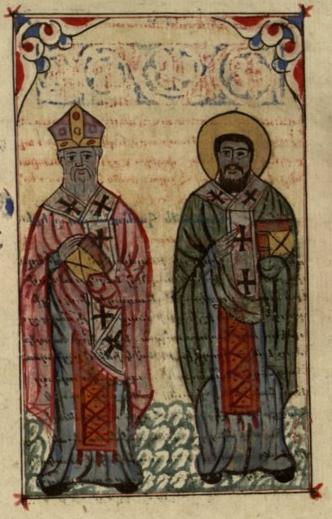
Fr. Andrew Louth, in his essay “Why Did the Syrians Reject the Council of Chalcedon?” (in Chalcedon in Context, Price and Whitby eds., Liverpool 2009), answers the title question decisively: “For the same reason as most of the East: because they judged Chalcedon to have betrayed the faith of Cyril, in which they saw the faith of the Church.” The rejection of Chalcedon in the non-Chalcedonian East was not, at root, heretical innovation. It was judged—by the rejectors—as fidelity to the faith of Cyril, and through Cyril to the faith of Athanasius and the Fathers.
The Joint Commission’s Conclusion
Informed by a century of careful patristic scholarship (Lebon’s landmark study on Severus, Grillmeier’s Christ in Christian Tradition, McGuckin on Cyril, Van Loon on Cyril’s dyophysite elements), the Joint Commission of 1989–1990 reached a conclusion that is not the product of modern ecumenical sentimentality but of historical theology done carefully:
“The Orthodox agree that the Oriental Orthodox will continue to maintain their traditional Cyrillian terminology of ‘one nature of the incarnate Logos’ (mia physis tou Theou Logou sesarkōmenē), since they acknowledge the double consubstantiality of the Logos which Eutyches denied. The Orthodox also use this terminology. The Oriental Orthodox agree that the Orthodox are justified in their use of the two-natures formula, since they acknowledge that the distinction is ‘in thought alone’ (τῇ θεωρίᾳ μόνῃ). Cyril interpreted correctly this use in his letter to John of Antioch and his letters to Acacius of Melitene, to Eulogius, and to Succensus. Both families accept the first three Ecumenical Councils, which form our common heritage.”
— Second Agreed Statement, Chambésy, 1990, §§7–8
Not every Orthodox theologian accepts this reading. The observer does not claim that the 1989–1990 reading is binding on the Eastern Orthodox conscience; no pan-Orthodox council has received it. The Coptic Pope Shenouda III, characteristically, maintained distinct theological reservations about Chalcedon to the end of his life, while fully endorsing the Agreed Statements’ substance. What the observer claims is more modest — and also, more textually defensible:
- The mia physis formula, in Cyril’s use and in the miaphysite reception, is not a denial of Christ’s true humanity. The Oriental Orthodox anathematize Eutyches as thoroughly as the Eastern Orthodox do. The rigorist conflation of miaphysite with monophysite is a category error that the 1989 Agreed Statement corrected and that most working patristic scholars of the last fifty years have rejected.
- The mia physis vocabulary is older than the dyophysite technical vocabulary of Chalcedon. In strict historical terms, the miaphysite tradition preserved the Alexandrian idiom; the Chalcedonian tradition formalized a newer technical distinction between physis and hypostasis. Whatever the theological merits of the innovation, it was an innovation.
- The patristic corpus before Chalcedon—Ignatius, Irenaeus, Athanasius, the Cappadocians, and Cyril himself—speaks in both grammars, unitive and distinctive, without canonizing either as exclusive. The miaphysite refusal to adopt the newer Chalcedonian grammar was not a departure from the Fathers. It was one of two legitimate stances a Cyrilline theologian could take in the fifth century, and it was the stance taken by the majority of the Christian East.
- At Chalcedon, by Price’s documentation, Cyril was the explicit criterion of orthodoxy. Leo’s Tome was approved because (and only because) it was judged Cyrilline. Any position that sets Chalcedon against Cyril—including some contemporary Chalcedonian rigorism that treats Leo as the standard by which Cyril is judged—inverts the council’s own self-understanding.
The rigorist Eastern Orthodox who holds that the miaphysite tradition is heretical — not merely out of full communion, but substantively heterodox — must answer three questions. Which Father does he name whose Christology the miaphysites have betrayed? Which technical distinction of the pre-Chalcedonian era does he claim they have abandoned? And what scholarly patristic consensus, in the last century, supports his claim? The answer to each of these questions, on the evidence, is embarrassingly thin. The 1989–1990 Commission — with the participation of Metropolitan Damaskinos of Switzerland (representing the Ecumenical Patriarchate), Bishop Bishoy of Damiette (Coptic), Catholicos Garegin Sarkissian (later Karekin I of All Armenians), Fr. John Romanides, and others — did not conclude that the Oriental Orthodox were heretics. After a generation of careful study, they concluded that both families have “loyally maintained the same authentic Orthodox Christological faith, and the unbroken continuity of the apostolic tradition, though they have used Christological terms in different ways.” This is documentary fact. Whoever contradicts it must at least be able to name on what patristic ground he stands to contradict it.
✣ ✣ ✣
The Reception & Dialogues Question
“We have now clearly understood that both families have always loyally maintained the same authentic Orthodox Christological faith, and the unbroken continuity of the apostolic tradition.”
— Second Agreed Statement (Chambésy, 1990), §9
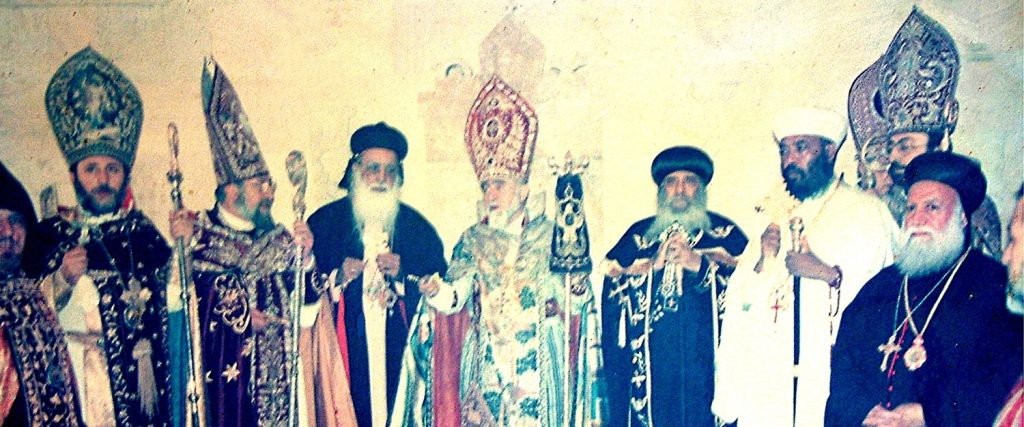
The Joint Commission recommended, in its 1990 Chambésy Recommendations on Pastoral Issues, that the Churches lift their mutual anathemas against one another’s Fathers (Severus, Dioscorus, Leo, etc.) and restore full communion. The Coptic Holy Synod accepted this recommendation on 2 June 1990; the Syrian, Armenian, Ethiopian, and Malankara Holy Synods followed in November 1990.
The mainstream Eastern Orthodox hierarchy has received the Agreed Statements in part, but no pan-Orthodox council has formally ratified the lifting of anathemas. Here, then, is the reception question in its candor: what has to happen for an Eastern Orthodox hierarchical act to be received? No seventh Ecumenical Council has been held since 787. The Council of Crete (2016) addressed the question of Oriental Orthodox relations only in passing, and was itself not attended by all autocephalous churches. The 1989–1990 Agreed Statements, signed by the official representatives of all fourteen (then-current) autocephalous Eastern Orthodox Churches and all the Oriental Orthodox Churches, have not been formally ratified and have not been formally rejected. They sit, signed, awaiting.
What the rigorist cannot honestly claim is that the Agreed Statements are a private project of ecumenical outliers. Their signatories include, on the Eastern Orthodox side, representatives appointed by the Ecumenical Patriarch Demetrios I (and continued by Bartholomew I), and theologians of the stature of Fr. John Romanides — a hierarch-theologian not ordinarily classed as an ecumenist.
Concerning Recent Dialogue
Less than one year after his elevation, Pope Shenouda III of Alexandria visited the Ecumenical Patriarch of Constantinople and Pope Paul VI of Rome in October 1972. This was “the first Alexandrian Pope to do so since the Chalcedonian Schism in 451 CE.” The following year, on 10 May 1973, Shenouda and Paul VI signed the Joint Christological Declaration in Rome.
Shenouda’s ecumenical engagement was sustained and structured. He visited Constantinople repeatedly, exchanged warm correspondence with Ecumenical Patriarchs Demetrios I and Bartholomew I, participated in the World Council of Churches throughout his papacy, and hosted the 1989 Joint Commission meeting at the Coptic Monastery of Anba Bishoy in Wadi El-Natrun — where, at the opening session, he personally “appealed to the participants to find a way to restore communion between the two families of Churches.”
This pattern has continued under his successor. Pope Tawadros II, elected November 2012, made his first foreign visit as Pope to the Vatican in May 2013 — “on the 40th anniversary of the signing of an agreement on Christology between our Churches,” as his delegation put it. Pope Tawadros and Pope Francis have since established 10 May as the annual “Day of Coptic-Catholic Friendship.” Tawadros has also met with Ecumenical Patriarch Bartholomew, visited Greece (December 2016), and received Metropolitan Hilarion (Alfeyev) as a representative of the Russian Patriarchate. The eighteen-month flurry of ecumenical engagement immediately after his 2012 enthronement was the work of a new pope establishing continuity of posture, not a novelty.
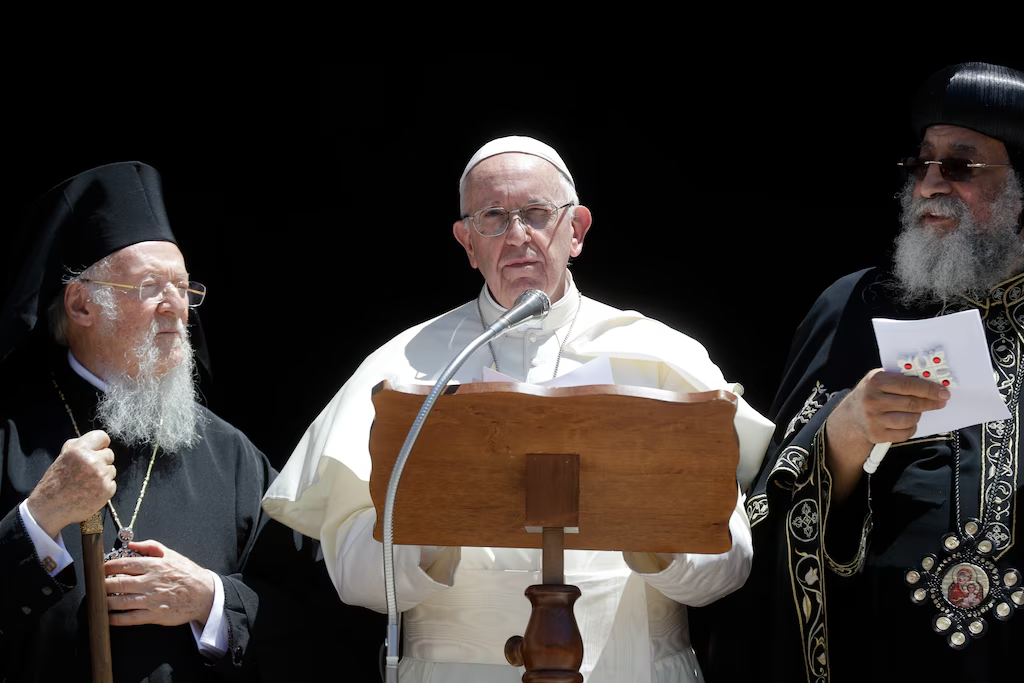
The question the observer presses is not whether this ecumenical engagement proves the Oriental Orthodox are within the Church. It is whether this engagement — which is the posture, sustained across half a century, of the hierarchs of a communion of sixty million — can coherently be described as “a non-Orthodox assemblage” coming with a false claim to have Christ. The description does not fit the evidence.
✣ ✣ ✣
The Ecclesiastical-Boundaries Question
“We do not change the boundaries marked out by our Fathers. We keep the Tradition we have received. If we begin to lay down the Law of the Church even in the smallest things, the whole edifice will fall to the ground in no short time.”
— St. John of Damascus, On the Holy Icons, II.12
The Orthodox Church has always confessed that she is the One, Holy, Catholic, and Apostolic Church. She has also, always, distinguished between the theological verdict on a separated body (“this is not the true Church”) and the sacramental or pastoral judgment on what that body has preserved (“her sacraments are, or are not, recognized as valid”).
The clearest case is Rome. The Russian Orthodox Church, from the 18th century onward, has recognized Roman Catholic baptism without requiring rebaptism of converts received by economy. This is not a modern ecumenical softening. St. Theophan the Recluse himself, in a letter in the Fedorov compilation, writes: “It seems that our Church is condescending to Catholics and recognizes the power of not only the baptism of the Catholics and other sacraments, but also the priesthood, which is very significant. Therefore, it is better for us to refrain both from asking these questions and from solving them.”
The register of sacramental recognition is not the same as the register of ecclesial communion. Rome is not in communion with the Russian Orthodox Church; she is, on most Orthodox accounts, “outside the Church” in the strict ecclesial sense. And yet — by St. Theophan’s own hand — her baptism, her sacraments, and her priesthood are recognized by the Russian Church. The distinction between these two registers is not an ecumenical invention. It is present in the witness of the saint the rigorists most often invoke.
What follows from this for the Oriental Orthodox? The observer does not claim to know, even at. atime where re-baptisms are not required, intermarriages, and even limited degrees of intercommunion are allowed. But he claims that if Rome — at nine centuries’ schism, with substantial doctrinal accretions the Orthodox reject — receives Theophan’s distinction, then the blanket rigorist denial of any sacramental latitude to the Oriental Orthodox (at fifteen centuries’ division, but without comparable accretions, confessing the Creed in its ancient form, preserving the seven sacraments in their ancient rites) must at minimum be argued. It cannot be assumed. It cannot be inherited as if it were self-evident. It is not.
✣ ✣ ✣
The Asymmetry Question
“The whole Christian world is anxious to see the Church unite. Christian people, being fed up with divisions and dispersion, are pushing their Church leaders to do something about Church unity, and I am sure that the Holy Spirit is inspiring us.”
— His Holiness Pope Shenouda III of Alexandria
Address at the International Week of Prayer for Christian Unity, St. Mark’s Cathedral, Cairo, 1974
There is a rhetorical move in some rigorist Eastern Orthodox polemic that runs: “Both sides teach that the other is outside the Church. The dispute is a symmetrical one of rival ecclesial claims. We are simply holding our own.”
This move does not survive examination of the evidence. A rigorist Oriental Orthodox tradition exists — it is not fictional. St. Gregory of Tatev (Grigor Tatevatsi, 1346–1410), the great medieval Armenian theologian of Tatev University, wrote his Book of Questions (Girk’ Harc’mants, 1397) as a rigorous defense of miaphysite Christology against what he regarded as Dyophysite error; his principal polemical target, scholars note, was the Fratres Unitores, the Armenian-Dominican Roman union movement of his day, but the theological principle he defended cuts against Chalcedonian Christology as well. The Armenian Rite of Calling to the Priesthood preserves to this day a formal anathema: “I anathematize all the ranks of heretics; Arius, Macedon, and Nestor, and all the ranks of Diophysites.” The Syriac Orthodox Rite of Ritual Clothing of Monks preserves a formal anathema against Leo’s Tome. Certain Coptic lay apologetic circles continue to press a strict “Chalcedon is Nestorianizing” line.
These voices are real. They should not be minimized, and the observer will not minimize them.
But they are not the posture of the Oriental Orthodox hierarchy in the present moment. In the half-century from 1972 to the present, the hierarchs of the Oriental Orthodox communion — the Coptic Pope, the Armenian Catholicos, the Syriac Patriarch, the Ethiopian Patriarch, the Eritrean Patriarch, the Malankara Catholicos — have:
- initiated and sustained the Joint Commission with the Eastern Orthodox, resulting in the 1989 and 1990 Agreed Statements (signed, not unsigned);
- signed the 1991 Damascus Declaration (Ignatios Zakka I with Ignatios IV Hazim);
- signed the 2001 Alexandria Pastoral Agreement on Mixed Marriages (Shenouda III with Petros VII);
- signed the 1973 Common Declaration with Rome (Shenouda III with Paul VI);
- signed the 1998 Common Declaration (Karekin I with John Paul II);
- signed the 2017 Joint Declaration on non-repetition of baptism (Tawadros II with Francis);
- participated actively in the World Council of Churches;
- co-hosted the 2025 World Conference on Faith & Order of the World Council of Churches in Cairo.
What the rigorist Eastern Orthodox observer must recognize is that he is not facing a mirror opponent. He is being asked to press a polemic against a communion whose own hierarchs are pressing toward reunion with him. The shape of the dispute is not symmetrical. It is an asymmetry —of posture, of ecumenical direction, of pastoral intent.
This does not settle the theological question. It does, however, change the moral shape of the question. To anathematize a body that is anathematizing you back is one kind of thing. To anathematize a body that is extending its hand to you — while you alone press the polemic — is a different kind of thing. The observer does not say the rigorist Eastern Orthodox cannot defend his position in the latter case. The observer says only that the rigorist Eastern Orthodox must defend it in the latter case, and must know that is what he is doing.
✣ ✣ ✣
What the Rigorist Eastern Orthodox Position Requires
Laid out with candor, the rigorist Eastern Orthodox position — the position that the Oriental Orthodox are, strictly, outside the Church — requires its defender to hold:
- that Shenouda III, Tawadros II, Karekin I, Zakka I Iwas, and their brother hierarchs, in spending their primacies in sustained fraternal engagement with the Eastern Orthodox, have been either naïve or insincere;
- that Petros VII of Alexandria, a sitting apostolic patriarch, was in grave pastoral error when he signed the 2001 Alexandria Agreement recognizing the Coptic confession as “the same authentic Orthodox Christological faith”;
- that Ignatios IV of Antioch was in grave pastoral error when he signed the 1991 Damascus Declaration;
- that the sacramental lives of sixty million Copts, Armenians, Ethiopians, Eritreans, Syriacs, and Indians — the baptisms, Eucharists, ordinations, marriages, and unctions of fifteen continuous centuries — are either void of grace or grace-given in some ambiguous economic way that the rigorist has not yet theologically specified;
- that the martyrdom of the twenty-one on the Libyan beach in 2015 was either not a genuine martyrdom or was a grace of God given to a non-Church;
- that the apparitions of the Theotokos at Zeitoun (1968–1971), confirmed by an Oriental Orthodox Pope and witnessed by millions, were either not the Theotokos or were a grace given to a building outside the Church;
- that the Holy Fire, which traditionalist Patriarch Diodoros I himself gave “first to the Armenian Patriarch and then to the Coptic” every Holy Saturday of his nineteen-year patriarchate, was either not the Holy Fire or was given for reasons outside Orthodox ecclesiology to account for;
- that St. Isaac the Syrian, received by Athos, by the Russian Synod, by St. Paisios in vision, and by Metropolitan Hilarion in his Oxford doctorate and two major scholarly books, is either incorrectly received or received in a way that establishes no precedent whatsoever for any similar judgment toward any other hierarchs outside Eastern Orthodox communion.
This is an enormous load to bear. The observer does not claim it cannot be borne. He claims that it has to be borne knowingly — and that honesty requires acknowledging that the weight is as heavy as it is.
✣ ✣ ✣
Questions for Reflection
These are for sitting with, not for arguing about. Offer them to the Lord and to your father-confessor, not to the internet.
- What fruits do you see in the Oriental Orthodox tradition, and what account do you give of where those fruits come from?
- What would it require of you, concretely, to hold that St. Paisios was wrong about St. Isaac the Syrian?
- When you read the 1990 Chambésy statement — “have always loyally maintained the same authentic Orthodox Christological faith” — and you disagree with it, on whose authority are you disagreeing? Have you named that authority out loud?
- Would you kneel with a Coptic family on Holy Saturday while the Armenian Patriarch carries the Holy Fire from the Tomb? If yes, what does your action mean? If no, what does your refusal mean?
- Is there an Oriental Orthodox Christian you know personally? What do you see in their faith that you would have to call empty to maintain the rigorist position?
- The twenty-one martyrs of Libya died reciting the Name of Jesus. If you believe they are not among the saints, say so to the Lord directly, and listen for what He gives you in return.
- What would you regard as sufficient evidence to change your position? If the answer is “nothing,” that answer is itself worth praying over.
- Have you read the Oriental Orthodox in their own voice — St. Severus of Antioch, St. Nersēs Shnorhali, Pope Shenouda, Matta El-Meskeen — or only as they appear in Eastern Orthodox polemical literature?
- What does it cost you, spiritually, to hold the rigorist line? What does it cost you, spiritually, to soften it? Both costs are real. Both must be counted.
- Are you willing to let the question remain open in you — not resolved ecumenically, not resolved polemically, but held honestly — until the Lord gives you clarity?
Prayer
Lord Jesus Christ, our God, Who on the night in which Thou wast betrayed prayed to the Father that they all may be one: have mercy on the divisions of Thy Church. Mend what we have torn. Heal what fifteen centuries of polemic have inflamed. Grant to Thy servants in both our Orthodox families the humility to receive Thy judgment rather than to press our own; the courage to see one another’s faith without flinching; the patience to wait upon Thy Spirit where we ourselves cannot yet see. Through the intercessions of Thy all-holy Mother, of the holy Fathers of our common councils — Athanasius, the three Gregories, Cyril, Basil, John the Goldenmouthed, Ephrem the Syrian — and of all the saints of both our families, grant us the same authentic Orthodox faith and the unbroken continuity of the Apostolic tradition. Amen.
✣ ✣ ✣
Bibliography of Sources Cited
Sources are numbered to match the footnote superscripts in the text. Primary documents are prioritized; secondary documentation is noted where primary access was unavailable.
- 1. Archon Order of Saint Andrew the Apostle, Ecumenical Patriarchate of Constantinople. Public statement on the Coptic martyrs of Libya (February 2015). The “42 Martyrs of Amorion” parallel is drawn explicitly in the Archons’ statement.
- 2. Metropolitan Tikhon (Mollard) of All America and Canada. Address at the Coptic Cathedral, New York, 19 February 2015. Official OCA press release.
- 3. Hieromonk Isaac (Atallah) of the Holy Resurrection Kalyva. Saint Paisios the Athonite (first edition, Holy Monastery of St. Arsenios the Cappadocian, Souroti, 2004). Also: OrthoChristian.com, “St. Paisios’ Love and Defense of St. Isaac the Syrian” (referencing the Orthodox Ethos article “Abba Isaac the Much-Wronged Saint”).
- 4. For the commissioning of the service by Fr. Gerasimos Mikragiannanites and the first church dedicated to St. Isaac at Kapsala, see OrthoChristian.com, “St. Paisios’ Love and Defense of St. Isaac the Syrian.”
- 5. Metropolitan Kallistos (Ware) of Diokleia, Foreword to Hilarion Alfeyev, The Spiritual World of Isaac the Syrian (Cistercian Studies 175; Kalamazoo: Cistercian Publications, 2000).
- 6. On St. Nersēs IV Shnorhali, his correspondence with Manuel I Komnenos and Michael III of Anchialos, and the twelfth-century union attempt, see: Sirarpie Der-Nersessian, The Armenians (New York: Praeger, 1969), and the Armenian Apostolic Church’s own official documentation.
- 7. St. Theophanes the Confessor, Chronographia, ed. C. de Boor (Leipzig: B. G. Teubner, 1883; repr. 1980), p. 416, lines 13–15. The Greek: ὠρθοδόξησε ὁ πατριάρχης Ἀλεξανδρείας, Κοσμᾶς, σὺν τῇ πόλει αὐτοῦ, ἐκ τῆς τῶν Μονοθελητῶν κακοδοξίας.
- 8. Pharos Journal of Theology 98 (2017), “The decline of the Melkite Church in Islamic Egypt and its reunification attempt with the Coptic Church at the time of Patriarch Cosmas I”; cf. also History of the Patriarchs of Alexandria.
- 9. OrthodoxWiki, “Callinicus (Kyparissis) of Alexandria”: “Patr. Callinicus attempted to restore unity with the Coptic Church. However, he was not successful. He resigned from the Patriarchal See on June 5, 1861, and returned to Greece.” The specific wording of correspondence sometimes attributed to the British Anglican cleric George Greenwood rests on secondary British Orthodox sources; the fact of the attempt is verified. [Note: primary documentation of the 1858–1861 exchange would require access to the Alexandria patriarchal archives.]
- 10. Orthodox Observer blog and multiple Jerusalem sources; Wikipedia, “Church of the Holy Sepulchre,” citing that the Holy Fire ceremony is “led by the Greek Orthodox patriarch (with the participation of the Coptic and Armenian patriarchs).”
- 11. Patriarch Diodoros I of Jerusalem, Letter to Patriarch Ignatios IV of Antioch, 17 May 1997; archived at OrthodoxInfo.com (“Letter of Patriarch Diodoros I to the Patriarch of Antioch”). Also: his 22 September 1992 declaration at Jerusalem, archived in the same collection.
- 12. Patriarch Diodoros I, interview published on John Sanidopoulos’s Orthodox Christianity Then and Now (from an Easter 2000 interview, published posthumously).
- 13. Metropolitan Timothy of Vostra, quoted in the same collected materials on the Holy Fire tradition.
- 14. On the Zeitoun apparitions (2 April 1968 – 29 May 1971) and Pope Kyrillos VI’s official Coptic authentication (5 May 1968): see the Coptic Orthodox Church’s official hagiography of Pope Kyrillos VI; Francis Johnston, When Millions Saw Mary (Augustine Publishing, 1980); Pearl Zaki, Our Lord’s Mother Visits Egypt (Cairo, 1977); Youssef G. Kamell, John P. Jackson, and Rebecca S. Jackson, A Lady of Light Appears in Egypt: The Story of Zeitoun (St. Mark’s Avenue Press, 1996); and the extensive contemporary photographic documentation in Al-Ahram, The Times, The New York Times, and Le Figaro for May 1968 onward. On the Warraq al-Hadar apparitions (11 December 2009 onward) and the formal authentication by Anba Dumadius, Archbishop of Giza, on 15 December 2009 under His Holiness Pope Shenouda III: see the official statement of the Bishopric of Giza, published in Al-Watani, Al-Ahram, Almasry Alyoum, and Al-Gomhuria (12–21 December 2009); also the statement collated at the Coptic Orthodox Diocese of Los Angeles (lacopts.org), the official biography pages at zeitun-eg.org/warraq, and the public testimony of Bishop Theodosius of Giza, who personally witnessed the apparition.
- 15. OrthodoxInfo.com, assessment of Zeitoun, in its essay collection on Marian apparitions. For the most substantial Eastern Orthodox scholarly engagement with Zeitoun, see Travis Dumsday, The Marian Apparitions at Zeitoun: An Evidential Inquiry (Yonkers, NY: St. Vladimir’s Seminary Press, 2024), ISBN 978-0-88141-761-6. Dumsday is Chair of Philosophy and Religious Studies at Concordia University of Edmonton and an Eastern Orthodox layman; his previous monographs were published by Cambridge University Press, Bloomsbury Academic, and the University of British Columbia Press. The SVS Press publication is significant beyond its philosophical content: it represents the formal engagement of the principal Eastern Orthodox academic press in North America with the Coptic Marian phenomena as “powerful evidence for the reality of the supernatural,” on the documentary record left by an Oriental Orthodox parish community.
- 16. Pastoral Agreement Regarding the Sacrament of Matrimony Between the Patriarchate of Alexandria and the Coptic Church (5 April 2001), signed by Patriarch Petros VII and Pope Shenouda III. Quoted from the Patriarchate of Alexandria press release; text archived at orthodox.net and at OrthodoxWiki.
- 17. John Henry Newman, On St. Cyril’s Formula, Mia Physis Sesarkomene, in Tracts Theological and Ecclesiastical (London: Pickering, 1874); originally published in The Atlantis (July 1858). On the Alexandrian usage of physis as equivalent to hypostasis in pre-Chalcedonian idiom. Text available at newmanreader.org.
- 18. John A. McGuckin, St. Cyril of Alexandria: The Christological Controversy — Its History, Theology, and Texts, Supplements to Vigiliae Christianae 23 (Leiden: Brill, 1994). See also McGuckin’s programmatic essay “St. Cyril of Alexandria’s Miaphysite Christology and Chalcedonian Dyophysitism,” in Christine Chaillot (ed.), The Dialogue Between the Eastern Orthodox and Oriental Orthodox Churches (Volos Academy Publications, 2016), where the archaic-physis thesis is defended at length.
- 19. On the transmission of the mia physis formula through the pseudo-Athanasian Letter to Jovian (an Apollinarian forgery), see Hans van Loon, The Dyophysite Christology of Cyril of Alexandria, Supplements to Vigiliae Christianae 96 (Leiden: Brill, 2009); and the distillation in “On St. Cyril and the Mia Physis Formula,” published at OrthoChristian.com and pravoslavie.ru.
- 20. St. Cyril of Alexandria, First Letter to Succensus, where Cyril attributes the mia physis formula to οἱ ἅγιοι Πατέρες (the holy Fathers). In modern discussion see the academic defense of Cyril’s attribution in “Why the Nicene Creed does not explicitly contain the words human physis or human ousia, and why Cyril of Alexandria thought that the fathers have said mia physis,” Academia.edu (2022).
- 21. St. Ignatius of Antioch, Epistle to the Ephesians 7.2, in The Apostolic Fathers, Loeb Classical Library, ed. Bart Ehrman (Cambridge, MA: Harvard University Press, 2003): “There is one Physician, fleshly and spiritual, generate and ingenerate, God in man, true life in death, Son of Mary and Son of God, first passible and then impassible — Jesus Christ our Lord.” Greek text in the standard editions of Ignatius’s letters.
- 22. St. Irenaeus of Lyons, Against Heresies III.16.2 and III.16.8, translation at newadvent.org/fathers/0103.htm. On the unity of Christ: “there is one and the same Jesus Christ, the Son of God.”
- 23. St. Athanasius of Alexandria, Letter to Epictetus (Letter 59, c. 371), translation at newadvent.org/fathers/2806059.htm and fourthcentury.com. Athanasius’s Christological witness is examined at length in Leighton Pullan, Early Christian Doctrine, ch. XI (available at CCEL).
- 24. The formula “as a rational soul and flesh are one man, so God and man are one Christ” is attributed to Athanasius at the Council of Chalcedon (Second Session, Act I) and cited by Cyril of Alexandria. It is referenced in Aquinas, Summa Theologiae III, Q. 2, Art. 1 (newadvent.org/summa/4002.htm), who traces the Chalcedonian usage to the Athanasian-attributed source. The attribution is now generally regarded as pseudo-Athanasian (from the Apollinarian circle), but the authority-granted use of the formula at Chalcedon is documentary fact.
- 25. St. Gregory of Nazianzus, Letter 101 to Cledonius (spring 382 or 383), the famous “quod non assumptum, non sanatum” principle. English translation at newadvent.org/fathers/3103a.htm; Greek text with discussion in Frederick Williams and Lionel Wickham (trans.), On God and Christ: The Five Theological Orations and Two Letters to Cledonius, Popular Patristics Series (Crestwood, NY: St. Vladimir’s Seminary Press, 2002).
- 26. On the Chalcedonian fathers’ resistance to a new creed and the imperial pressure driving the Definition: Richard Price and Michael Gaddis (trans.), The Acts of the Council of Chalcedon, 3 vols., Translated Texts for Historians 45 (Liverpool: Liverpool University Press, 2005), Introduction to vol. I. See also the discussion in Timothy Barnes’s review, Classical Review 58.1 (2008).
- 27. Richard Price, Introduction to The Acts of the Council of Chalcedon (Liverpool UP, 2005), vol. I, p. 65: “The fathers of Chalcedon were profuse in their professions of loyalty to Cyril. Even when judging the Tome of Pope Leo (the great western Christological statement, formally approved at Chalcedon), their criterion of orthodoxy remained agreement with Cyril; this is clear throughout the lengthy discussion of the Tome in the fourth session.” See also Aloys Grillmeier, Christ in Christian Tradition, vol. 1: From the Apostolic Age to Chalcedon (451), 2nd rev. ed. (Atlanta: John Knox Press, 1975).
- 28. Fr. Andrew Louth, “Why Did the Syrians Reject the Council of Chalcedon?”, in Richard Price and Mary Whitby (eds.), Chalcedon in Context: Church Councils 400–700, Translated Texts for Historians, Contexts 1 (Liverpool: Liverpool University Press, 2009), pp. 107–116.
- 29. First Agreed Statement of the Joint Commission for the Theological Dialogue between the Orthodox Church and the Oriental Orthodox Churches, Anba Bishoy Monastery, Wadi El-Natrun, Egypt, 20–24 June 1989. Text archived at orthodoxjointcommission.wordpress.com and ecupatria.org.
- 30. Second Agreed Statement, Orthodox Center of the Ecumenical Patriarchate, Chambésy, Geneva, 23–28 September 1990, §§7–9. Recommendations on Pastoral Issues of the Joint Commission (Chambésy, 1990), issued alongside the Second Agreed Statement.
- 31. Coptic Orthodox Diocese of the Southern United States, “The Agreed Statements: Oriental Orthodox Responses”; see also Wikipedia, “Pope Shenouda III of Alexandria,” citing standard Coptic Church sources; Coptic Orthodox Diocese of the Midlands, U.K.; and Britannica.
- 32. Anba Bishoy 1989 statement and meeting record (Joint Commission of Theological Dialogue), archived at trinityorthodox.ca.
- 33. Coptic Orthodox Diocese of the United Kingdom (Bishop Angaelos), interview with Crux (April 2017).
- 34. Copticorthodox.church, official biography of Pope Tawadros II, listing ecumenical engagements.
- 35. St. Theophan the Recluse, letter quoted in Sergei Fedorov, The Reality of Sacraments Outside the Church; collected at orthodoxethos.com, “Did St. Theophan the Recluse Adopt an Ecumenistic Ecclesiology?”
- 36. On Gregory of Tatev: Sergio La Porta, Introduction to Book of Questions of Gregory of Tatev, trans. Vatche Ghazarian and Dajad Davidian (Rhode Island: Mayreni Publishing, 2019); A. Khachatryan, “Grigor Tatevatsi and the Sacraments of Initiation,” PhD thesis (University of Edinburgh, 2015; era.ed.ac.uk/handle/1842/11790). On the Armenian Rite of Calling to the Priesthood: documented in multiple Armenian Apostolic liturgical sources.
- 37. Official website of the Coptic Orthodox Church, list of Pope Tawadros II’s official acts and meetings.
Glossary
| Anba Bishoy Monastery | Coptic Orthodox monastery in Wadi El-Natrun, Egypt. Site of the First Agreed Statement of the Joint Commission (June 1989). |
| Chalcedon, Council of (451) | Fourth Ecumenical Council in the Eastern Orthodox reckoning. Defined that Christ is “one and the same” in “two natures, without confusion, without change, without division, without separation.” The Oriental Orthodox communions reject the council’s formulation, not its intent. |
| Chambésy | Orthodox Center of the Ecumenical Patriarchate near Geneva, Switzerland. Site of the Second Agreed Statement (September 1990). |
| Cyrilline / mia physis | Shorthand for the Christological formula of St. Cyril of Alexandria: mia physis tou Theou Logou sesarkōmenē (“one incarnate nature of God the Word”). Both Eastern and Oriental Orthodox honor St. Cyril as the “Seal of the Fathers”; they interpret his formula in terms each family has defended. |
| Dyophysite | From Greek dyo physeis, “two natures.” The Chalcedonian Christological formula, which confesses Christ in two natures (divine and human) united in one hypostasis without confusion, change, division, or separation. |
| Eastern Orthodox | The family of autocephalous Orthodox Churches (Constantinople, Alexandria [Greek], Antioch, Jerusalem, Russia, Serbia, Romania, Bulgaria, Georgia, Cyprus, Greece, Poland, Albania, Czech Lands and Slovakia, and more recently OCA and Ukraine) who accept the seven Ecumenical Councils, including Chalcedon. |
| Hypostasis (ὑπόστασις) | Greek term for the concrete individual or person of the Trinity. In post-Cappadocian technical usage (from the late fourth century forward), distinguished from ousia (essence, common to all three Persons) and from physis (nature). In the older Alexandrian usage (pre-Chalcedonian), hypostasis and physis were often used interchangeably. |
| Joint Commission | The Joint Commission for the Theological Dialogue between the Orthodox Church and the Oriental Orthodox Churches, established in 1985 and issuing the 1989 and 1990 Agreed Statements. |
| Miaphysite | The Christology of the Oriental Orthodox: confessing the one united nature (physis) of Christ, divine and human, without division and without confusion, following Cyril’s formula. Miaphysite is carefully distinguished from Monophysite (the Eutychian heresy, which confuses the two natures into one), which both families anathematize. |
| Monophysite | The Eutychian heresy (after Eutyches, archimandrite in Constantinople, d. after 451) that Christ’s humanity was absorbed into His divinity so that only one nature remained. Anathematized at Chalcedon (451) and by the Oriental Orthodox themselves. The term is often, incorrectly, applied to the Oriental Orthodox, who reject the label as misleading. |
| Oriental Orthodox | The family of Churches that did not receive Chalcedon: the Coptic Orthodox Church, the Armenian Apostolic Church, the Ethiopian Tewahedo Orthodox Church, the Eritrean Orthodox Tewahedo Church, the Syriac Orthodox Church, and the Malankara Orthodox Syrian Church. Approximately 60–70 million faithful worldwide. |
| Phronema Patrum (φρόνημα πατέρων) | “The mind of the Fathers.” The patristic consensus as a hermeneutical and theological standard. A key touchstone in both Eastern and Oriental Orthodox self-understanding. |
| Physis (φύσις) | Greek term for “nature,” “kind,” or in some older Alexandrian contexts, “concrete individual reality” (near-synonym of hypostasis). Its semantic range made it susceptible to different technical uses in different patristic schools, which in turn contributed to the Chalcedonian controversy. |
| Tome of Leo | The Christological letter of Pope St. Leo I of Rome to Patriarch Flavian of Constantinople (449), formally approved at the Council of Chalcedon in its fourth session (451). Approved by the fathers of the council as agreeing with Cyril; rejected by the non-Chalcedonians as departing from Cyril. |
| Warraq al-Hadar (Wârrâq al-Ḥaḍar) | Working-class district on a Nile island in the Giza governorate of Greater Cairo. Site of the second great Coptic Orthodox Marian apparition of the modern era — at the Church of the Virgin Mary and the Archangel Michael, beginning 11 December 2009 and witnessed by more than two hundred thousand Christian and Muslim observers. Authenticated by the Bishopric of Giza on 15 December 2009 under the patronage of His Holiness Pope Shenouda III of Alexandria. The 2009 apparition is theologically and evidentially continuous with the apparitions at Zeitoun (1968–1971). |
| Zeitoun | District in Cairo, Egypt. Site of the 1968–1971 apparitions of the Theotokos on the domes of the Coptic Church of St. Mary. Authenticated by Pope Kyrillos VI of Alexandria on 5 May 1968. |