What Is Lifted Up: A Reflection for the Feast of the Ascension, May 21 2026
Lift up your heads, O you gates!
Psalm 24:7
And be lifted up, you everlasting doors!
And the King of glory shall come in.
The Feast of the Ascension is the celebration of Christ’s bodily ascent into heaven on the fortieth day after his Resurrection, completing the cycle of his post-Resurrection appearances to his followers. For the disciples, the Ascension was bittersweet: Christ, who was once separated from them physically at the crucifixion, was to once more leave them voluntarily. However, Jesus promised them a Comforter, and spoke of the necessity of his ascent for the establishment of the Church:
And being assembled together with them, He commanded them not to depart from Jerusalem, but to wait for the Promise of the Father, “which,” He said, “you have heard from Me; for John truly baptized with water, but you shall be baptized with the Holy Spirit not many days from now.”
— Acts 1:4-5
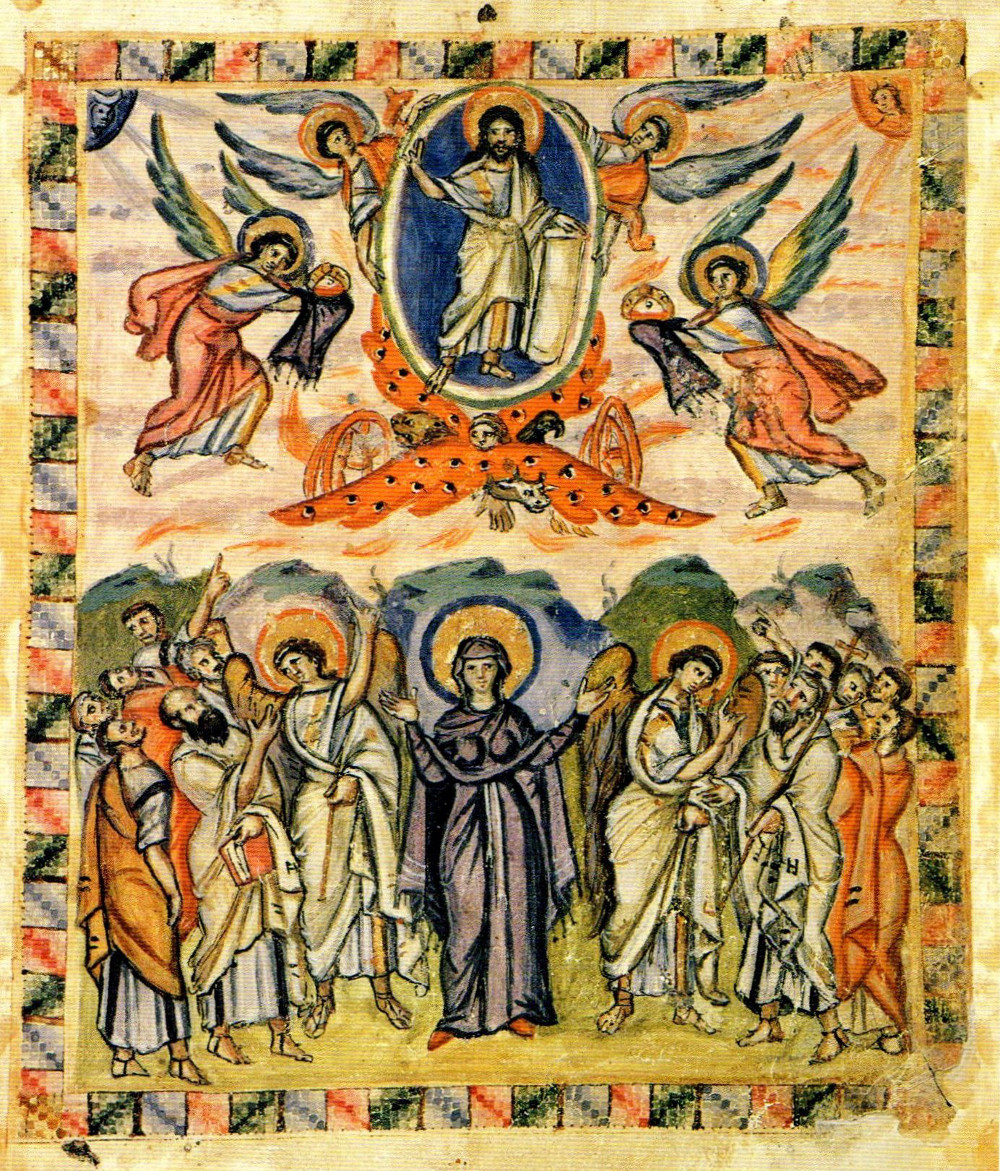
Remarkably, the icon of the Ascension has stood, in essentially the same form, for more than fifteen centuries. The Theotokos at the center, hands raised in prayer. The apostles flanking her in two groups of six, looking upward, gesturing, several of them startled. Two angels in white between them, addressing the apostles in the words of Acts: Men of Galilee, why do you stand looking up into heaven? And above, in a circle of light, Christ — sometimes seated upon a throne, sometimes upright in blessing, always borne by angels, always carrying his wounded humanity into the place from which he, the King of Glory, came.
But who is the King of Glory who enters? And what does he carry with him through those doors?
✠ ✠ ✠
Christ does not enter alone. He does not enter as He came forth.
He came forth from the Father before all ages — the eternal Word, the only-begotten Son, light of light, true God of true God. He entered the womb of his Mother and took from her our flesh. He grew in that flesh, and worked with his hands in that flesh, and wept in that flesh at the tomb of his friend, and bled in that flesh in Gethsemane, and was nailed in that flesh to the cross.
When the gates lift up on this day, he carries that flesh through them, to the place where he always was.
This is the marvel the Fathers labored to confess and that the icon labors to show. That which has not been assumed has not been healed, Gregory the Theologian wrote, long before any Eastern and Oriental divide — and the Orthodox Church in every tongue still confesses it. What he took from his Mother he did not set down. Not at the cross, where the nails could not pry it from him. Not in the tomb, where death could not hold it. Not at the resurrection, where it rose with him glorified. And not at the Ascension, where the everlasting doors open, and the King of Glory enters carrying our humanity into the very life of God.
The body that ascends is the body that was crucified. The body that was crucified is the body that was born of the Theotokos Mary. The body that was born of Mary is the body that, on the night he was betrayed, he took and blessed and broke and gave to his disciples saying: Take, eat of it all of you; this is my Body broken for you and for many, for the remission of sins.
The icon of this feast has stood in essentially the same form through centuries of Eastern and Oriental Orthodox division, perhaps reflecting the deep parallelism in worship between the two divided families. The icon does not argue for unity, but rather remembers what was given before our breaking, and waits — as the Theotokos waits at its center — for us to see.
✠ ✠ ✠
This is what we receive at the altar.
When the Church gathers and the priest lifts up the bread and the cup, and the Spirit is invoked, and the Mysteries are offered for the life of the world, on behalf of all and for all — what we receive is not a symbol of an absent Lord. It is the Body and Blood of the one who ascended and now reigns from heaven. The same Body. The Body that walked in Galilee and was scourged at the praetorium and was lifted on the wood and rose on the third day and entered the everlasting doors. That Body. Given to us under bread, in our hands and on our tongues, on the morning of the eighth day, in every tongue the Church speaks — though in altars that have not yet reconciled, the Body in each is one Body, and the Christ given is one Christ. The chalices we cannot share are chalices that hold the same theanthropic Lord and Savior.
This is the wonder of communion. The doors that lifted up to receive him on this feast are the doors that open again, every time the Liturgy is offered, to lower him into our hearts. He does not leave us in ascending. He carries our humanity into the Father, and from the Father he gives himself back to us who have received his Spirit, again and again, until the end of the age.
The Eucharist is the Ascension answered. He ascends with our flesh; he descends with his own. He carries our humanity into the throne; he places his Body onto the altar. The same Body in both motions. The same Christ in both directions. The everlasting doors do not close behind him.
✠ ✠ ✠
Christ does not ascend as one who leaves creation behind, but as the King of Glory who enters the heavenly sanctuary in the flesh he took from us. The body born of the Virgin, crucified, buried, and raised, is now lifted above the heavens and seated at the right hand of the Father.
Lift up your gates, O ye princes; be lifted up, ye everlasting doors, and the King of Glory shall come in. — Psalm 23:7 LXX / Psalm 24:7
The gates are lifted because the Crucified One has conquered death — but the same command is also spoken as hope to every soul. If Christ is the King of Glory, then the heart is not made to remain closed in fear, grief, or exile. It is called to be opened by grace: lifted from pride into humility, from isolation into communion, from division into love. The Ascension is not only Christ’s enthronement above us, but his promise that what is wounded in us can rise toward him.
So the Lord ascends, and in him our nature is healed, our exile is ended, and our desire is made whole. The Head has gone before, and the Body follows — not alone and not by earthly ambition, but together in holiness, in communion, and in the love that makes the soul spacious enough to receive the King.
✠ ✠ ✠
Christ ascends, but he does not depart from his Church. He is hidden from our sight, yet not absent from our life; enthroned in heaven, yet sitting among those who love him, giving himself as the gift that binds us to him and to one another.
“He ascended to the heights, enslaving the power of death. Today he is distributed as imperishable gifts for humanity. More highly exalt him forever.” — from the Armenian Hymnal
The Ascension is therefore not distance, but communion. Christ raises our nature to the Father, and in doing so he binds earth to heaven. The Head is glorified above, but the Body is not abandoned below. He ascends as King, yet remains offered to his Church as life, grace, and incorruptible communion.
Thus we do not look upward as orphans, but as members of his Body. Heaven is no longer closed over us, and earth is no longer cut off from glory. In Christ, the distance is overcome: he is with us here, and we are with him there.
✠ ✠ ✠
He has entered. He has not departed. The Body that passes through those doors comes back to us at the altar, and we are gathered into his ascent. And because there is one Body, and the gates that lifted up for him will lift up for us, the prayer of the upper room is not finished. He prayed that we might be one, as he and the Father are one. He prayed it before he ascended, and he prays it still, where he has gone. The Ascension is also this: that his prayer for our oneness in truth and love has gone with him into the place where every prayer of his is heard.
Lift up your gates, O ye princes; and be ye lifted up, ye everlasting doors; and the King of Glory shall come in.
Christ has ascended.
He is ascended indeed.