
That Which is Gathered: A Reflection for the Feast of Pentecost, May 31 2026
Behold now, what is so good or so pleasant as for brethren to dwell together in unity!
Psalm 132:1 LXX / Psalm 133:1
The Feast of Pentecost is the celebration of the descent of the Holy Spirit upon the apostles on the fiftieth day after the Resurrection, ten days after the Ascension–and the Church has long called this day her birthday. It is the day on which the gathered disciples, filled with the Spirit, became the one Body of Christ in the world. What the Ascension promised, Pentecost establishes. The Lord who carried our flesh into the Father does not leave his own as orphans; he pours out upon them the Comforter he had promised, and the frightened company waiting behind closed doors becomes the Church.
When the Day of Pentecost had fully come, they were all with one accord in one place. And suddenly there came a sound from heaven, as of a rushing mighty wind, and it filled the whole house where they were sitting. And there appeared to them divided tongues, as of fire, and one sat upon each of them. And they were all filled with the Holy Spirit.
— Acts 2:1–4
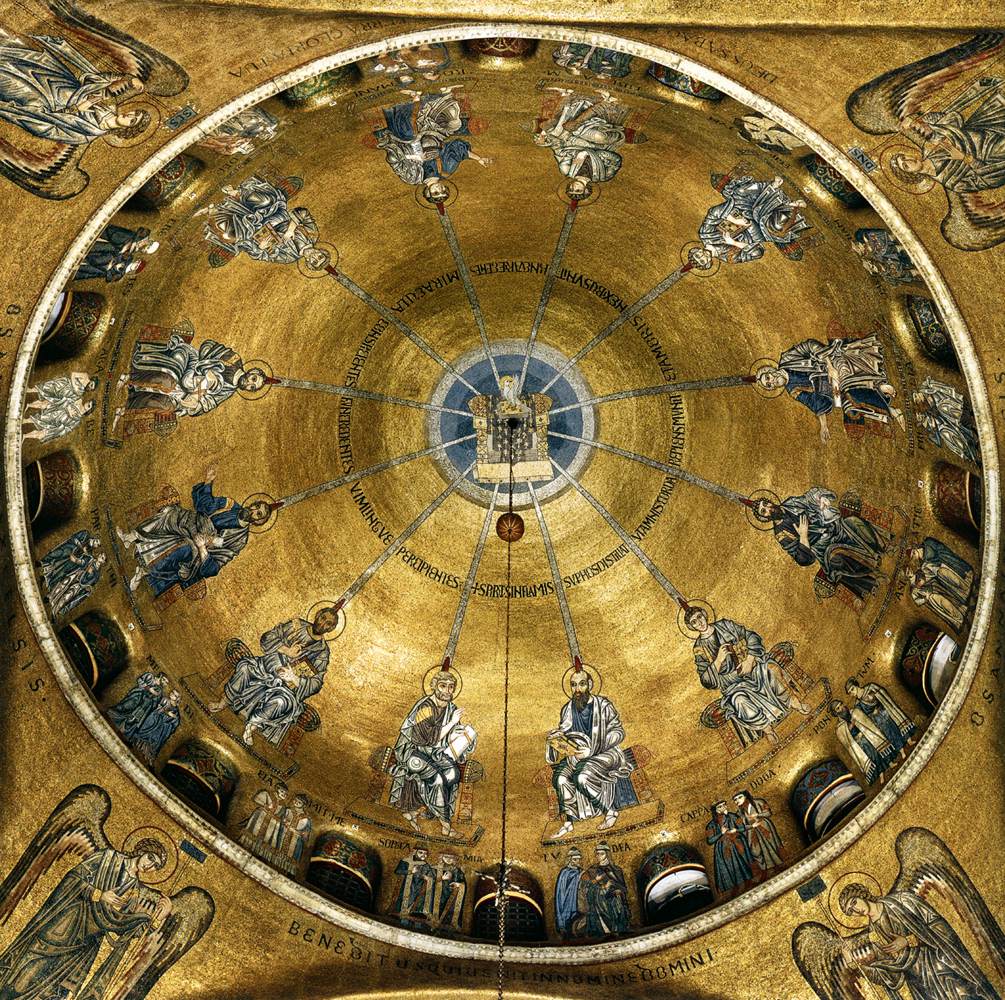
The icon of this feast, like the icon of the Ascension, has stood in essentially the same form for many centuries. The apostles are seated in a wide semicircle, twelve men ranged like the curved wall of a single chamber — the upper room shown as the first church. From a small dark segment of heaven above, rays of light come down and rest as flames upon each head, distributed and personal, never poured out as one undivided mass. And below, in an arch of shadow beneath their feet, an old crowned figure looks up out of the dark: Cosmos, the world, holding in a cloth the scrolls of a preaching he has not yet received–the nations not yet gathered in, waiting at the threshold of the Church that is, at this very moment, being born above him.
But what is born on this day? What is gathered, and filled, and established, that was not there the morning before?
✠ ✠ ✠
First, the scattered are gathered.
These are the same men who had fled at the Passion, when the Shepherd was struck and the sheep were scattered. Now they are found with one accord in one place–and the Greek of that phrase, ἐπὶ τὸ αὐτό, is the very phrase the Psalter uses of brethren who dwell together in unity. The disciples are no longer a frightened scattering of individuals; they are gathered into one, in one place, with one accord, and it is upon that gathering–not upon scattered men–that the Spirit descends.
And the gathering widens at once. The sound draws a crowd from every nation under heaven, and they too are gathered into a single hearing, each in his own tongue but around one confession. This is the work the Church will never stop doing: collecting out of dispersion. As Cyril of Jerusalem observed, what was once divided at Babel as a judgment on pride is here restored as a union of minds, since now the object of zeal is holy. The kontakion of the feast confesses the same: when the Most High distributed the tongues of fire, He called all to unity. The Church is, before she is anything else, the gathered ones — those whom the Spirit draws together into one.
✠ ✠ ✠
Then the gathered are filled.
The Spirit filled the whole house; they were all filled with the Holy Spirit. Pentecost is a feast of fullness, and the One who fills is the One the Church names the Treasury of good things and the Giver of life. He does not measure out his grace in careful portions. He fills–the house, the apostles, and before the day is over, the three thousand who hear Peter and are cut to the heart and gathered in and baptized. Grace, at Pentecost, is not a thing the Spirit hands over; it is the Spirit’s own self, given and indwelling, filling what was empty and waiting. The vessels prepared in the upper room are filled to overflowing, and from that fullness the Church begins to pour out into the world.
✠ ✠ ✠
And the filled are made a communion.
For what does this gathered, Spirit-filled company immediately become? Luke tells us in a single verse: they devoted themselves to the apostles’ teaching and to the fellowship, to the breaking of bread and to the prayers. The word he uses for fellowship is koinonia–communion. The Church is born and is at once a communion: gathered around one teaching, one Bread, one cup, one prayer. This is the Ascension answered in a second key. He carried our humanity into the Father and gives his own Body back to us upon the altar; the Spirit gathers us around that altar and makes of the many one Body. Communion is not an activity the Church performs on certain mornings. It is what the Church is, from her first day–one Bread, one Body, because we who are many partake of the one Bread.
✠ ✠ ✠
So the Church that is born on this day is one.
There were many tongues in the street, but one confession in the house; many nations, but one Body; and the Spirit gathered the diverse into a single communion without erasing the diversity. The Church of Egypt sings this in the Asomen, the hymn of the Holy Fifty days: He made the two into one, which is heaven and earth. The Spirit who joined heaven to earth is the same Spirit who joins peoples to one another in the one Church–and that hymn, sung in Coptic at a Coptic altar, confesses the very communion that the Greek kontakion confesses in Constantinople. The tongues differ; the Body is one.
And here Pentecost both judges us and consoles us. For the one Church established on this day is now, between the Eastern and Oriental Orthodox families, visibly two. The division is real, and grievous, and not to be wished away by calling it small. But the birthday of the one Church is also the day that measures our divisions against her origin, and the day that promises their healing–for the Spirit who gathered the scattered into one on the first Pentecost is the same Spirit still, and the gathering he began is not yet finished. The chalices we cannot share are chalices the one Spirit longs to gather back into one communion.
✠ ✠ ✠
What is given to the whole Church is given also to each soul, for the fire was distributed, and one tongue rested upon each. The Spirit who gathers and fills and makes the Church a communion comes to do the same within us: to gather the heart out of its isolation, to fill what is empty in it, to make it capable of communion at all. The heart closed by pride, by suspicion of the brother, by an unbalanced form of zeal, by old grief, is the heart Pentecost descends to open–from dispersion into gathering, from emptiness into fullness, from division into communion and love.
✠ ✠ ✠
On the evening of this feast the Church bends the knee for the first time since Pascha, and takes up again a prayer she had laid aside through all the bright weeks of the Resurrection. From Pascha until now she does not say O Heavenly King, for the King she invokes had not yet sent the Spirit. Today the prayer returns to her lips, in every tongue she prays, because today the One she calls upon has come, and the Church is born.
O Heavenly King, the Comforter, the Spirit of Truth, who are everywhere present and fill all things, the Treasury of good things and Giver of life: come and abide in us, and cleanse us from every stain, and save our souls, O Good One.
He has gathered the scattered. He has filled the empty. He has made of the many one Body, and bound that Body together in communion, and established his one Church upon the earth. And the prayer Christ prayed before he ascended–that they may be one, as he and the Father are one–is the prayer the Spirit was sent to accomplish among us, until the day when every cup is one cup and every tongue confesses, in one communion, the same Lord.
Come, O Heavenly King.
Come, and gather us into one.