Fighting Fire with Fire: Saint Tounom, the Split Column, and the Fire We Quarrel Over at Christ’s Tomb
A reflection on the Holy Fire of 1579, the making of an anti-Armenian legend, and the hard work of ecumenical memory
“One is the true God, Jesus Christ; one is the true faith, that of the Orthodox Christians!”
—The Cry of the Orthodox Arabs at the Split Column, 1579 (as retold by the monk Parthenius, 1846)
“But the wisdom that is from above is first pure, then peaceable, gentle, willing to yield, full of mercy and good fruits, without partiality and without hypocrisy.”
—JAMES 3:17 (NKJV)
*A pastoral note: this essay is written by a layman, for fellow laypeople trying to think seriously about a question many would rather avoid. It is not a polemic, a “gotcha,” or an attempt to bypass the hierarchy of the Church in whose mind these matters finally rest. It is the kind of questioning a conscience conducts when it has stopped rehearsing its position and started listening. It is offered in that spirit. Please note that this lay-level blog post is not intended to assert any dogmatic or ecclesiological claims contrary to Orthodox teaching, tradition, or modern dialogue. For any questions or concerns, please contact info@syndoxia.com.
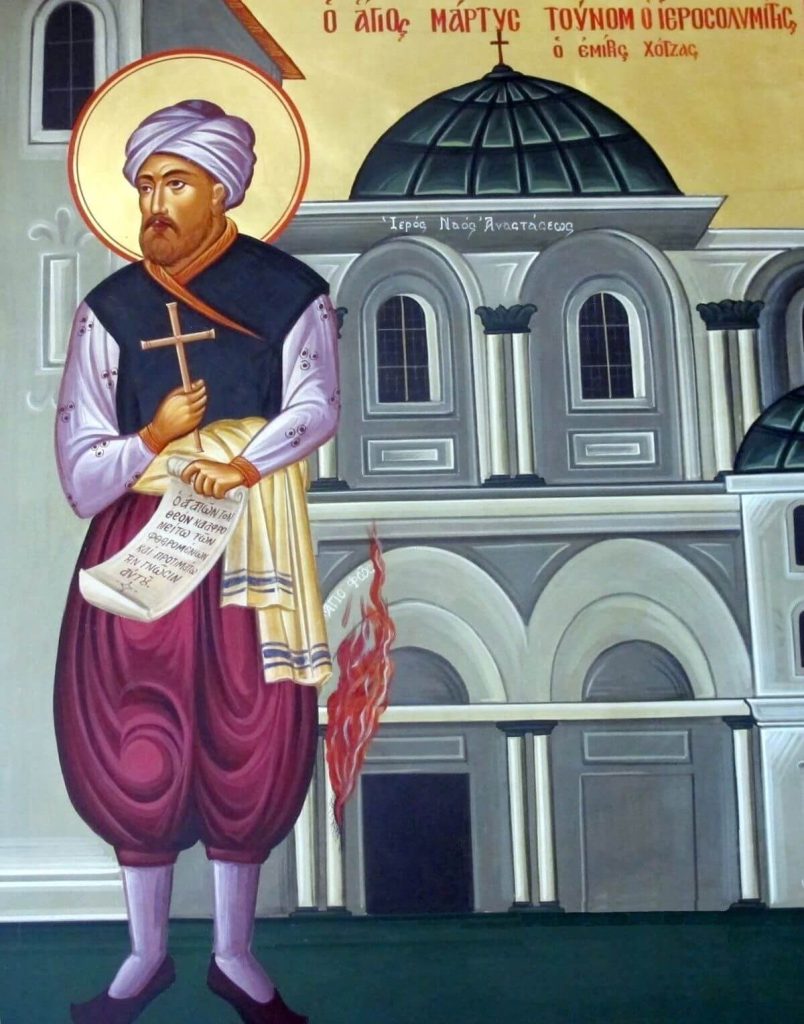
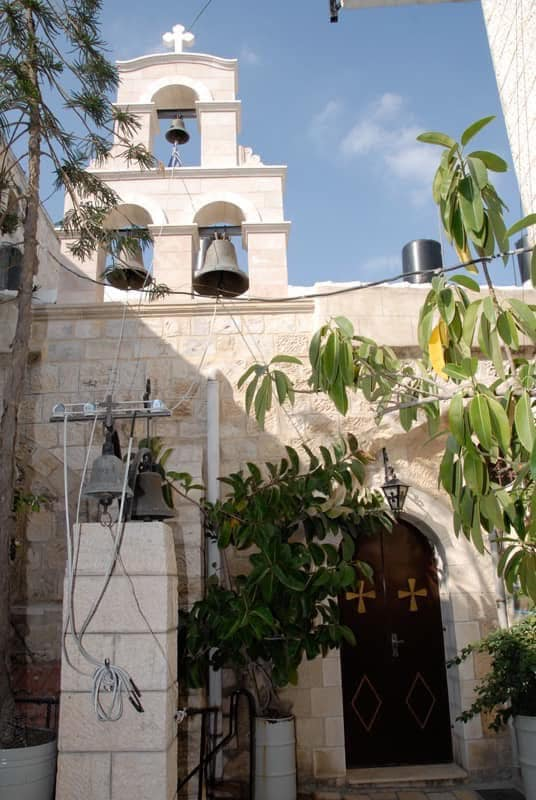
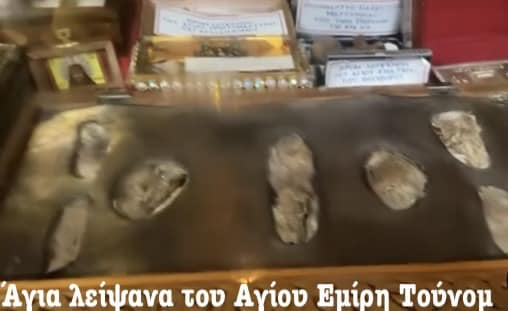
Yesterday the Eastern Orthodox Church commemorated Saint Tounom the Emir. Today, on Thomas Sunday, the Paschal candles still burn. Somewhere in Jerusalem, at a small convent called Megali Panagia, a reliquary is set out for veneration. The icon beside it shows a man in Ottoman dress, a broken column at his shoulder, fire on the fractured stone. The man is named, in the Orthodox synaxaria, Tounom—sometimes Tunom, sometimes Omir, the word “emir” absorbed into a proper name through four hundred years of linguistic weather. The story we tell of him on April 18 is the story of a Muslim officer who saw the Holy Fire descend in 1579 and died a Christian.
It is a beautiful story. It is also, in the form most Eastern Orthodox have received it, a story that was shaped over centuries into a polemic against the Oriental Orthodox brothers and sisters–particularly against the Armenians.
For the millions of Oriental Orthodox Christians, most of whom were brought into the faith by their sheer ethnicity, the story of God’s seeming preference for the Eastern Orthodox Church feels like a father rejecting his son. It feels like a slap in the face, as if a communion of Christians who genuinely sought to preserve the apostolic tradition to the point of bloodshed was was looked at as a an illegitimate child.
For Eastern Orthodox Christians, the modern ecumenical dialogue demands its members proper justification for this story. Is the church hypocritical so as to recount an event with such fervor, only later to confuse its members by accepting those same people that the holy fire itself rejected?
For these reasons, we must take the saint seriously; and we ought to take one another seriously–out of courtesy to the Armenian Christians who claim to be descendants of saints highly- regarded in the Eastern Orthodox communion such as Gregory the Illuminator, the martyr-nun Hripsime and abbess Gayane, as well as the Forty Martyrs of Sebastia.
Even if courtesy is not the reason we do so, curiosity still can compel us to trace how a tradition about a Holy Saturday in 1579 traveled through four centuries and three languages and ended up as a weapon in a family fight that the rest of the Church spent most of the twentieth century trying to end.
This is not an exposé. Saint Tounom is not a fraud. The Holy Fire is not a fraud. The Orthodox Church is not on trial. What is on trial is the habit of telling true stories in ways that wound our brethren. Syndoxia means with one accord. The word is Pauline and Lukan in spirit; it is a note of harmony, a choir’s intention. It is the note I want to hold throughout what follows, especially when the argument gets difficult.
Let’s begin where all Eastern Orthodox Christians begin: with the story heard and known today.
Summary
Every April 18, the Eastern Orthodox Church commemorates Saint Tounom the Emir — a Muslim officer who, on Holy Saturday 1579, is said to have witnessed the Holy Fire descend at the Church of the Holy Sepulchre, confessed Christ, and died for it. The story is beautiful, and the saint is real. But the version most have inherited carries something the saint himself did not: a polemical frame in which the Armenians are the villains, bribers and schemers whose prayers failed and whose humiliation vindicates Greek Orthodoxy as the one true faith.
This essay traces how that frame was added to the story across centuries — and what it costs us when we keep repeating it. It asks whether a miracle at Christ’s empty tomb was ever meant to function as a verdict against fellow Christians; whether the pleasure of being on the winning side of a confessional history is the same thing as love of Christ; and whether, after the Chambésy Agreed Statements of 1989 and 1990 formally identified the centuries-old Christological dispute as a terminological misunderstanding, we can still in good conscience pray our brothers and sisters into the role of defeated rivals. The saint does not need the polemic. The Light at the Tomb does not belong to any one of us. Tounom is bigger than the quarrel.
The Story as it is Received Today
Here is the tale, in the form in which most Orthodox Christians encounter it–the form preserved in the chronicle of the Moldavian monk Parthenius Ageev, who visited Jerusalem in 1845 and published his account a decade later:
It is Holy Saturday, 1579, under Sultan Murad III. The Greek Orthodox Patriarch of Jerusalem is Sophronius IV. The Patriarchs of Constantinople, Alexandria, and Antioch are respectively Jeremiah II, Sylvester, and Joachim. The Armenian community in Jerusalem, we are told, has bribed the Ottoman Porte and the local authorities with a large sum of money, arguing before the Turks that the Holy Fire comes down not specifically for the Greeks but for any Christians–and that if the Armenians alone are inside the Church of the Resurrection, they too will receive it. The Ottomans, greedy for silver, accept the bribe. They issue an order: only the Armenian patriarch may enter the Church today; only the Armenians may receive the Fire.
The Orthodox are locked out. Patriarch Sophronius and his people stand in the courtyard of the church — it is growing dark — weeping, chanting, holding unlit candles. Hours pass. The Armenian patriarch, inside the Aedicule, prays. Nothing happens.
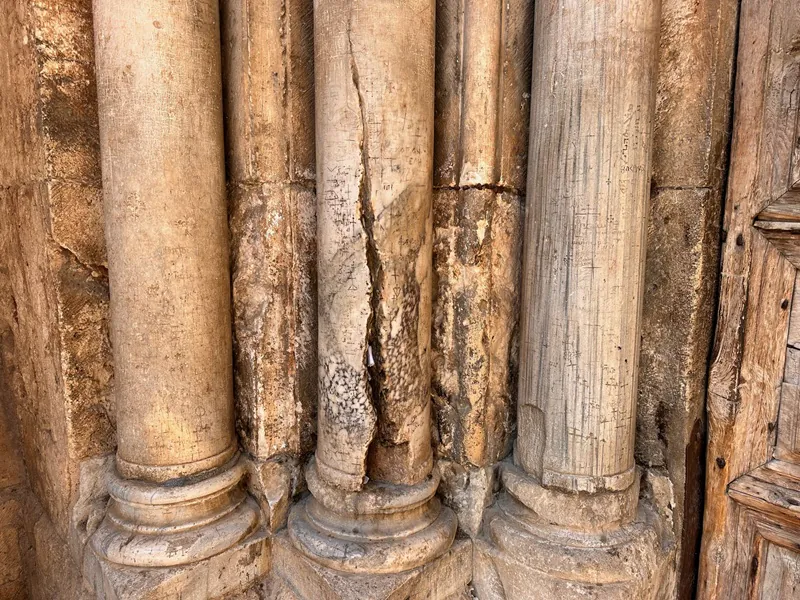
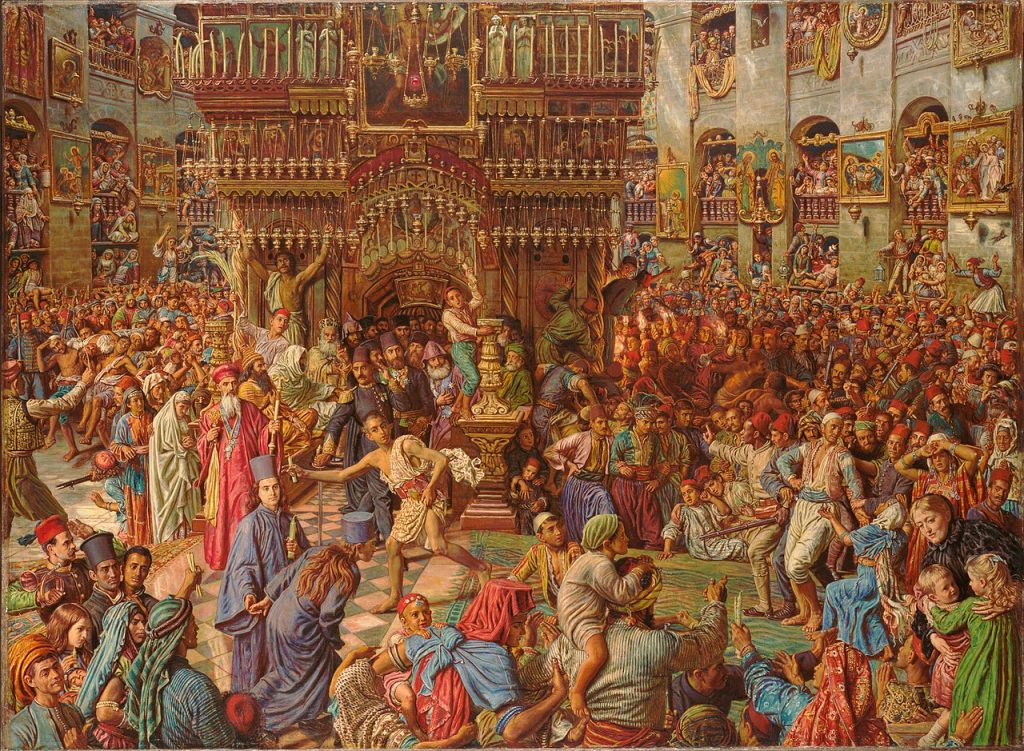
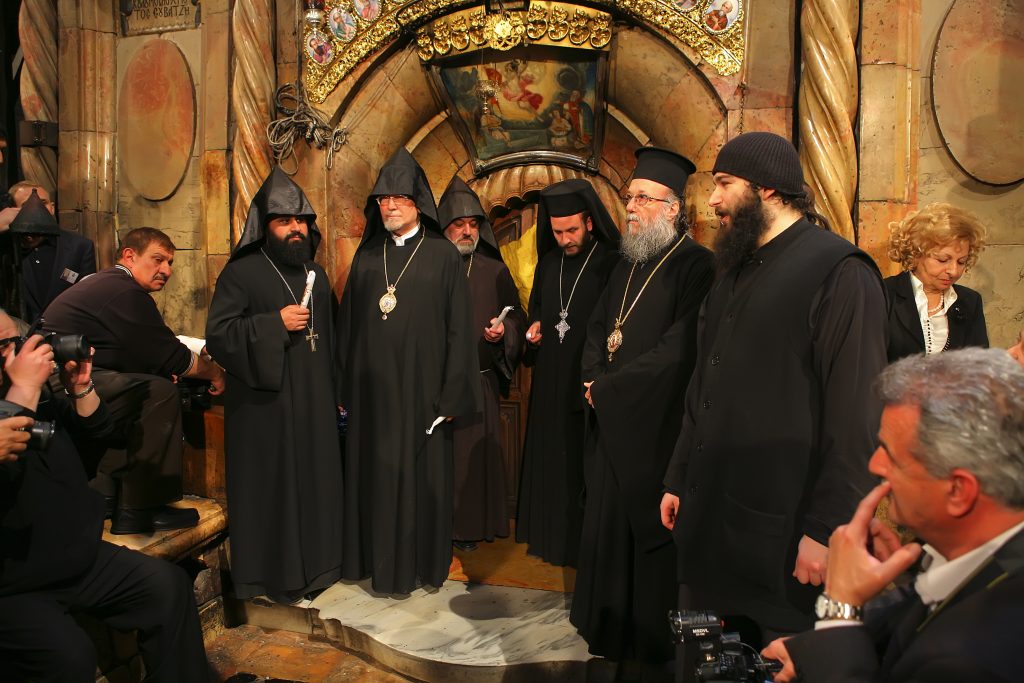
Then a clap of thunder. The left-hand marble column of the Great Door cracks open, and out of the fissure flame pours. Sophronius raises his candles, and they kindle. The Orthodox faithful light theirs from his. The Orthodox Arabs of Jordan begin to dance, crying out the sentence that still echoes around the Church every Holy Saturday: “One is the true God, Jesus Christ; one is the true faith, that of the Orthodox Christians!“
Among the Ottoman soldiers on duty at the Monastery of Saint Abraham, nearby, is an emir. In some versions he is Turkish; in Parthenius he is explicitly Arab. When he sees the fire emerge from the column he leaps—from a balcony, in the more dramatic retellings—and lands on the paving stones below as though on wax. His footprints are impressed into the marble; the non-Orthodox later try to erase them; pilgrims report being able to touch them to this day. He drives his sword into a wall or column, as into soft wax. He cries out that Christ is the true God. He is seized, beheaded, his body burned. The Greeks gather his bones secretly and take them to a convent called the Great Panagia, where they remain, giving off a sweet fragrance, until our own time.
The Armenians, meanwhile, receive nothing. The Turks, angry at having been deceived, want to massacre them. Only their fear of the Sultan restrains them. As a parting humiliation, the Ottomans are said to have forced every Armenian leaving the church that day to eat a measure of dung.
That, give or take, is the story as most of us have it. Four things in it deserve our attention. First, the specific year—1579. Second, the Armenian bribery narrative. Third, the failure of Armenian prayer. Fourth, the named convert, Tounom himself.
✠ ✠ ✠
The Long Holy Fire: Older than the Quarrel
Before we open the 1579 question, I need to remind both of us that the Holy Fire is not a 1579 phenomenon. The tradition at the Church of the Anastasis is old — much older than any of the confessional disputes that swirl around it. Before the split column, before the emir, before the Armenians and the Greeks argued over the keys, there was a Paschal fire in Jerusalem.
The earliest hint comes from Eusebius of Caesarea, writing around 328 in his Life of Constantine. He tells of an incident (probably around the year 180) during the episcopate of Bishop Narcissus of Jerusalem, when the lamps for the Paschal vigil were dry. Narcissus ordered them filled with water; they burned like oil. The event is not the annual Holy Fire as we now know it—it is a one-time miracle, and it predates the Constantinian basilica by more than a hundred years—but Orthodox tradition has always read it as a foreshadowing, a hint that the site of the Resurrection is a place where fire behaves oddly.
An Armenian tradition preserved by the thirteenth-century historian Kirakos Gandzakets’i takes the origin of the annual miracle even further back, to around 330, and attributes it to Saint Gregory the Illuminator—the apostle of Armenia, remembered as the first Catholicos of the Armenian Church. Kirakos writes that Gregory placed a lamp on the Lord’s tomb and prayed that it be lit each Pascha “by the command of God,” with no human hand, and that this miracle continues down to Kirakos’s own day. I note this at the outset because it will become important later: the oldest Armenian account of the Holy Fire places its origin in Armenian sanctity, at a time when the Orthodox Church was undivided by Chalcedon.
Moving forward: the Latin monk Bernard the Wise (Bernardus Monachus) made a pilgrimage to Jerusalem around 867 and left the first clearly-dated Christian description of the ceremony. He wrote that after the singing of Kyrie eleison, an angel descended and kindled the lamps hanging over the Sepulchre; the patriarch passed the flame to the bishops and then to all the people. By the early tenth century, the Greek metropolitan Arethas of Caesarea was writing a letter to the Emir of Damascus describing the annual phenomenon—a letter whose audience was Muslim and whose tone was sober.
Muslim sources acknowledge the miracle from very early. The Arab geographer and historian al-Mas’ūdī (d. 956), travelling in Palestine, describes fire descending from heaven on Easter Saturday. Al-Bīrūnī (d. c. 1048)—a polymath of unusual scientific seriousness — treats the fire as a known annual event. The Syrian chronicler Ibn al-Qalānisī (twelfth century) tells us that the Fatimid caliph al-Ḥākim bi-Amr Allāh ordered the Church of the Holy Sepulchre destroyed in 1009 precisely because he was enraged by the popularity of this Christian miracle. Al-Ḥākim succeeded in demolishing the complex; he could not demolish the ceremony. When the church was rebuilt, the fire returned.
Around 1106–1107, the Russian abbot Daniel of Chernigov made a pilgrimage and wrote the first detailed description of the ceremony as we know it today: the patriarch entering the Aedicule alone, praying, emerging with kindled candles; a blue light descending from the dome; the crowd lighting their candles from the patriarch’s.
One more detail from this early period, because it matters for what comes next. In 1101, two years after the Crusaders had seized Jerusalem and installed a Latin hierarchy, the Latin patriarch Daimbert presided over the Holy Fire ceremony for the first time. The fire, according to both Latin and Greek chroniclers, did not come. Only when Greek clergy were restored to participation did it descend. Christopher Tyerman, the distinguished Oxford historian of the Crusades, notes drily that “the newcomers evidently had not learnt the knack.” In 1238, Pope Gregory IX issued a papal bull denouncing the Holy Fire as a fraud and forbidding Catholic clergy from participating—a prohibition that held for centuries.
I lay out this longer history because I want us to see the shape of the field. The Holy Fire tradition is not a seventeenth-century Greek invention. It is a feature of Jerusalem Paschal worship attested from the ninth century at the latest, plausibly much earlier, and acknowledged (sometimes hostilely, sometimes sympathetically) by Christians of every confession and by Muslims in multiple languages. The question of what the fire is — a miracle in the strong sense, a pious sign, a ritual using natural lights, or a complex phenomenon that has varied over time — is not settled by any honest reading of the sources. What is settled is that something happens in that courtyard on Holy Saturday, and that it has happened long enough, and attracted enough serious attention from people in a position to know, that no responsible historian calls it straightforward fraud.
Against this immense, long, multi-confessional background, the 1579 “split column” is a relatively small incident. What makes it important is not the fire itself—the fire had been descending for centuries—but the way the story of this one year was told, retold, and finally weaponized.
✠ ✠ ✠
Reading the Earliest Texts: A Detective’s Trip to Munich
Here is where I have to ask you to put on, for a little while, the hat of a historical detective. Bear with me; the payoff is perhaps worth it.
The earliest surviving text of the 1579 split-column story lives in a Greek manuscript in the Bavarian State Library in Munich. Its call number is Codex Monacensis Graecus 346. It was copied, in the year 1634, by a Cretan priest named Akakios, from an earlier manuscript composed in 1608 by a priest named Ananias. The 1608 original has been lost. What we have is the 1634 copy. The gap between the event described (1579) and this earliest surviving witness is therefore fifty-five years; between the event and the original composition (Ananias, 1608), twenty-nine years.
Twenty-nine years is not nothing. A priest writing in 1608 could well have spoken to people who stood in the courtyard of the Anastasis on Holy Saturday 1579. The Ananias text, in other words, has a reasonable claim to preserve living memory.
What does the Ananias text—the oldest layer—actually say?
The text describes the column miracle in terms that most Orthodox readers will immediately recognize. The patriarch is locked out of the church. He and his people stand in the courtyard weeping. The patriarch stands near the throne of Saint Helena beside a certain column. Suddenly a column splits, fire emerges, the patriarch kindles his candles, the people kindle theirs from his, the locked doors open, and the feast proceeds. When those who had locked them out see the miracle, they open the doors and let the patriarch in.
Notice what is not in this text.
There is no Armenian patriarch. There is no Armenian bribery of the Ottoman authorities. There is no failed Armenian prayer inside the Aedicule. There is no named emir—no Tounom, no Omir. The locking-out is attributed vaguely to “those in power” — not specifically to Armenian scheming. The text is concerned with the Greek patriarch’s vindication against an obstruction; it is not concerned with the vindication of one Christian confession against another.
This is the first thing for us to absorb. The split column is in the earliest layer. The anti-Armenian polemic is not.
Let us keep going. The next major witness is the Proskynitarion of the Holy City of Jerusalem compiled by Symeon, archimandrite and warden of the Holy Sepulchre, printed in Vienna in 1749—170 years after the event. By this time, a named “Arab emir” called Tunom has entered the narrative as a witness to the miracle, standing in the courtyard, impressed by what he sees, quarreling with his co-religionists, eventually executed for confessing Christ. The Tounom tradition, in other words, is already present by 1749 in some form. The scene has filled out: a named convert, a specified punishment, relics gathered.
But even in the 1749 text, the explicit anti-Armenian framing — the bribery, the scheming, the failed Armenian prayer, the dung-eating, the Sultan’s anger—is not present in the way we know it. The 1749 text is principally a celebration of the miracle and the convert, not a polemic against the Armenian Church.
The explicit anti-Armenian version appears, fully developed, in the third major witness: the chronicle of Parthenius Ageev, describing his own pilgrimage of 1845, published in Moscow in 1855. Parthenius is the one who gives us the sentences I quoted at the start: “some rich Armenians took it into their heads to force the Greeks out of the Holy Sepulchre… They gathered a large sum of money and bribed the Ottoman Porte…” It is Parthenius who specifies that Ottoman authorities wanted to slaughter every Armenian and made them eat dung as they left. It is Parthenius who gives us the emir leaping from the balcony, sinking into marble as into wax, thrusting his weapon into the stone.
To put this in a table:
|
Textual layer |
Approx. Date |
Split column? |
Named emir / convert? |
Explicit anti-Armenian polemic? |
|---|---|---|---|---|
|
Ananias / Akakios (Codex Mon. Graec. 346) |
composed 1608, copied 1634 |
Yes |
No (unamed witness) |
No |
|
Symeon of Jerusalem (Vienna Proskynitarion) |
1749 |
Yes |
Yes–”Tunom the Emir” |
Partial / Not-Explicit |
|
Parthenius Ageev (Wanderings) |
written 1846, published 1855 |
Yes |
Yes–Elaborated |
Yes-fully Developed |
This is a fairly standard example of what scholars of hagiography call stratigraphy — the layering of material over time. The deepest layer is 1608, and the deepest layer is not anti-Armenian. The surface layer is 1846, and the surface layer is the layer most of us actually read.
I want to be very careful here. The point of noting this is not to say “ha, you’ve been duped.” The point is not to puncture. Traditions grow. The story of the Theotokos’s Dormition grew across centuries and is no less holy for having grown; the feasts of many saints acquired detail and color long after the saints themselves had reposed. What I am doing here is not Protestant skepticism. It is Orthodox honesty—the kind of honesty that allows us to ask, about each layer, what is it doing? What does it want to say, and what does it want to do to the hearer? For a post in a forum whose whole purpose is reconciliation between Eastern and Oriental Orthodox Christians, this question is exactly the question we have to ask. Because the deepest layer—the 1608 layer—wants to praise the Resurrection and the faithfulness of the patriarch and the people. The surface layer—the 1846 layer—wants, additionally, to humiliate our Armenian brothers and sisters. If that is the case, it is contrary to the Gospel, who teaches us the wisdom that is from above is first pure, then peaceable, gentle, willing to yield, full of mercy and good fruits, without partiality and without hypocrisy (James 3:17).
✠ ✠ ✠
What actually happened in 1634: Alexander Treiger’s Manuscript
If the anti-Armenian version of the 1579 story is a nineteenth-century embellishment, we owe ourselves this question: were there any genuine Greek-Armenian tensions at the Holy Fire that the later storytellers might have been drawing on? The answer is yes—but the real tensions occurred in a different century, over a different issue, and with a different texture.
The person we have to thank for knowing this clearly is Father Alexander Treiger, Professor of Religious Studies at Dalhousie University in Halifax, one of the leading living scholars of Christian Arabic literature. In 2024 he published, in the journal Bible and Christian Antiquity (English Supplement, volume 3, issue 23, pages 88–129), a critical edition and English translation of a remarkable document: an Arabic account of the Holy Fire on Holy Saturday, 1634.
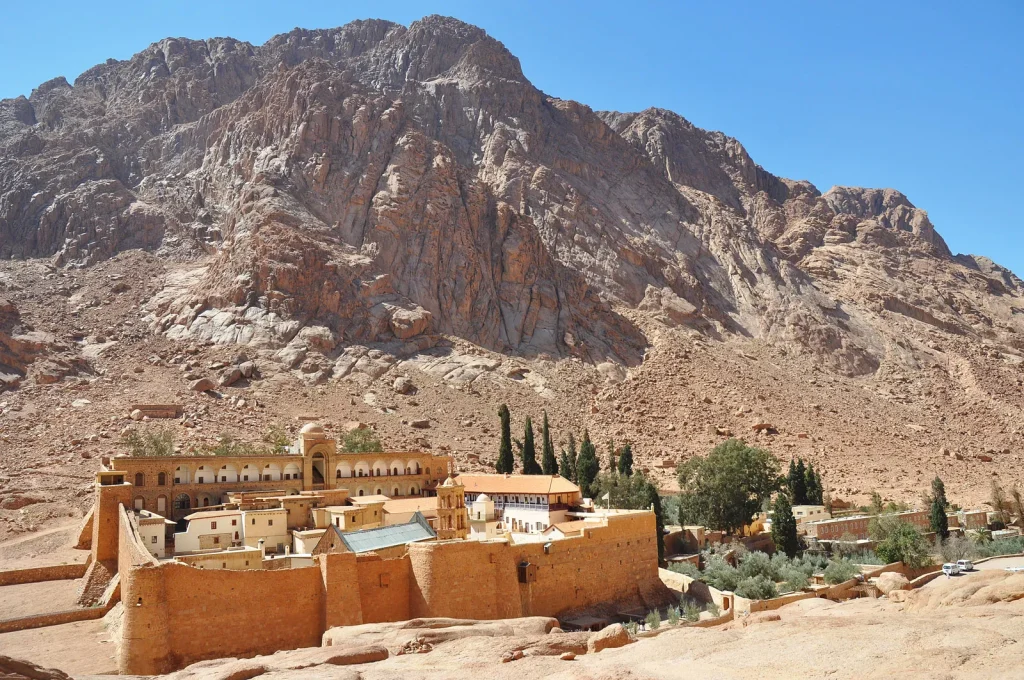
Treiger’s source is Sinai Arabic manuscript 305, preserved at the Monastery of Saint Catherine on Mount Sinai. The manuscript was copied on December 8, 1634—just eight months after the events it describes. In the world of manuscript studies, a near-contemporary witness of this kind is, as one commentator put it, “the holy grail.” The scribe is most plausibly an Arab Christian monk connected to the Monastery of Saint Basil; internal evidence suggests Syrian-Armenian-Assyrian background. He is writing not as a Greek partisan but as an Eastern Christian observer.
What does he describe?
He describes a genuine and documented Greek-Armenian confrontation at the Holy Sepulchre on Holy Saturday of 1634. Its occasion, however, was not a grand polemic about which church is the true Church. It was a calendrical dispute. In 1634 the Armenian calculation of Pascha had fallen one week later than the Greek. The Armenian Patriarch of Jerusalem at the time, Grigor Paron-Ter (in office 1613–45), insisted on preserving the Armenian date—and on preventing the Greeks from celebrating until his own community did. He obtained intimidation of the Coptic community (which had initially agreed to celebrate with the Greeks), brought the Ottoman qāḍī (judge) and soldiers into the Holy Sepulchre, had the Tomb sealed, and prevented Greek pilgrims from approaching.
The Arabic text then describes what happened at the ninth hour: an earthquake, a brightness from within the Tomb “like the brightness of heaven,” Ottoman soldiers falling on their faces, bystanders proclaiming “True and veracious is the religion of the Christians, and their Light has appeared!” The Franks—the Latin Catholics—who had previously suspected the whole business was a pious fraud involving an Ethiopian with a flint, “came to believe in the splendid Light, for they had neither believed in, nor acknowledged, the Great Saturday.”
The Armenian patriarch is humiliated in this account. But notice what the account does not contain: it does not contain a broader polemic against the Armenian Church. It tells a specific story about a specific patriarch’s attempt to use Ottoman force against the Greeks in a calendar dispute, and the vindication of the Greek position that day. The Coptic community in the narrative is treated sympathetically—”they were poor, being few in number in the holy city of Jerusalem, and had no one to govern their affairs”—not as heretics but as a fellow beleaguered Christian community intimidated by a stronger Oriental Orthodox patriarch. The polemic is narrow, not sweeping.
What does this mean for our Tounom question?
Treiger’s text confirms that a real seventeenth-century memory of Greek-Armenian confrontation at the Holy Fire existed and circulated. The 1634 event was genuine, contemporaneously documented, and of the kind an oral tradition might preserve for generations. What the later Parthenius-era retelling appears to have done is take this seventeenth-century memory, combine it with older memories of Greek-Latin confrontations from the late sixteenth century (preserved in other chronicles, including a 1620 Ukrainian document recording the oral traditions of Patriarch Theophanes III), and retroject the whole composite backward onto the year 1579—a year which, as we have seen, does have an attested miracle tradition of its own (the split column), though originally without the Armenian framing. The composite becomes, in Parthenius’s hands, a story in which Armenians bribe, Armenians fail, Armenians are humiliated.
In the mid-seventeenth century there was a further real event that is worth naming. In 1611, Patriarch Theophanes III of Jerusalem—Sophronius IV’s successor—obtained an Ottoman decree stopping the Armenian Patriarchate of Jerusalem from taking over the celebration of the Holy Light. This is a documented jurisdictional action, not a miracle story. It tells us that in the early seventeenth century there was a genuine question about whether the Armenians or the Greeks would preside at the Holy Fire, and that the Greeks secured their position by imperial decree. This is exactly the sort of real history around which popular piety can grow a legend.
The Armenian tradition itself, by the way, has its own memory of such tensions—though it does not dwell on them in the same way, and it does not (so far as I have been able to find) treat them as the signature moments of Armenian identity at the Holy Sepulchre.
So here is the cleaner picture. The Greek Orthodox had, in the first decades of the seventeenth century, real and documented tensions with the Armenian Patriarchate over the Holy Fire ceremony. The Greek Orthodox had, by the early seventeenth century, a real tradition (in the Ananias text) about a 1579 miracle of the split column that did not mention Armenians. Over the next two centuries, these two streams—the 1579 miracle tradition and the later jurisdictional memory—merged in the popular imagination, until by the time the Moldavian monk Parthenius arrived in Jerusalem in 1845 he recorded them as a single, seamless anti-Armenian story, and transmitted that story, through the publication of his chronicle in 1855, to the entire Russian Orthodox world.
✠ ✠ ✠
The Sixteenth-Century Core: What We Can Honestly Claim
Having taken apart the layers, I don’t want to leave you with the impression that there is nothing historical here. There is. Let me set out what a careful reader can honestly say about 1579.
First, the date is specific and internally consistent. The Ananias/Akakios text names the four Greek Orthodox patriarchs in office—Sophronius IV of Jerusalem, Jeremiah II of Constantinople, Sylvester of Alexandria, Joachim of Antioch—and the Ottoman sultan, Murad III. If you cross-check the official patriarchal lists and the Ottoman regnal dates, the only year in which all five men were simultaneously in office is 1579. This is not the sort of detail a later hagiographer would have invented from nothing; it is a genuine datum. Something happened in 1579, and the Ananias text dates it correctly.
Second, the cracked column is a real physical feature. It stands at the left of the main door of the Church of the Holy Sepulchre, and you can touch it—pilgrims still do. Scientific analyses have been undertaken: Dr. George Papadopoulos (Professor of Mechanics at the National and Kapodistrian University of Athens) and Professor Evgeny Morozov (Moscow Institute of Physical Engineering) have examined high-resolution photographs of the fracture. Their conclusions, independently, suggest that the fissure is consistent with a combined event: a powerful electrical discharge (lightning strike) and a simultaneous seismic tremor, the combination of which embrittled the stone and produced the particular zigzag fracture pattern visible. Whether one interprets this naturalistically or miraculously, the column’s fracture is not the kind of erosion that occurs over time — it is consistent with a single dramatic event. Parthenius’s version of the story explicitly mentions lightning; this detail, far from undermining the tradition, turns out to match the physical evidence.
Third, the Orthodox Arab dance around the Sepulchre is an old and continuing practice. The cry—Wāḥid huwa rabbunā Yasū’ al-Masīḥ, wāḥid īmānunā, “One is our Lord Jesus Christ, one is our faith”—is still shouted on Holy Saturday by the Arab Christian youth of Jerusalem, who dance around the Aedicule in a tradition they trace back to a time when Ottoman authorities forbade Christian song in public except inside churches. The sixteenth-century origin of this practice is plausible.
Fourth, Muslim conversion and neomartyrdom in Ottoman Jerusalem is a real and well-documented phenomenon. The Greek Orthodox scholar Nomikos Michael Vaporis, in his indispensable study Witnesses for Christ: Orthodox Christian Neomartyrs of the Ottoman Period, 1437–1860 (St. Vladimir’s Seminary Press, 2000), catalogs roughly two hundred new martyrs, including a subset of Muslims who converted to Orthodoxy and were executed for apostasy. The sixteenth century alone produced approximately twenty-five such martyrs. A Muslim Ottoman officer converting to Christianity and being executed in 1579—whether or not his name was Tounom—is thoroughly plausible as a historical event. In Ottoman legal terms, a Muslim’s conversion to Christianity was ridda (apostasy) and carried the death penalty under most readings of Hanafi jurisprudence. A man who confessed Christ after a public Christian miracle would, with near certainty, have been executed.
Fifth, the relics at the Megali Panagia convent are present. The reliquary is displayed for veneration on April 18. The continuity of devotion—even if the tradition has accumulated layers of legend—is itself a datum.
What we can honestly say, therefore, is this: something happened in Jerusalem on Holy Saturday 1579. The specific Patriarchs named were in office. A column in the courtyard of the Church of the Holy Sepulchre sustained damage consistent with a lightning strike and seismic activity. There may well have been a Muslim witness so impressed by the events that he publicly confessed Christ and was executed. The Orthodox have venerated his memory at a small convent in Jerusalem ever since.
What we cannot honestly say with absolute certainity is that the Armenian patriarch bribed the Ottoman authorities that day; that the Armenians tried and failed to summon the fire; that the Sultan was angry at them; that they were forced to eat dung. Those elements were added later, at least two centuries after the event, and they do not appear in the earliest textual witness we have. They are, so far as the evidence goes, not history but accretion.
And here I want to pause and make sure we feel what this means. It means that the historical core of the Tounom tradition—the miracle, the convert, the martyrdom—is independent of the anti-Armenian frame. You can honor Saint Tounom, venerate his relics, celebrate his feast, and still refuse to use his story against your Armenian neighbors. The saint does not need the polemic. The polemic was bolted on to him, in a later century, by Greek-speaking monks working during the period of greatest Greek-Armenian rivalry over the physical Church of the Holy Sepulchre. The saint was, and is, bigger than the quarrel.
Simply put, the martyr’s confession of the Orthodox faith need not be contingent, nor is more validated, upon the debasement of the Armenian Apostolic faith–even if their suspected bribery was true. The story conflates faith and works together, and while we profess them to be synergistic and connected, arguing a communion’s faith by the works of a select few in one of the most tense, polarized locations of the world is not able to be reasonably substantiated.
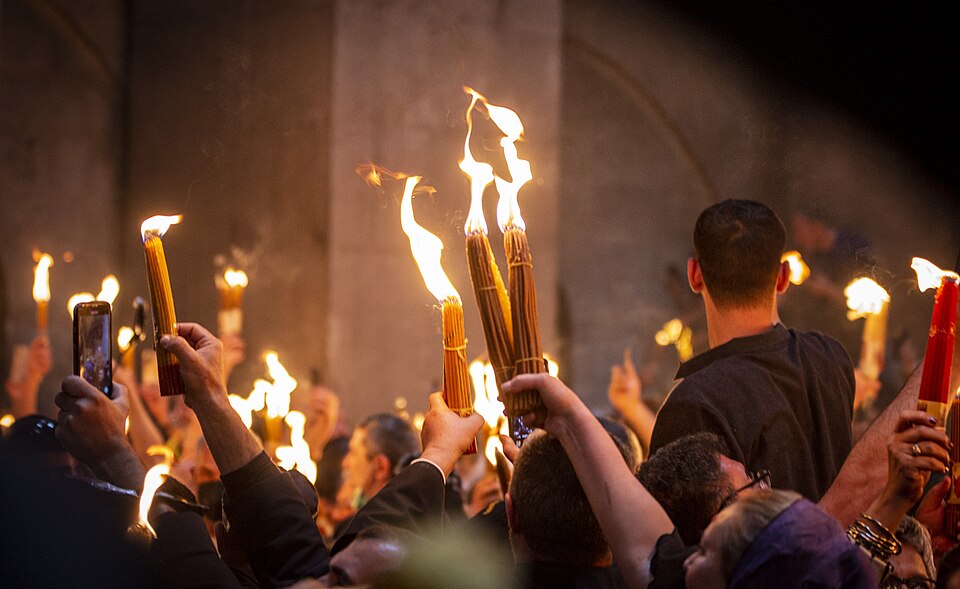
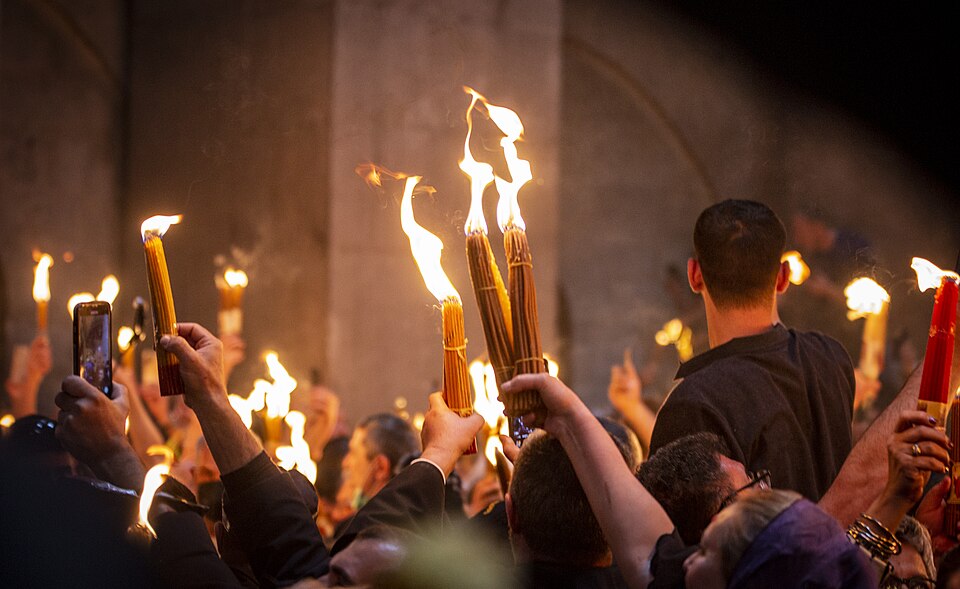
(ID 9193640 | Holy Fire © Greggr | Dreamstime.com)
✠ ✠ ✠
The Parallel Polemic We Don’t Usually Hear: Kirakos’s Armenians
In order to “even-the-playing-field” in the claim that the Eastern Orthodox alone merit the Holy Fire and is a validator against everyone else, I would like to raise awareness to a history less heard. The Armenians have been here first. Seven centuries before Parthenius, a thirteenth-century Armenian historian named Kirakos Gandzakets’i was writing a Holy Fire miracle story—and in his version, the Holy Fire vindicates the Armenians against the Greeks.
Kirakos was a Benedictine-like figure of Armenian church life. Born around 1200 near the Caucasus, educated at the monastery of Getik, taken briefly captive by Mongols (during which he learned some Mongolian), survivor, chronicler, he wrote a sweeping History of the Armenians in the middle decades of the thirteenth century. The work covers church history, political history, Mongol affairs. Its treatment of the Holy Fire is striking.
The story as Kirakos tells it concerns a late-twelfth-century dispute between the Armenians and their Georgian and Greek neighbors over the correct calculation of Easter. Under Queen T’amar of Georgia, the three sides agreed to submit the matter to God’s arbitration at the Holy Sepulchre. Envoys were sent. They watched. The Greeks, according to Kirakos, attempted to manipulate the outcome with a mechanical trick: they trained a white dove to descend into the water at the ceremony, creating the impression that the Holy Spirit had come—and the dove was then to certify their calculation. The trick was exposed. When the Armenian Catholicos Petros prayed, a river ran upstream; a great light rose and dimmed the rays of the sun. The Armenian calculation was vindicated. The Greeks, Kirakos writes with satisfaction, were derided and jeered at in all the Muslim-ruled cities. “And the true faith of the Armenians was strengthened further.”
Read that passage next to Parthenius’s passage about the Greeks and the Armenians, and tell me what you see.
You see the same narrative structure, the same rhetorical moves, the same punchline in the mouth of the opposite party. In Kirakos, the Greeks are the scheming rivals, the deceivers with their trained dove, the humiliated losers; in Parthenius, the Armenians are the scheming rivals with their bribery, and the humiliated losers. In both, the Holy Fire is the divine judge. In both, the narrator’s own people are the party vindicated. In both, the losing party is depicted as crude, deceitful, grasping.
Here is a plain observation: when your “my confession was vindicated by a miracle at the Holy Sepulchre” narrative has an exact mirror-image on the other side of the aisle, the genre itself is visible. Miracle-competition stories at shared holy places are a genre, and the genre is older and more widespread than any of the specific disputes it has been mobilized to adjudicate. The Latin Crusaders had their version of this genre; the Georgians had a version; the Copts have had versions. The Holy Sepulchre is a kind of mirror for each confession’s self-understanding, and in the mirror each confession sees itself vindicated. This does not mean the miracle is not real. It does mean that the miracle does not say what the confessional polemic wants it to say.
I want to dwell on this. If, as an Eastern Orthodox believer, one should one be comfortable dismissing Kirakos’s story as Armenian propaganda (trained dove? river running upstream?), they should then themselves whether the Armenian reader of Parthenius’s version reacts the same way to my their own account—and whether the Armenian reader is wrong to do so. If I do not accept Kirakos’s evidence as proof that the Armenian Church is the one true church, why do I expect anyone else to accept Parthenius’s? The evidentiary status of the miracle narratives is symmetrical. If I use mine as a club, I am—by the logic of my own position—licensing Kirakos’s grandchildren to use his as a club against me.
There is a way out of this, and the way out is not skepticism about miracles. The way out is humility about the interpretation of miracles. The Holy Fire is a real paschal phenomenon in Jerusalem. What it means is that Christ is risen—and that the Tomb is empty, and that the Light has come into the world, and that anyone who has eyes to see may see. What it does not mean, I think, is that any single confessional community owns the Resurrection. The Resurrection is owned by the Risen One, and he has shared his Light unstintingly. It falls on Greeks and Armenians and Copts and Latins alike—and, on at least one Holy Saturday, on a Muslim emir.
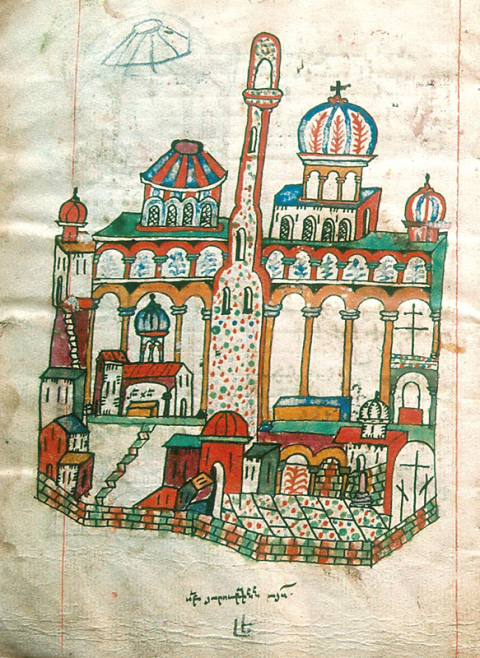
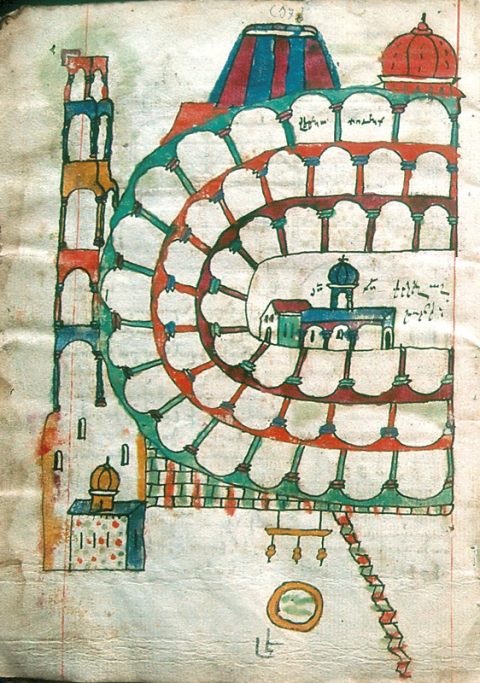
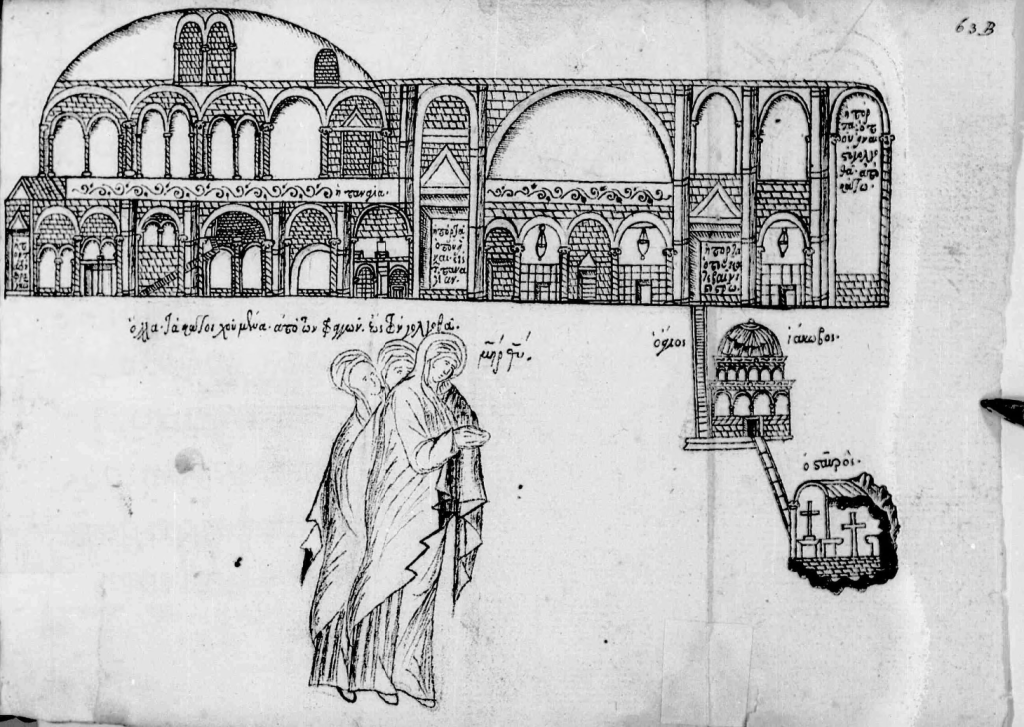
Illuminated Armenian manuscript depicting the Holy Sepulchre, from a late-seventeeth-century manuscript.
✠ ✠ ✠
The Deeper Wound: The “Armenian” As a Slur
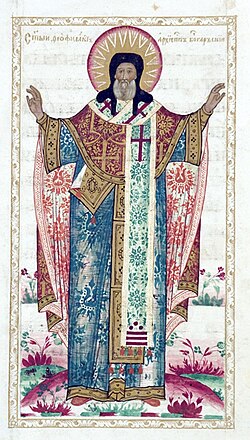
There is a habit in older Byzantine theological literature that I need to name because it shapes how many Eastern Orthodox still hear the word “Armenian” today. The habit is this: in anti-heretical writings, “Armenian” is used as shorthand for miaphysite or monophysite heretic. The ethnic term collapses into a doctrinal category. When a Byzantine author in the eleventh or twelfth century writes against “the Armenians,” he often means not “the people of Armenia” but “those who disagree with the Council of Chalcedon,” where the two categories are treated as identical.
We see this habit in a saint whom many of us love: Theophylact, Archbishop of Ohrid (died around 1107). Theophylact is a tremendous figure in Orthodoxy. His commentary on the four Gospels, on Acts, on the Epistles, is one of the finest patristic-style exegetical works after Saint John Chrysostom—Saint Nikolai Velimirović called it precisely that. His explanation of the Beatitudes has fed Orthodox catechesis for nine hundred years. He is commemorated on December 31. I own a copy of his Matthew commentary and I have been blessed by it.
And Theophylact, in his polemical writings and his letters, treats “the Armenians” as a category of error to be refuted. He is not alone in this. Euthymius Zigabenus, writing his Panoplia Dogmatica for Alexios I Komnenos around 1110, devotes a full section of his heresiological compendium to Armenian errors, in which doctrine, ritual, and ethnicity are blurred together. Byzantine anti-heretical canons and liturgical texts through the medieval period adopt similar language. The rhetorical effect is to make “Armenian” function as a slur—a way of dismissing a theological position by labeling it ethnically.
I want to say this carefully, because Theophylact is a saint venerated on December 31. But a saint’s holiness does not make every sentence he wrote infallible, and a saint’s polemics against those outside his own community are among the places where we are most obligated to read him with discernment. Theophylact wrote in the eleventh century, in a Byzantine world that had just suffered the 1054 breach with Rome, the encroachments of the Normans, the rise of the Seljuks, and an increasing sense that Orthodox Byzantium was theologically besieged. His anti-Armenian rhetoric has a historical context. That context does not obligate us, twelve centuries later, to perpetuate the category.
Real Armenians are not what the polemical category says they are. The Armenian Church has, since the sixth century, consistently and explicitly condemned the teaching of Eutyches—the actual monophysite heresy, the teaching that Christ’s human nature was absorbed into his divine nature. What the Armenian Church affirms is Cyril of Alexandria’s formula mia physis tou Theou Logou sesarkōmenē—”one incarnate nature of God the Word” — a formula which, rightly understood, is also the Christological teaching of the Eastern Orthodox Church. Saint Cyril is a saint in both families. Saint Cyril gave us this formula. The differences between us, as we will see in the next sections, turn out to be largely about how we supplement Cyril’s formula—whether with the language of Chalcedon (“in two natures”) or with the Cyrillian mia physis alone.
This means that when the Eastern Orthodox call the Armenian Church “monophysite,” they are using a word the Armenians themselves emphatically reject, because it describes a heresy they too condemn. His Holiness Aram I, Catholicos of the Great House of Cilicia, said recently in Athens: “We are not monophysites. It is not merely my claim—history confirms it. ‘One nature’ is heresy. The dual, united nature is Orthodoxy. Our theology is rooted in our shared apostolic foundation. Our interpretation is Orthodox.” This is a Catholicos of the Armenian Apostolic Church rejecting, in our capital city, the label our own polemics have placed on his church.
The more accurate term is miaphysite—”one (united) nature”—which emphasizes that in Christ the divine and human are united without confusion, a very different claim from Eutyches’ fused-and-absorbed single nature. The Oriental Orthodox churches (Armenian, Coptic, Ethiopian, Eritrean, Syriac, Malankara Indian) are miaphysite in precisely this Cyrillian sense. To call them monophysite is, at best, careless; at worst, it is a slur. And when we hear it in polemical Byzantine literature, we should recognize the slur for what it is, even when the sainted author used it.
I want to underline something that might seem obvious but is worth saying. I am not asking any Eastern Orthodox reader to stop loving Saint Theophylact. I am not asking anyone to strike him from the calendar. I am asking us to love him the way we love any beloved elder—fully, gratefully, with eyes open to the fact that elders are finite men shaped by their times, and that a saint’s polemic is not the saint’s halo. We do the same with ourselves and our own family: we cherish our grandfather and we do not repeat the 1962 joke that now lands as a cruelty. Love holds both truth and tenderness.
✠ ✠ ✠
The Armenian’s Weren’t at Chalcedon–Because they Were Witnessing
Let me tell you a story that almost every Orthodox Christian has been told wrong.
Most were taught that the Council of Chalcedon in 451 AD defined the orthodox Christological faith; that the majority of bishops of the Christian world accepted it; and that a stubborn minority—the monophysites of Egypt, Syria, and Armenia—rejected it out of parochial nationalism, or misunderstanding, or heresy. Over time this minority hardened into the “non-Chalcedonian” churches we know today, while the majority of the One Holy Catholic and Apostolic Church continued under the name of Orthodoxy (and, in the West, Rome). The Armenians, in this picture, said “no” to Chalcedon, and the “no” was either theological error or tribal pride.
It is not that simple. Let me share the piece of the story I think gets omitted from Orthodox catechesis too often.
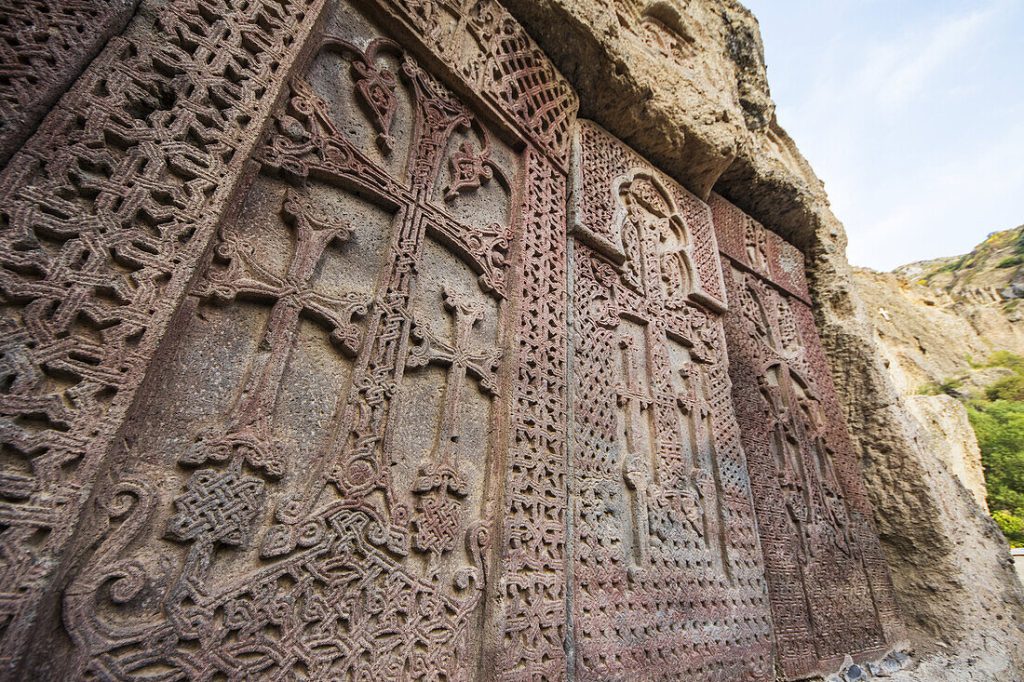
On May 26, 451, the Armenian army—led by Vardan Mamikonian, later canonized as Saint Vardan—fought the Battle of Avarayr against the vastly larger forces of the Sassanid Persian Empire. The Persian emperor, Yazdegerd II, had demanded that Armenia abandon Christianity and return to Zoroastrianism. Armenia refused. The Armenians went into the field knowing they would lose; they fought anyway, because they would rather die as Christians than live as Zoroastrians. Saint Vardan fell on the field. So did most of his officers. The battle was the greatest national trauma of early Armenian history, and it is commemorated to this day—the Feast of Saint Vardan is one of the great days of the Armenian calendar.
The Council of Chalcedon opened on October 8, 451—four and a half months after Avarayr. While Emperor Marcian presided at Chalcedon, Armenia was burying its dead.
Think about what that means. Think about what you would have done if your father or your brother had died at Avarayr in May and an invitation arrived from Constantinople in September to send bishops to a theological council in the Byzantine heartland—in a language many of your bishops could not read, about a subtle distinction of Christological formula written in Greek philosophical categories, to be received by a Persian-occupied territory still reeling from a massacre. The Armenian bishops did not attend Chalcedon because Armenia was otherwise engaged. It was not a schism; it was an absence.
More than that: the Armenian alphabet itself had been invented only about forty-six years before Chalcedon, by Saint Mesrop Mashtots around 405 AD. Forty-six years is about the span between 1980 and today. The Armenian Church in 451 was still in the first generation of having a written theological vocabulary in its own language. The decrees of Chalcedon had to be translated into Armenian before they could even be read by Armenian bishops. By the time the translation was done, and by the time the theological debates could be assessed, the political situation had shifted: the Armenians were under Sassanid suzerainty, not Byzantine; the Byzantine emperor had issued Zeno’s Henotikon (482), which bypassed Chalcedon in favor of the first three Councils alone; and the Armenian Church, meeting at Dvin in 506 under Catholicos Babgen I, accepted the Henotikon—a document that maintained communion with a Byzantine imperial position that had itself stepped back from Chalcedon.
In other words: when the Armenians first formally decided on Chalcedon, in 506, they accepted the position then held by Constantinople itself. The schism, such as it was, came later. The Second Council of Dvin (usually dated 554 or 555) firmly rejected Chalcedon under the pressure of the Persian-backed Zoroastrian authorities who preferred Armenian theological distance from the Christian Byzantine emperor. The Third Synod of Dvin (c. 607–610) cemented the break, particularly from the Georgian Chalcedonian church.
None of this history excuses either side’s subsequent behavior. I am not trying to say “the Armenians were innocent victims who can never have been wrong about anything.” Theology is serious; formulations matter; the Fourth Ecumenical Council is not a trivial thing to reject. What I am trying to say is that the conditions under which Chalcedon arrived in Armenia were conditions of exhausting trauma, linguistic newness, and political entrapment between two empires. If you imagine a different timeline—Avarayr never happens, Armenia is at peace, Armenian bishops arrive at Chalcedon, perhaps one of them offers the same formula we now call Cyrillian without opposition — the history of the Christian East would be unrecognizable. The Armenian “no” is less the no of a stubborn heretic and more the no of a wounded younger sibling who felt he had not been asked.
The theological content of the Armenian position, once we get beneath the polemical caricatures, is recognizably Cyrillian. The Armenians follow Saint Cyril’s formula mia physis tou Theou Logou sesarkōmenē. They condemn Eutyches. They affirm that Christ is fully and consubstantially God and fully and consubstantially Man. They hold, as do the other Oriental Orthodox churches, that “one incarnate nature” expresses the unity of Christ’s Person more strongly than the Chalcedonian “in two natures”—which they worry (wrongly, as they themselves have come to accept) can be read in a Nestorian direction, separating Christ into two subjects. The Chalcedonians hold (correctly) that “in two natures” safeguards the reality of Christ’s humanity and divinity against an Eutychian absorption. For sixteen centuries, each side has charged the other with tending toward the heresy its own formula was designed to avoid.
It turns out, on careful examination by the most qualified contemporary theologians from both sides—to which we will come—that neither side’s charge is correct. We have been talking past each other, in different Greek, Syriac, Armenian, and Coptic theological vocabularies, about the same Christ. Nerses Shnorhali saw this in 1166. The Joint Commission of the Theological Dialogue saw it in 1989. And we, today, after so many centuries of wound and weariness, have a chance to see it too.
✠ ✠ ✠
St. Nerses the Gracious: the Reconciliation that Almost Was
If the story of 1579 is where the wound was deepened, the story of 1166 is where it was almost healed.
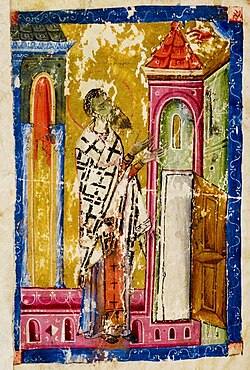
Saint Nerses IV, called Shnorhali—”the Gracious,” “the Filled-with-Grace” — was the Catholicos of All Armenians from 1166 until his death in 1173. He was, by every account that has come down to us, one of the most luminous personalities of the Christian twelfth century. He was born in 1102 into the noble Pahlavuni family in Cilicia; his great-grandfather was the polymath Grigor Magistros; his brother Gregory III was Catholicos before him; he was educated by the monk Stepanos Manouk in the Red Monastery of Shughr. He was a poet. He composed nearly twelve hundred hymns, troparia, and sharakans, many of which are still sung in the Armenian liturgy every week. He was a theologian, a musician, a letter-writer. He is venerated as a saint by the Armenian Apostolic Church—which celebrates him in October, on the Saturday of Advent—and also by the Catholic Church, which keeps his feast on August 13, the day of his falling asleep. Pope John Paul II called him “the Catholicos who combined an extraordinary love for his people and its tradition with far-sighted openness to other Churches in an exemplary effort to seek communion in full unity.”
Here is what he did that matters for our story.
In the 1160s, as he traveled through Cilicia to mediate an Armenian conflict, Nerses stopped at the Byzantine frontier town of Mamistra. There he met the Byzantine governor Alexios Axouch. Over several conversations they discussed the strained relations between the Armenian and Greek churches—relations which had actually hardened in 1140, when the Orthodox Synod in Constantinople had formally declared the Armenian and Syrian Jacobite churches heretical. Axouch was so impressed by Nerses’s theological clarity and his spirit that he urged him to write a formal exposition of Armenian belief that could be taken back to the Emperor Manuel I Komnenos in Constantinople.
Nerses did. The result is his Exposition of the Faith of the Church of Armenia, composed in 1166 at imperial request. It is one of the most remarkable ecumenical documents of the Middle Ages. In it, Nerses lays out the Armenian Christological tradition in language drawn almost entirely from Saint Cyril of Alexandria—whom both churches venerate as their common father. He emphasizes the common acceptance of the first three ecumenical councils, the common condemnation of Nestorianism and of Eutyches, the common confession of Christ as fully God and fully man. And then—this is the part I find almost holy—Nerses declines to polemicize against Chalcedon. He does not affirm it. He does not deny it. He simply writes as if the theological issue at stake can be addressed on the common ground of Cyril, and leaves to a later moment the question of whether the specific language of Leo’s Tome and Chalcedon’s definition is an acceptable articulation of that common faith.
This is a deliberate, difficult, astonishing choice. In the heat of the twelfth century, with both sides already hardened into a tradition of mutual anathemas, Nerses chose to ask: what if the fight has been about words over which we have more agreement than we realized?
On his return from mediation, his brother Gregory III having died, Nerses became Catholicos. As Catholicos—now with real authority to commit the Armenian Church to negotiation—he convened a council in 1171 at the Armenian seat of Hromkla, to which Manuel I sent theological emissaries. The conversations were serious, sustained, and, at the level of the heart, successful. The two sides drew closer than they had been in seven hundred years.
The reunion did not happen. The emperor’s formal conditions included matters the Armenian Synod could not accept—specifically, full acceptance of the Tome of Leo and of the Council of Chalcedon as ecumenical, and acceptance of the Byzantine patriarchal jurisdiction in ways that would have subordinated the Armenian Catholicosate. Nerses himself was willing to move very far toward the Greek position. His synod was not. Nerses died on August 13, 1173, and was buried in the fortress of Hromkla. Within a generation, the Armenian Church had reaffirmed its traditional stance.
But Nerses’s work was not wasted. His writings remained. His spirit was inherited by his nephew and pupil, Saint Nerses of Lambron (1153–1198)—the “Lambronatsi”—who continued ecumenical work in even more intensive form, drawing close also to Rome. Nerses of Lambron’s position was repudiated by an Armenian synod after his death, but his writings, too, remained. The Armenian Church is large and old and contains multitudes; figures like Mkhitar Gosh and Catholicos Magakia Ormanyan, and in our own time Catholicos Aram I of Cilicia and Catholicos Karekin II of Etchmiadzin, have kept alive the irenic current that flows from Nerses Shnorhali through the centuries.
I want to say something that might sound strange to some readers. When we stand at the Paschal liturgy and hear us sing “Christ is risen from the dead, trampling down death by death, and upon those in the tombs bestowing life,” we might ought to think of Nerses. We ought to think of him not because he is Orthodox in our narrow sense—he is, as far as we have formally defined the question, a Catholicos of a church with which we are not yet in full communion—but because he was, in 1166, already living the theology the Chambésy Commission would finally put on paper in 1989. He saw that the fight was largely about formulas and that the substance underneath the formulas was the same risen Christ. He saw it eight hundred years early.
If a saint of the Armenian Church saw it eight hundred years ago, and if Eastern and Oriental Orthodox theologians have now formally agreed that he was right, on what ground can we—the laity, the pewsitters, the parishioners—continue to repeat in our devotional literature the language of the nineteenth century that treats the Armenians as rival heretics? Nerses’s question has become our question. The reunion he sought is a work our generation may finish.
What Chambésy Actually Settled
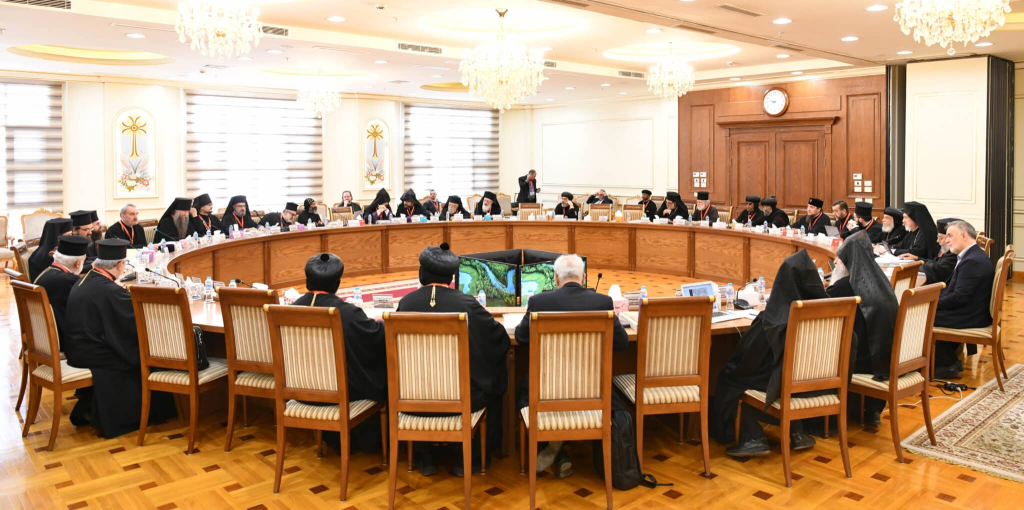
In September 1990, in a small town on the outskirts of Geneva, Switzerland, the Orthodox Center of the Ecumenical Patriarchate hosted the second meeting of what is formally called the Joint Commission of the Theological Dialogue Between the Orthodox Church and the Oriental Orthodox Churches. Thirty-four bishops and theologians from churches in Cyprus, Czechoslovakia, Egypt, Ethiopia, Finland, Greece, Lebanon, Poland, Switzerland, Syria, the United Kingdom, the United States, the Soviet Union (Russian, Georgian, and Armenian representatives), and Yugoslavia gathered under the chairmanship of Metropolitan Damaskinos of Switzerland.
They built on the First Agreed Statement, adopted the previous year at the Anba Bishoy Monastery in Egypt, where Pope Shenouda III had welcomed the delegation. They worked through conciliar history, terminology, the Seven Councils versus the Three Councils, the language of “two natures” versus “one nature of the incarnate Word,” the specific fathers each side venerated and the other anathematized. And at the end of their work, they issued a document — the Second Agreed Statement—that I would urge every Orthodox reader to read in its entirety.
Let me give you the heart of it, in substance rather than verbatim, because the document is short and its language is precise.
The Commission found, first, that both families of churches unanimously condemn the Eutychian heresy — the actual monophysite heresy, the view that Christ’s humanity was absorbed into or confused with his divinity. Both families reject this. There has never been a Christian eucharist offered in the Armenian Church that was offered to a fused Christ. There has never been a Coptic liturgy to a divinity that swallowed up a humanity. The heresy Chalcedon was called to condemn is a heresy all of us condemn.
The Commission found, second, that the Oriental Orthodox use of the Cyrillian formula “one nature of the incarnate Word” (mia physis tou Theou Logou sesarkōmenē) is orthodox when — and it always has been — it acknowledges the “double consubstantiality” of Christ, that is, that Christ is consubstantial with the Father according to divinity and consubstantial with us according to humanity. The Oriental Orthodox confess this double consubstantiality; Eutyches denied it; therefore the Oriental Orthodox are not Eutychians, and their Cyrillian formula is orthodox.
The Commission found, third, that the Eastern Orthodox use of the Chalcedonian formula “in two natures” is orthodox when — and it always has been — the distinction between the two natures is held to be “in thought alone” (tē theōria monē), that is, a conceptual distinction that in no way divides the single, personal unity of Christ. Cyril of Alexandria himself used this language in his letters to John of Antioch, to Acacius of Melitene, to Eulogius, and to Succensus. The Eastern Orthodox confess the unity of Christ’s Person; therefore they are not Nestorians, and their Chalcedonian formula is orthodox.
The Commission found, fourth, that both families have always loyally maintained the same authentic Orthodox Christological faith and the unbroken continuity of the apostolic tradition, though they have used Christological terms in different ways. This is the key sentence. Read it again. Two families. Same faith. Same apostolic tradition. Different terms.
The Commission then proposed specific recommendations: that the Eastern Orthodox lift the anathemas against Oriental Orthodox councils and fathers — Dioscorus of Alexandria, Severus of Antioch, Philoxenus of Mabbug, Jacob of Serugh, Timothy Aelurus, and others; and that the Oriental Orthodox lift the anathemas against Chalcedon, the Tome of Leo, and the later Councils not accepted by them. The manner of each lifting was to be determined by each church’s own synod.
This was in 1990. The ink on the Agreed Statement has now been dry for more than a generation.
I want to be honest about where this left us, because the blog post would be dishonest if I told you the story had a tidy ending.
First: the Chambésy Agreed Statements were received with enthusiasm by many. The Coptic Orthodox Church under Pope Shenouda III formally endorsed them. The Armenian Apostolic Church’s hierarchs, then and now — Karekin II of Etchmiadzin, Aram I of Cilicia — have consistently reaffirmed their substance. The Ecumenical Patriarchate endorsed them. So did the Church of Greece, the Patriarchates of Alexandria and Antioch, and a number of other Eastern Orthodox churches.
Second: the Agreed Statements were received with serious caution by others. The Holy Synod of the Russian Orthodox Church, in a 2006 statement, said the agreement required further clarification and that unilateral acts of communion were premature. The Sacred Community of Mount Athos issued a detailed memorandum raising concerns about specific formulations, particularly the handling of Severus of Antioch and the implied softening of the condemnations of earlier Ecumenical Councils. Some Orthodox theologians have worried that lifting anathemas pronounced by an ecumenical council would itself be an act beyond the authority of any subsequent commission or synod.
Third: even where the theological convergence has been accepted, the practical and canonical steps required for full restoration of communion have not been taken. Anathemas remain formally on the books. Intercommunion between the families is not regular. Jurisdictional overlap in the Middle East is unresolved. And in the years since 1990, some Oriental Orthodox hierarchs — Pope Shenouda III in his later years, for example — pulled back from the most optimistic early statements.
So: we are not yet in communion. I want to say this plainly, because I refuse to soften it. The reunion that Nerses Shnorhali sought is not yet accomplished. Any post that told you otherwise would be lying to you.
But: the theological obstacle, which for sixteen centuries seemed insurmountable, has been addressed. The Christological case against the Armenian Church that the Tounom hymn quietly implies — your Holy Fire never came because your faith is false — is a case that the senior theologians of both our families have now formally, repeatedly, and on the basis of the most careful Cyrillian analysis, denied. The Armenian faith is not false. The Armenian Holy Fire does descend. The Armenian altar at the Aedicule is not a false altar.
When we Orthodox read the Parthenius account today and nod along with its framing, we are repeating, in 2026, a polemic that our own theologians in 1990 officially identified as based on a terminological misunderstanding. We are, in effect, disagreeing with the Ecumenical Patriarch in order to agree with a nineteenth-century Russian monk.
That is a choice we are free to make. But let us make it with our eyes open.
✠ ✠ ✠
The Holy Sepulchre as a Classroom
Now let me take you back into the building.
If you walk into the Church of the Holy Sepulchre today—any day, not just Holy Saturday—you will find yourself in a physical diagram of the history we have been tracing. Six Christian communities share custody of the building: the Greek Orthodox Patriarchate of Jerusalem, the Roman Catholic Franciscan Custody of the Holy Land, the Armenian Apostolic Patriarchate of Jerusalem, the Coptic Orthodox Church, the Ethiopian Orthodox Tewahedo Church, and the Syriac Orthodox Church. Each holds specific rights in specific places at specific times. The arrangement is called the Status Quo.
The Status Quo is not a treaty. It is not a single document. It is a body of custom, frozen in place by Ottoman firmans—the decree of Sultan Osman III in 1757 being the first major codification, followed by the firman of Sultan Abdülmecid I in 1852, and a further firman in 1853. It was internationalized by Article 9 of the Treaty of Paris after the Crimean War (1856); the phrase “Status Quo” in international law first appeared in the Treaty of Berlin (1878). In 1929, a young British Mandate official named L. G. A. Cust produced the standard written description, The Status Quo in the Holy Places, though even his own superior attached the warning that its details were “not to be taken as necessarily having official authority.”
What this means in practice is that the Holy Sepulchre is governed by a system in which every stone, every lamp, every cornice, every hour of liturgical celebration is assigned by centuries of custom to one of the six communities. A chair in the wrong shade in 2002 led to a fistfight between Ethiopian and Coptic monks and sent eleven clergy to the hospital. In April 2008, a brawl broke out when a Greek monk was ejected by a rival faction during Palm Sunday services. In November of the same year, Greek and Armenian clergy clashed during the Feast of the Cross. The system is fragile in its particulars and almost absurdly robust in its general shape.
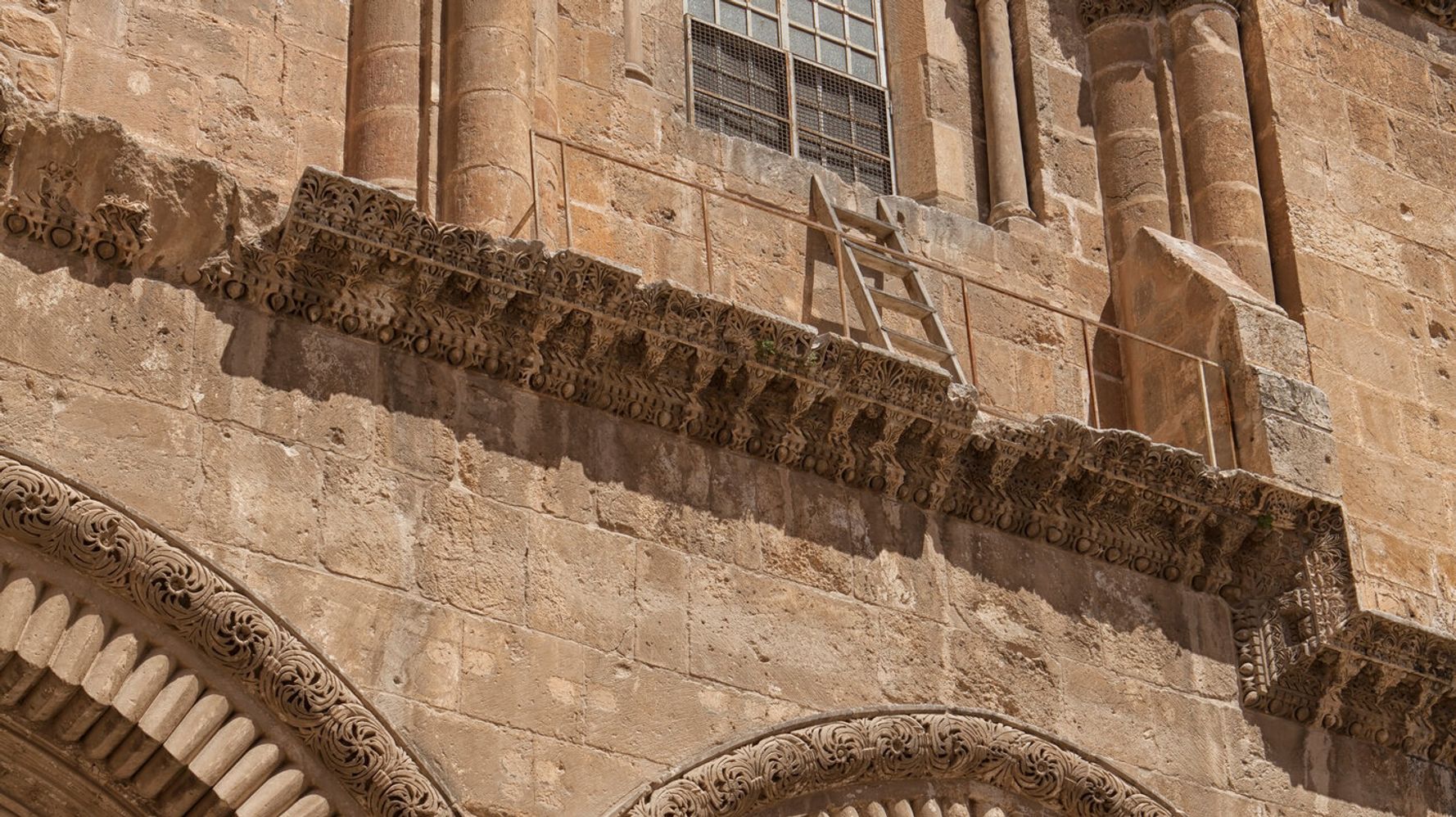
The most famous illustration of the Status Quo is the Immovable Ladder. If you look at a photograph of the façade of the Church of the Holy Sepulchre, you will see, leaning against the right-hand window on the second story—an area controlled by the Armenian Apostolic Church—a simple wooden ladder. It has been there since at least 1728, possibly earlier. When Sultan Abdul Hamid I issued a firman in 1757 freezing the state of the church “as it was,” the ladder was captured in the freeze. It has now stood there for nearly three centuries. No community may move it without the consent of all six. Periodically—in 1997, in 2009—it has been temporarily shifted by a workman or a mischievous interloper, and always returned. The ladder is sometimes called a scandal. I think it is more honestly called an icon.
An icon of what? An icon of the fact that we Christians, custodians of the holiest site in our religion, have not for nearly three hundred years been able to agree on so simple a thing as whether to move a ladder.
And yet. And yet.
Two other facts about the same building balance this one.
First: the key to the main door of the Church of the Holy Sepulchre has been held, since the early Crusader period—since roughly 1187—by two Muslim families, the Joudehs and the Nusseibehs. Every morning at dawn, a member of the Nusseibeh family arrives at the church, inserts the key, and opens the door. Every evening at dusk, he returns, and locks it. This arrangement persists because the six Christian communities could not, and cannot, trust each other with the key. A Muslim family has held it for eight and a half centuries because we needed someone else to lock our doors for us. There is an ecumenical theology to draw from that fact alone, and I will leave the drawing of it to you.
Second: in 2018, when the Israeli government proposed a bill allowing greater state taxation and expropriation of church lands, the three senior custodians— the Greek Orthodox Patriarch, the Armenian Patriarch, and the Franciscan Custo did something almost unheard of. They jointly closed the Church of the Holy Sepulchre. They locked it from the inside. The faces of the three hierarchs appeared side by side in photographs. They issued joint statements. For several days in February 2018, the holiest site in Christianity was shut—not against the government, exactly, but in solidarity across the ecclesiastical divide against a common threat. Pilgrims were sent away. Icons were veiled. The key stayed with the Nusseibehs, but the door did not open. When the bill was withdrawn, the three hierarchs opened the door together.
And then—the clearest sign of what can happen when we have to work together —between 2016 and 2017, the three communities that share custody of the Aedicule (the small kiosk over the actual tomb of Christ) agreed to a joint structural restoration of the shrine, led by the National Technical University of Athens under Professor Antonia Moropoulou. For the first time in more than five centuries, the marble slab covering the burial couch of Christ was lifted. The National Geographic Society documented the work. The engineers found what earlier sources described: the original burial bed, preserved beneath layers of marble added in Crusader and Ottoman times. Greek, Armenian, and Franciscan officials stood side by side during the opening. The restoration was completed on schedule. For once, we moved the ladder together.
This tells me something. The Holy Sepulchre is not only a monument to our divisions. It is also, quietly, a monument to the fact that we can still, when pressed, stand together. When the Israeli government threatened our common patrimony, we closed the doors together. When the Aedicule was in danger of structural collapse, we rebuilt it together. When the key is turned at dawn by a Muslim neighbor, we receive it together.
The Holy Sepulchre is a classroom. It teaches us, in stone and in ritual and in the small daily habits of men living in common rooms, that we are already one Church in the ways that matter most—we cannot even die of our divisions, because we must keep each other’s schedules, share each other’s scaffolding, honor each other’s Vigils. We are like a large quarrelsome family who, whatever else we think of each other, must meet at the same Easter table and cannot not be each other’s cousins. The Armenian Patriarch will be there. The Coptic Metropolitan will be there. The Syriac priest will be there. The Ethiopian Abuna will be there. The Franciscan Custos will be there. And the Greek Orthodox Patriarch will be there, lifting his candles.
If the Holy Fire is real—and I believe, on balance, that something miraculous happens in that room each Pascha—then it is real for all of them. That is an architectural fact. The building will not admit otherwise.

✠ ✠ ✠
Tonoum Himself: What Can We Say, What Can We Let Go?
We have spent a lot of time on the frame. Now let us come back, at last, to the face in the icon.
Who was Tounom?
The honest answer is: we do not know much. The oldest textual stratum—the 1608 account of the priest Ananias, preserved in the 1634 Munich codex— describes the miracle of the column but does not name the emir, and may not even include him. The figure enters the written record, under the name “Tounom” or “Tunom” or “Omir,” in the Vienna edition of 1749, a century and seventy years after his martyrdom. His name itself is unusual. “Omir” is clearly a Greek transliteration of the Arabic/Turkish title emir, meaning commander or governor. “Tounom” is harder to identify; it has been proposed to be a corruption of a Turkish or Arabic name now lost. Attempts to fit him to known Ottoman officers in the Jerusalem garrison of 1579 have not yielded a definite match in the Ottoman kadi sijill records surveyed so far.
What we can say—and what is important—is this.
It is entirely plausible that a Muslim officer witnessed the Paschal ceremony in 1579 and was moved, either by the ceremony itself or by the reports of what happened at the column, to confess Christ publicly. Under Ottoman law, public apostasy from Islam was punishable by death. A Muslim who confessed Christian faith in a public setting before witnesses, and who refused to recant, was liable to execution. Father Nomikos Michael Vaporis, in his authoritative Witnesses for Christ: Orthodox Christian Neomartyrs of the Ottoman Period, 1437–1860 (St. Vladimir’s Seminary Press, 2000), catalogues nearly two hundred such neomartyrs, including a number who were born Muslim and converted to Christianity—a category of martyrdom specifically recognized in Orthodox tradition. The sixteenth century produced, by Vaporis’s count, about twenty-five neomartyrs; the seventeenth, about forty-one; the eighteenth, fifty-seven; the nineteenth, sixty-six. The fact that a Muslim officer at the Holy Sepulchre in 1579 might have converted and died—that is not, in itself, implausible. It fits a documented pattern.
The extraordinary elements in the Tounom story—the leap that left footprints in the stone as though in soft wax, the sword thrust into rock, the fragrant bones—are the standard idioms of Orthodox hagiography, borrowed from a stock of saintly tropes that run through the tradition from the Greek synaxaria back to the Apocryphal Acts. They may reflect what pilgrims genuinely reported seeing (folk piety has a way of producing stone impressions at pilgrimage sites), or they may be part of the narrative shaping that all hagiography undergoes. A careful reader can hold both possibilities in mind.
What the 1845 Parthenius account adds—the bribery, the Armenian failure, the forced humiliation—is the polemical overlay. It is not about Tounom. It is about the Armenians. When we strip this overlay away, Tounom himself remains: a man of the dominant faith who, having entered the courtyard of the Christian holy place as a soldier of a triumphant empire, walked out as a convert to a persecuted church and lost his life for the confession.
Let me ask you to do a small meditation.
Imagine Tounom on the evening of Holy Saturday 1579, the day before his death. He is a Muslim. The Qur’anic account of Jesus, which he has held since boyhood, affirms the Messiah’s virgin birth, his miracles, his status as a great prophet, but denies his crucifixion and his divinity. He has spent his career in the service of a state that understands itself to be the instrument of Islamic truth. His privileges, his income, his social identity, his place in the next life as he has been taught it—all of these rest on the Islamic confession. To convert publicly is to lose all of them simultaneously: privilege, income, identity, eternity as he has been taught to expect it. It is also to adopt the faith of the subjugated population he has been assigned to police. Ottoman officers did not convert to the faith of their Christian subjects. It was structurally unthinkable.
And then something happens that makes it thinkable. Whatever actually occurred at the column—a lightning strike, a seismic crack, a miraculous flame, a powerful piece of communal ecstasy, some combination of all of these—it was enough, for him, to make his whole prior self come apart. And he chose, in the next hour, to take the consequences.
That is a real spiritual event, regardless of the exact physics of the column. What Tounom teaches us is not that the Greeks were vindicated against the Armenians. What Tounom teaches us is that at the Tomb of Christ, on the night of the Resurrection, even the guard at the gate can become a disciple. The Light that shines from that Tomb does not respect Ottoman ranks, or Christian millets, or the official map of religions. It looks for hearts, and it finds them, and when it finds them, the life they had before—privileged or not, secure or not, Muslim or Christian or Armenian or Greek—becomes dispensable.
This is why, I think, the Orthodox Arabs of Jordan sing, and dance, and leap around the Sepulchre. Not because the Armenians were humiliated. Not because the Greeks were vindicated. Because the Light does not belong to any of us. It is loaned to all of us. And it finds, on any given Pascha, whichever heart is open.
If I were writing a new icon of Saint Tounom—and I am not an iconographer, so this is offered in the humility of the layman—I would write him standing at the column, yes, with the flame. But I would not have him looking at the Greek Patriarch, in a way that separates Greeks from Armenians. I would have him looking at Christ in the tomb, with the Greek Patriarch on one side of him and the Armenian Catholicos on the other, their candles all lit by the same fire. I would write on the icon, in Greek and Armenian and Arabic: One is the true God, Jesus Christ. And I would leave off the continuation.
Because the continuation—one is the true faith, that of the Orthodox Christians—is not false, in our proper Orthodox confession. But it is a sentence we have sometimes said in a way that quietly excluded an entire communion of brothers and sisters who have also been glorifying that same Christ, often under longer and bloodier persecutions than our own. And Tounom, if he knew what the Armenian altar two hundred feet from the column had suffered since 1895, would not want his feast to be used that way.
✠ ✠ ✠
What the Polemical Frame Does to Our Souls
I want to spend a short section on something that rarely gets discussed in Orthodox reflection on inter-Orthodox disputes: the spiritual effect on us of telling certain stories in certain ways.
When we read the Parthenius version of the Tounom story in its fully developed anti-Armenian form—when we linger over the bribery, the Armenian failure inside the Edicule, the Turks’ rage at having been deceived, the forced humiliation—what happens inside us?
For the Eastern Orthodox, there is a small, quiet satisfaction. A tightening of the shoulders in the place where triumph lives. A sense of having been proven right. It is not quite schadenfreude; it is something slightly more refined than that. It is the pleasure of belonging to a church whose miracles have been verified against its rivals. It is the pleasure of being on the correct side of a cosmic adjudication.
For the Oriental Orthodox, there is a overwhelming sense of anger, dejection, and confusion. It only takes counter-readings of the atrocities of the Greeks against the Armenians to restore back that sense of confidence and validation that the Eastern Orthodox attempted to claim from them. It is the fighting of fire with fire, and the opposite of what Christ commands us to do.
I want to name these feelings clearly, because it is not the feeling Christ teaches us to have.
“Blessed are the peacemakers, for they shall be called sons of God… Therefore if you bring your gift to the altar, and there remember that your brother has something against you, leave your gift there before the altar, and go your way. First be reconciled to your brother, and then come and offer your gift. 25 Agree with your adversary quickly, while you are on the way with him, lest your adversary deliver you to the judge, the judge hand you over to the officer, and you be thrown into prison.”
—MATTHEW 5:9; 23-25 (NKJV)
The Lord tells a parable: “Two men went up to the temple to pray; the one a Pharisee, and the other a publican. The Pharisee stood and prayed thus with himself, God, I thank thee, that I am not as other men are, extortioners, unjust, adulterers, or even as this publican” (Luke 18:10-11). The Pharisee is not wrong about the facts. He is not an extortioner; he is not unjust; he fasts twice in the week; he gives tithes of all that he possesses. His objectively accurate self-description is not the problem. The problem is the tiny, decisive word even: or even as this publican. The problem is the comparison. The problem is what the Pharisee’s prayer, which includes a true description of his own piety, does to the publican standing in the corner of the temple.
I fear that something very similar happens when we pray liturgies that congratulate us on having received the Holy Fire that our brethren did not. I am not saying we should not celebrate the miracle; I am saying we should be careful of the pleasure of other people’s exclusion. There is a way to celebrate the Light that draws everyone toward it. There is a way to celebrate it that makes ourselves the center of the story. The two ways feel almost identical in the mouth. But their effect on the soul is entirely different. One produces what our tradition calls agape, the love that rejoices in the truth. The other produces what the Fathers call filavtia, self-love—the quiet cultivation of spiritual privilege.
Saint Isaac the Syrian–who is, by the way, a father revered in both our families; his works have been read in Coptic, Ethiopian, Syriac, and Greek monasteries for fifteen centuries — writes on this with devastating clarity:
A man who rebukes someone for his sin before the set time is himself sick with the same sickness. For he who has been healed does not remember others’ sicknesses.
Read that again and sit with it. He who has been healed does not remember others’ sicknesses.
If the Holy Fire’s descent in 1579 was really a vindication of truth against error, the proper response would be what? Triumph over our brethren, or tears for them? What does Christ do, when confronted with those who have missed the point? He weeps over Jerusalem. He feeds the five thousand without asking their theology. He dies, on this very rock, for the wrong ones.
I do not think the genre of the vindicating miracle, in its polemical mode, has a substantial warrant in the Gospel. There are miracles in the Gospel, of course — the loaves and fishes, the walking on water, the raising of Lazarus. But they are never deployed to make one community feel smaller than another. They are deployed to reveal God. When we take a miracle—even a miracle we genuinely believe happened—and turn it into a way to make other Christians feel smaller, we have taken something the Gospel has given us and used it for a purpose the Gospel would not recognize.
I do not think the average Orthodox person who has loved the Tounom story has intended any of this. It is a beautiful story: the emir, the leap, the conversion, the martyrdom, the fragrant bones. What I am asking, today, after the feast and during Bright Week when the candles are still lit in our homes, is that we consider separating the saint from the frame. The saint is the Church’s. The frame is a gift of the nineteenth century that we are free to excuse ourselves from.
And here is what might happen if we decline it. When we stop reading the story as a story against the Armenians, we notice that the story is actually about God. It is about the Tomb. It is about a Muslim officer who was given the Resurrection and took it. It is about the fact that the Paschal Fire, whatever its natural or supernatural origin, has for centuries drawn people toward Christ from every direction—Greek and Armenian, Arab and Russian, Ethiopian and Turk. It is the story it was before we made it a weapon. It can be that story again.
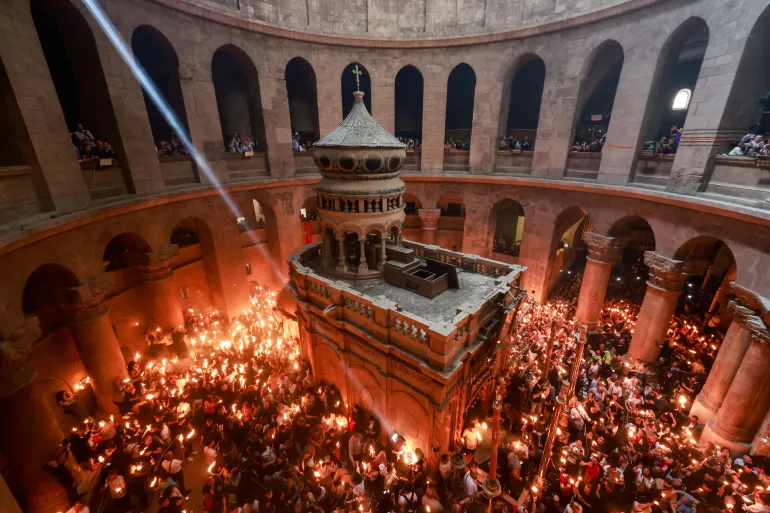
✠ ✠ ✠
What the Polemical Frame Does to Our Souls
A blog post is a strange medium for contemplation, so I want to do something a little unusual. I want to offer you a set of questions—questions I think a mature Orthodox reader, Eastern and Oriental, should be willing to sit with for a long time rather than answer quickly—and to ask you not to resolve them today. Take them to Vespers tonight. Take them to Matins tomorrow. Take them into the Paschal season that is still unfolding.
I have grouped them by theme. None of them has an obvious answer. Nor are these questions rhetorical or sarcastic. But we must be able to articulate them. That is the point.
ON MIRACLES AND THEIR USES:
- If a miracle genuinely occurred at the Holy Sepulchre in 1579, what does the miracle itself teach? Does it teach that Greeks are the true church and Armenians are not, or does it teach something about the presence of God at the Tomb of Christ that has implications quite apart from confessional adjudication? If the same miracle had occurred with the Armenian Patriarch standing outside the door, would we draw the opposite conclusion? What does our willingness or unwillingness to reverse the conclusion reveal about how we are really reading the miracle?
- When a miracle is used to produce shame in the defeated party—when Armenians are made to eat humiliation as they leave the church—is the resulting narrative one that Christ, who refused to call down legions of angels when he could have, would recognize as his own work?
ON TRADITIONS THAT GREW OVER TIME:
- Ought we to dismiss any current claims against the story as we hear it today because it violates preservation of tradition, even if Christians closer to the event itself heard it a different way? Is this relativism?
- Is there a difference between a tradition being composite — assembled over centuries, layered with polemical accretions — and a tradition being false? The tradition of the Theotokos’s Dormition is also composite, also grew over centuries, and we consider it holy. How do we distinguish accretion that deepens the truth from accretion that distorts it? What is the criterion?
- When we discover that a beloved element of a saint’s story entered the written record in the nineteenth century, are we obligated to jettison the saint? Or are we obligated, more modestly, to jettison the nineteenth-century element while keeping the saint? What would it mean to love Tounom without loving the Parthenius frame?
ON ARMENIANS:
- Have you ever actually had a sustained conversation with an Armenian Christian about their faith? If you have, what did you learn that no book of polemics had taught you? If you have not, what has prevented it? What would change if you did?
- If the Chambésy Agreed Statements had been composed by Saint Nerses Shnorhali and Emperor Manuel I Komnenos in 1170 — if the reunion had happened in the twelfth century — what would Orthodox devotion around the Tounom feast look like today? What would the hymn ascribed to Tounom, “Rejoice, for you drove out the error of the sons of Hagar,” look like if there had been no perceived “error” to drive out between us and our Armenian brethren?
ON OURSELVES:
- What would it cost you — spiritually, practically, socially in your parish — if the bishop announced tomorrow that the Armenian Apostolic Church had been restored to full communion and that an Armenian priest would be concelebrating with your priest next Sunday? What fear or pride does the answer to that question reveal in you? What is underneath the fear? What is underneath the pride?
- When you pray the Paschal liturgy and confess that Christ is risen, is your love of Orthodoxy mostly a love of Christ, or is it at least partly a love of being on the winning side of a confessional history? If the first, how does that love behave toward the Armenians today? If the second, what would repentance look like?
ON TONOUM SPECIFICALLY:
- Imagine Tounom on Holy Saturday, 1579, in the courtyard of the Anastasis. He is a Muslim officer with a sword at his side and nothing in the world to gain by converting. What would it have taken to make you cross that line in his place? Are we the kind of people Tounom’s story could recruit, or are we the kind of people Tounom’s story is about to recruit against?
- If Tounom, in the first hour of his new faith, had been asked to choose between the Greek Patriarch’s altar and the Armenian Patriarch’s altar, what do we actually think he would have chosen? Does our certainty about the answer come from the sources, or does it come from our own confessional habits? If we can conclude it would be the Armenian’s behavior that would have deterred him from the their faith, how does that apply to our inter-Orthodox conduct today?
ON TONOUM SPECIFICALLY:
- What does it mean to say with one accord — syndoxia, shared glorification — if we will not even edit our saints’ lives to be more charitable to our brethren? Can we call our Paschal cry “one is the true faith” without being honest that the Armenians and the Copts are also saying it, in their churches, to the same risen Christ?
- The Lord prays in John 17: that they all may be one. Does that prayer include the Armenians? Does it include the Copts? Does it include us, as we are? Or, does it have intonations of my own prideful victory and validation over the other, which I conflate with the Triumph of Orthodoxy? If it does, and if that prayer is in any sense binding on us, what do we owe, today, to the project of its fulfillment?
I do not have answers to most of these. I have some partial and hesitant answers to a few. I offer them, as a layman writing a blog for Eastern and Oriental Orthodox readers, in the hope that a community taking them seriously over a long time — months, years, a lifetime — is the kind of community that might actually, in some generation after ours, complete what Nerses began.
✠ ✠ ✠
An Honest Examination of the Remaining Disagreements
I have spent the last several thousand words arguing, in substance, that the anti-Armenian frame of the Tounom story does not hold up to source-critical scrutiny, that the Chambésy Agreed Statements have largely settled the Christological question at the level of official theological dialogue, and that ordinary Orthodox laypeople have warrant to stop repeating nineteenth-century polemics in their devotional reading. I want to be honest now about what that argument does not settle, and what remains genuinely difficult between our families.
First, the Councils. The Eastern Orthodox Church recognizes seven ecumenical councils. The Oriental Orthodox churches recognize three. Even with the Christological substance agreed upon at Chambésy, the status of Councils four through seven — Chalcedon (451), Constantinople II (553), Constantinople III (680–681), and Nicaea II (787) — remains a real point of difference. The Oriental Orthodox can accept most of the substance of Constantinople II (which reaffirmed Cyril), much of the substance of Constantinople III (on the two wills, though with some terminological hesitation), and virtually all of the substance of Nicaea II (on the veneration of icons, where the Oriental Orthodox have never disagreed). But “accepting the substance” is not quite the same as “receiving the council as ecumenical.” This is an unresolved ecclesiological question, not merely a theological one.
Second, the saints. Dioscorus of Alexandria and Severus of Antioch are anathematized by name in Eastern Orthodox canonical sources. They are honored as saints in the Oriental Orthodox calendars. Leo the Great is anathematized in some Oriental Orthodox sources. He is honored as a saint in the Western and Eastern calendars. Any future lifting of anathemas would have to address these specific questions — not simply as theological abstractions but as matters of calendar, of liturgy, of hymnography.
Third, the Filioque as it appears in Eastern-Oriental dialogue. This is not actually a disagreement between us; both families reject the Filioque in its Western scholastic form. But the handling of pneumatology, the procession of the Spirit, and the double procession as articulated in some Oriental sources has sometimes been a point of fine-grained discussion that has been tacked to make the chasm appear wider than it is.
Fourth, liturgical practices. The Armenian Church uses unleavened bread in the Eucharist and undiluted wine (without added water) in its traditional practice. The Eastern Orthodox use leavened bread and wine mixed with water. These are not salvific differences, but they are real differences in ritual practice that go back a very long time.
Fifth, jurisdictional overlap. In the Middle East, where both families have ancient presence, jurisdictional overlap is complicated by questions of millet history, Ottoman privileges, and modern nationalism. Reunion would require, at minimum, a clear settlement of which bishop serves which faithful in which territory — something the Eastern Orthodox communion has not even fully settled within itself (consider the overlapping jurisdictions of North America).
Sixth, reception in the laity. Even where hierarchs have signed agreements, the laity on both sides have not always been catechized. There are Orthodox parishes in the United States where the Armenians are still routinely described as monophysite heretics; there are Armenian parishes where Chalcedon is described with a rhetorical hostility that the Armenian Catholicos himself would not use. The work of receiving the theological dialogue is an educational work that has largely not been done.
I mention all of this so that my argument is not mistaken for a claim that the dialogue is finished. It is not finished. The joy of Chambésy is that the first and largest obstacle — the Christological charge of heresy — has been formally identified as a misunderstanding at the level of theological terminology. The sadness of Chambésy is that thirty-five years on, many of the practical and canonical next steps have not been taken.
Syndoxia, as a project, exists in this precise gap. Its mission is not to force a unity that cannot yet be forced. Its mission is to catechize both our communities, patiently, into the theological, liturgical, and historical understanding that would make unity — when the Holy Spirit allows it — coherent. That requires honesty about what has been settled and what has not, what has been agreed and what is still tender. I offer this section as part of that honesty.
✠ ✠ ✠
What Orthodox Laymen Can Do
None of this is the work of laypeople primarily. Reunion, anathema-lifting, jurisdictional settlement, conciliar reception — these are the work of bishops in synod and of the Holy Spirit over time. If you are a layperson, as I am, and you have read to this point, you may be wondering: what does any of this mean for me, practically, this week, this Bright Week?
I want to offer a few small, practical suggestions, with no claim to completeness.
Learn the other tradition. Read something by Saint Nerses Shnorhali. His I Confess with Faith (Hawatov Khostovanim), a sequence of twenty-four short prayers for each hour of the day and night, is available in English translation. It is extraordinary poetry and extraordinarily orthodox theology. Read Saint Gregory of Narek’s Book of Lamentations (the Narek); Pope Francis named him a Doctor of the Universal Church in 2015, and his ninety-five prayer-poems are among the deepest mystical writings of the Christian Middle Ages. Read Saint Ephrem the Syrian — we already do; he is honored in both of our calendars; he is a bridge. Read, if you can find them, the writings of Saint Isaac the Syrian, a seventh-century East Syriac father whose works have been read in Egyptian, Ethiopian, and Greek monasteries for a thousand years and whom no Orthodox would hesitate to call a father of the Church.
Visit the Other church on a feast day. You do not have to communicate. You are not required by current canonical discipline to do so. But attend. Watch. Pray with the congregation. Hear the Armenian sharakan sung. Watch the Byzantine deacon’s censing. Discover, firsthand, that what is happening in these liturgies is the same Eucharistic worship of the same risen Christ that happens in your own parish, in a different idiom.
Correct the polemical language in your own speech. When you hear someone call the Armenians monophysite, offer a gentle clarification: the Armenians themselves emphatically reject that term, condemn Eutyches, and follow the Cyrillian miaphysite tradition which is not a heresy. When you read the Parthenius version of the Tounom story, notice where the anti-Armenian framing has been added, and separate it in your own mind from the saint himself. When you pray the Paschal liturgy and hear the cry “one is the true faith, that of the Orthodox Christians,” understand it as we are teaching our children to understand our own tradition — not as an exclusion of the Armenians, but as a confession of the risen Lord.
Hold the both-and. There are real unresolved questions between us. You do not have to pretend they do not exist. But the resolved questions — the Christological substance, the apostolic faith, the shared sacramental life in its essentials — are a large and growing ground on which the work of dialogue is being done. Celebrate what has been accomplished. Mourn what has not. Pray for the bishops whose work this is. Do not yield to cynicism; do not yield to false enthusiasm.
Do not require unity to be all-or-nothing. You and I may not live to see full restored communion between the two families. It may come in our grandchildren’s time, or our great-grandchildren’s. But we can, today, love the Armenians and Copts with the charity Christ commands. We can, today, refuse to pass on prejudices we have inherited. We can, today, receive the Paschal Fire as a gift to all of Christ’s churches and not as a private possession of our own. Charity first, friendship second, let theology follow love as often as the reverse.
Read the Agreed Statements. They are short. They are clear. They are in English. They are online, on the websites of the Ecumenical Patriarchate and of the Coptic Orthodox Church. You will not regret the hour it takes you to read them. I would especially commend the Second Agreed Statement of 1990 and the Proposals for Lifting Anathemas of 1993. These are documents your own bishops have signed. They deserve your attention.
Pray for the Churches by name. In your morning and evening prayers, as you pray for the unity of the Church, name the Armenian Apostolic Church specifically. Name the Greek Orthodox Church. Making it concrete in your own prayer life is one of the most patient ways love works.
Prayer
O Christ our God, risen from the tomb on the third day, who at the courtyard of Your Sepulchre in Jerusalem didst pour forth Your Paschal Light upon men of every nation — who did receive the confession of the Emir Tounom, and his martyrdom with fire, and has given his bones a place of peace in the Convent of Your Mother, where they exhale Your fragrance to this hour:
Have mercy on us, who have sometimes told the story of Your Light in ways that darkened the faces of our brothers and sisters. Let the Light that fell on Tounom fall on every altar where Thou art lifted up and confessed. Teach us, O Master, not to use holy things for our own glorification, not to turn zeal into harshness, nor truth into a weapon against our brother. plant in us the mind of Your Gospel, to love our neighbor, to bless those who oppose us, to pray for those who misunderstand us, and to seek peace without betraying what is true.
Grant peace to Your Church, peace to the new Jerusalem, peace among Christians, peace between peoples, and peace in our homes and hearts. Heal the wounds of suspicion, memory, revenge, and division. Where there is hatred, sow charity; where there is rivalry, sow humility; where there is confusion, send the light of Your wisdom.
For You are our Peace, the Light of the World, the Resurrection and the Life, and the Lover of Mankind. Unto You do we send up glory, together with Your good Father, and Your all-holy, good, and life-creating Spirit, now and ever, and unto the ages of ages. Amen.
☦︎༺♰༻☦︎
For SYNDOXIA–a lay effort toward clarity, charity, and truth in the question of Eastern–Oriental Orthodox reconciliation.
References & Suggestions for Further Reading
Primary sources on the Holy Fire and the 1579 / 1634 Jerusalem event
- Ananias (Priest). Proskynitarion (1608). Extant in Codex Monacensis Graecus 346 (Munich, Bavarian State Library), copied 1634 by Akakios the Cretan. First printed: A. Papadopoulos-Kerameus, ed. Προσκυνητάριον τῆς Ἰερουσαλήμ καὶ τῶν Λοιπῶν Ἁγίων Τόπων, 1608–1634. With Russian translation by G. S. Destounis. St. Petersburg, 1890.
- Symeon, Archimandrite and Warden of the Holy Sepulchre. Προσκυνητάριον Ἁγίας Πόλεως Ἱερουσαλήμ. Vienna, 1749.
- Papadopoulos-Kerameus, A., ed. Διήγησις θαύματος περὶ τοῦ Ἁγίου Φωτὸς γεγονότος ἔτει 1634. In Pravoslavnyi Palestinskii Sbornik 13/2 (St. Petersburg, 1894), pp. 13–23.
- Sinai, Monastery of St. Catherine, Arabic MS 305 (copied December 8, 1634). Edited and translated in Treiger, Alexander. “An Arabic Account of the Miracle of the Holy Fire (1634).” Bible and Christian Antiquity English Supplement, no. 3 (23) (2024), pp. 88–129.
- Jerusalem, National Library, Arabic MS AP ar. 119 (1826–1831). Jerusalem recension of the Arabic 1634 account.
- Parthenius (Ageev), Monk. Skazanie o strannstvii i puteshestvii po Rossii, Moldavii, Turtsii i Svyatoi Zemle. 5 vols. Moscow, 1855 (vols. 1–4) and posthumously (vol. 5, serialized in Dushepoleznoe Chtenie, 1899–1901). English excerpt: “Holy Week and Pascha in Jerusalem.” Orthodox Life 34 (1984), 28–29.
Early and medieval sources on the Holy Fire
- Eusebius of Caesarea. Ecclesiastical History, VI.9 (the Narcissus account).
- Egeria. Itinerarium Egeriae (late 4th c.).
- Bernard the Monk (Bernardus Monachus). Itinerarium (c. 867).
- Arethas of Caesarea. Letter to the Emir of Damascus (early 10th c.).
- Al-Masʿūdī. Murūj al-Dhahab wa-Maʿādin al-Jawhar (10th c.).
- Ibn al-Qalānisī. Dhayl Taʾrīkh Dimashq (12th c.).
- Daniel the Russian (hegumen). The Life and Journey of Daniel, Hegumen of the Russian Land (1106–07).
- Kirakos Gandzakets’i. History of the Armenians (13th c.). English translation by Robert Bedrosian, 1986, available at www.attalus.org/armenian/.
- Bar Hebraeus (Gregory Abū’l-Faraj). Chronicon Syriacum; Chronicon Ecclesiasticum.
- Evliya Çelebi. Seyahatname (17th c.)
Scholarly works on the Holy Fire
- Skarlakidis, Haris K. Holy Fire: The Miracle of the Light of the Resurrection at the Tomb of Christ. 3rd expanded ed. Athens: Elaia, 2019.
- Auxentios of Photiki (Bishop). The Paschal Fire in Jerusalem: A Study of the Rite of the Holy Fire in the Church of the Holy Sepulchre. Berkeley: St. John Chrysostom Press, 1993.
- Morris, Colin. The Sepulchre of Christ and the Medieval West: From the Beginning to 1600. Oxford: Oxford University Press, 2005.
- Lidov, Alexei. “The Holy Fire and Visual Constructs of Jerusalem, East and West.” In Visualizing Christian Religious Art and Architecture.
Jerusalem pilgrimage literature and Status Quo
- Cust, L. G. A. The Status Quo in the Holy Places. Jerusalem: H.M.S.O., 1929. Reprinted by the Israel Academy of Sciences and Humanities, 1980.
- Cohen, Raymond. Saving the Holy Sepulchre: How Rival Christians Came Together to Rescue their Holiest Shrine. Oxford: Oxford University Press, 2008.
- Cohen, Amnon. Economic Life in Ottoman Jerusalem. Cambridge: Cambridge University Press, 1989.
- Pahlitzsch, Johannes. Graeci und Suriani im Palästina der Kreuzfahrerzeit. Berlin: Duncker & Humblot, 2001.
- Peri, Oded. Christianity under Islam in Jerusalem: The Question of the Holy Sites in Early Ottoman Times. Leiden: Brill, 2001.
- Tarawneh, Fatima Salim. “The Ottoman Status Quo Regime and the Christian Sects in Jerusalem in the Late Nineteenth Century.” Advances in Social Sciences Research Journal 6/6 (2019), 177–183.
Armenian Church history and Christology
- Sarkissian, Karekin (Bishop, later Catholicos Karekin I). The Council of Chalcedon and the Armenian Church. London: SPCK, 1965; repr. New York: Armenian Church Prelacy, 1975.
- Garsoïan, Nina G. L’Église arménienne et le grand schisme d’Orient. Corpus Scriptorum Christianorum Orientalium 574. Louvain: Peeters, 1999.
- Thomson, Robert W. (trans.). Agathangelos: History of the Armenians. Albany: SUNY Press, 1976.
- Mahé, Annie and Jean-Pierre Mahé, eds. Saint Grégoire de Narek. Paris: Sources Chrétiennes, 2000.
- Nerses Shnorhali. I Confess with Faith (Hawatov Khostovanim). English translations available; see shnorhali.com for Armenian text with English parallel.
- Nerses Shnorhali. General Epistle (Yendhanragan Tught). English trans. by Fr. Arakel Aljalian.
- Terian, Abraham. Patriotism and Piety in Armenian Christianity: The Early Panegyrics on Saint Gregory. Crestwood, NY: St. Vladimir’s Seminary Press, 2005.
- Ormanyan, Malachia. The Church of Armenia: Her History, Doctrine, Rule, Discipline, Liturgy, Literature and Existing Condition. London: Mowbray, 1912.
Eastern/Oriental Orthodox dialogue
- Joint Commission of the Theological Dialogue Between the Orthodox Church and the Oriental Orthodox Churches. First Agreed Statement on Christology. Anba Bishoy Monastery, Wadi al-Natrun, Egypt, June 20–24, 1989.
- Joint Commission. Second Agreed Statement and Recommendations on Pastoral Issues. Chambésy, Geneva, September 23–28, 1990.
- Joint Commission. Proposals for Lifting Anathemas. Chambésy, November 1993.
- Meyendorff, John. Christ in Eastern Christian Thought. Crestwood, NY: St. Vladimir’s Seminary Press, 1975.
- Meyendorff, John. Imperial Unity and Christian Divisions: The Church 450–680 A.D. Crestwood, NY: St. Vladimir’s Seminary Press, 1989.
- Romanides, John S. “St. Cyril’s ‘One Physis or Hypostasis of God the Logos Incarnate’ and Chalcedon.” Greek Orthodox Theological Review 10 (1964–65).
- Samuel, V. C. The Council of Chalcedon Re-Examined. Madras: Senate of Serampore College, 1977.
- Torrance, Iain R. Christology after Chalcedon: Severus of Antioch and Sergius the Monophysite. Norwich: Canterbury Press, 1988.
- Karmiris, Ioannis. Dogmatic and Symbolic Monuments of the Orthodox Catholic Church. 2 vols. Athens, 1952–53 (in Greek).
Ottoman Jerusalem and the neomartyrs
- Vaporis, Nomikos Michael. Witnesses for Christ: Orthodox Christian Neomartyrs of the Ottoman Period, 1437–1860. Crestwood, NY: St. Vladimir’s Seminary Press, 2000.
- Constantelos, Demetrios J. “The ‘Neomartyrs’ as Evidence for Methods and Motives Leading to Conversion and Martyrdom in the Ottoman Empire.” Greek Orthodox Theological Review 23 (1978), 216–234.
- Gara, Eleni. “Neomartyr without a Message.” Archivum Ottomanicum 23 (2005–2006).
- Sariyannis, Marinos. “Aspects of ‘Neomartyrdom’: Religious Contacts, ‘Blasphemy,’ and ‘Calumny’ in 17th-Century Istanbul.” Archivum Ottomanicum 23 (2005–2006).
- Çolak, Hasan. The Orthodox Church in the Early Modern Middle East: Relations between the Ottoman Central Administration and the Patriarchates of Antioch, Jerusalem and Alexandria. Ankara: Türk Tarih Kurumu, 2015.
- Papademetriou, Tom. Render Unto the Sultan: Power, Authority, and the Greek Orthodox Church in the Early Ottoman Centuries. Oxford: Oxford University Press, 2015.
- Runciman, Steven. The Great Church in Captivity. Cambridge: Cambridge University Press, 1968.
Patristic sources relevant to the dialogue
- Cyril of Alexandria. On the Unity of Christ. Trans. John McGuckin. Crestwood, NY: St. Vladimir’s Seminary Press, 1995.
- Cyril of Alexandria. Select Letters (Ep. 4, Ep. 17, Ep. 39, Ep. 40, Ep. 45, Ep. 46, Ep. 55). Ed. Lionel Wickham. Oxford: Oxford University Press, 1983.
- Leo the Great, Pope. Tome to Flavian (449). In The Christological Controversy, ed. Richard A. Norris, Philadelphia: Fortress, 1980.
- Severus of Antioch. Orationes ad Nephalium; Contra Impium Grammaticum. Ed. Joseph Lebon, CSCO Syriac series.
- Severus of Antioch. Letters. Ed. E. W. Brooks. London: Williams & Norgate, 1903–04.
- Maximus the Confessor. On the Cosmic Mystery of Jesus Christ. Trans. Paul Blowers and Robert Louis Wilken. Crestwood, NY: St. Vladimir’s Seminary Press, 2003.
- John of Damascus. Expositio Fidei / On the Orthodox Faith. Trans. Frederic Chase. Washington, DC: Catholic University of America Press, 1958.
- Isaac the Syrian. The Ascetical Homilies. Trans. from the Greek by the Holy Transfiguration Monastery, Boston, 2011.
- Ephrem the Syrian. Hymns on Paradise. Trans. Sebastian Brock. Crestwood, NY: St. Vladimir’s Seminary Press, 1990.
Online resources
- Orthodox Joint Commission archives: orthodoxjointcommission.wordpress.com
- Armenian Church: armenianchurch.org (Etchmiadzin); armenianorthodoxchurch.org (Cilicia)
- Coptic Orthodox Church: copticorthodox.church
- The agreed statements, translated and annotated, at the official site of the Ecumenical Patriarchate’s Permanent Delegation to the WCC: ecupatria.org
- Fr. Alexander Treiger’s academic work: dal.academia.edu/AlexanderTreiger
- The Skarlakidis Holy Fire research materials: haryskarlakidis.gr
GLOSSARY:
Aedicule (also Edicule): The small shrine, or “little house,” inside the rotunda of the Church of the Holy Sepulchre, enclosing the tomb of Christ. From the Latin aedicula, diminutive of aedes, “house.” The current structure is a nineteenth-century reconstruction of an earlier Crusader shrine, with major restoration in 2016–17.
Akolouthia (ἀκολουθία): A liturgical service; specifically, the office prescribed for a saint or feast, including hymns, canons, readings, and rubrics. The Akolouthia of Saint Tounom — the service celebrating his feast — appears to be of eighteenth- or nineteenth-century composition.
Anastasis (Ἀνάστασις): “Resurrection.” The original Byzantine name for the Church of the Holy Sepulchre (ἡ Ἁγία Ἀνάστασις, “the Holy Resurrection”). The rotunda over Christ’s tomb is still called the Anastasis in Greek Orthodox usage.
Bright Week: The octave of Pascha, running from Pascha Sunday through the following Saturday. A period of liturgical rejoicing in which the normal fasting discipline is suspended and the Paschal services take precedence.
Catholicos (Καθολικός): The title of the primate of several ancient autocephalous Eastern churches, including the Armenian Apostolic Church (Catholicos of All Armenians), the Church of the East, and the Georgian Orthodox Church. The Armenian Church has two Catholicosates, the historic Mother See of Etchmiadzin and the Catholicosate of Cilicia.
Chalcedon, Council of: The Fourth Ecumenical Council of the Church, convoked by Emperor Marcian at Chalcedon (modern Kadıköy, Istanbul) in 451 AD. It confessed Christ as “one Person in two natures, without confusion, without change, without division, without separation.” Accepted by the Eastern Orthodox, Roman Catholic, and most Protestant communions. Rejected by the Oriental Orthodox churches, though the Chambésy dialogue has clarified that the rejection was about terminology, not about the substance of Christological faith.
Chambésy Dialogue: The series of theological meetings between Eastern and Oriental Orthodox churches, beginning informally in 1964 and formally as the Joint Commission in 1985. Major meetings produced the First Agreed Statement (Anba Bishoy, 1989), the Second Agreed Statement and Recommendations (Chambésy, 1990), and the Proposals for Lifting Anathemas (Chambésy, 1993).
Cyrillian Christology: The Christology of Saint Cyril of Alexandria (d. 444), expressed in his formula mia physis tou Theou Logou sesarkōmenē, “one nature of the Word of God made flesh.” Venerated by both Eastern and Oriental Orthodox traditions as common father. The Oriental Orthodox retain the exact formula; the Eastern Orthodox accept the formula but clarify it with the “two natures” language of Chalcedon.
Dyophysite: “Of two natures.” An adjective applied to Chalcedonian Christology. Often used by anti-Chalcedonians in a polemical sense to accuse Chalcedonians of crypto-Nestorianism.
Firman: An Ottoman imperial decree. Several firmans (1757, 1852, 1853) established and froze the Status Quo at the Holy Sepulchre.
Henotikon: A document issued by Byzantine Emperor Zeno in 482 AD attempting to reconcile Chalcedonians and non-Chalcedonians by reaffirming the first three councils without naming Chalcedon explicitly. Accepted by the Armenian Church at the First Council of Dvin (506).
Holy Fire (also Holy Light, Greek: Ἅγιον Φῶς; Arabic: Sabt al-Nūr): The fire that according to Eastern and Oriental Orthodox tradition descends annually at the Church of the Holy Sepulchre in Jerusalem on Holy Saturday, lighting the candle of the Greek Orthodox Patriarch inside the Aedicule. The ceremony is first clearly attested in the account of Bernard the Monk (867) and has been performed continuously since.
Hypostasis (ὑπόστασις): In Christological usage, the concrete, personal subject; the particular existence of Christ as one divine Person. Distinguished from physis (nature) and ousia (essence).
Immovable Ladder: A wooden ladder on the façade of the Church of the Holy Sepulchre, in place since at least 1728, whose presence is preserved under the Status Quo and has become an icon of the inability of the six custodial churches to agree on any change to the church, however minor.
Kollyvades Movement: An eighteenth-century movement of theological and liturgical renewal on Mount Athos, associated with Saints Nikodemos the Hagiorite, Makarios of Corinth, and Athanasios Parios, which produced the Philokalia, the Rudder (Pedalion), and the New Martyrologion.
Menologion (Μηνολόγιον): A liturgical book containing the lives of the saints for each day of the year, used in the divine services.
Miaphysite: “Of one united nature.” The proper term for the Christology of the Oriental Orthodox churches (Armenian, Coptic, Ethiopian, Eritrean, Syriac, Malankara). To be distinguished from monophysite, which implies Eutyches’s heresy that the Oriental Orthodox themselves condemn.
Monophysite: “Of one nature” in a heretical sense; the teaching of Eutyches (d. c. 456) that Christ’s human nature was absorbed into his divine nature. Condemned at Chalcedon. Frequently and inaccurately applied to the Oriental Orthodox churches, who emphatically reject the Eutychian teaching.
Neomartyr (Νεομάρτυς): “New martyr.” A term used in Orthodox tradition for those martyred after the fall of Constantinople in 1453, in the Ottoman period and beyond. Saint Tounom is a neomartyr by this definition.
Oriental Orthodox: The family of Eastern Christian churches that did not accept the Council of Chalcedon: the Armenian Apostolic Church, the Coptic Orthodox Church of Alexandria, the Ethiopian Orthodox Tewahedo Church, the Eritrean Orthodox Tewahedo Church, the Syriac Orthodox Church, and the Malankara Orthodox Syrian Church (India).
Ousia (οὐσία): Essence or being. In Trinitarian theology, the one shared essence of the three Persons of the Trinity. In Christology, that in which Christ is consubstantial with the Father (according to divinity) and with us (according to humanity).
Pascha (Πάσχα): Easter; the feast of the Resurrection of Christ. The central feast of the Christian year in both Eastern and Oriental Orthodox traditions.
Physis (φύσις): Nature. In Christology, the central term of the debate between Chalcedonians (who speak of two natures in Christ) and non-Chalcedonians (who speak of one united nature of the incarnate Word).
Proskynitarion (Προσκυνητάριον): A pilgrimage guidebook to the holy places of Jerusalem, genre of pilgrim literature that provided descriptions, devotions, and stories of miracles associated with the shrines. The earliest texts naming the cracked column miracle are proskynitaria.
Shnorhali: “Gracious,” “Filled with Grace.” The Armenian honorific applied most famously to Saint Nerses IV (1102–1173), Catholicos of All Armenians.
Status Quo: The customary system of rights, usages, and privileges regulating the six Christian communities that share the Church of the Holy Sepulchre. Rooted in Ottoman firmans (especially 1757 and 1852) and formally codified in the Treaty of Paris (1856) and the Treaty of Berlin (1878).
Synaxarion (Συναξάριον): The calendar of saints’ commemorations, with brief biographical entries, recited during the daily liturgical cycle. The Synaxarion for April 18 includes the commemoration of Saint Tounom.
Syndoxia (συνδοξία): “With one accord,” literally “with one glorification.” The name of this publication and its guiding principle: that the shared glorification of Christ is the existing ground on which the unity of Eastern and Oriental Orthodox rests, even as formal communion remains to be restored.
Tewahedo (ተዋሕዶ): Ge’ez word for “unity” or “made one,” used in the official names of the Ethiopian and Eritrean Orthodox churches to confess the unity of the divine and human in Christ.
Theotokos (Θεοτόκος): “God-Bearer,” “Birthgiver of God.” The title of the Virgin Mary solemnly affirmed at the Third Ecumenical Council of Ephesus (431), accepted by all Eastern, Oriental, and Catholic traditions.
Tounom: The name by which Eastern Orthodox tradition commemorates the Muslim emir allegedly converted at the Holy Fire in 1579 and martyred. Also attested as Tunom, Toumom, Tounoum, Omir. The precise Arabic or Turkish origin of the name has not been securely identified.
☦︎༺♰༻☦︎
Glory be to God forever. Amen.