About σύνδοξία
Syndoxia is a learning hub dedicated to reconciliatory studies between the Eastern Orthodox and Oriental Orthodox churches. It exists to explore, with seriousness and charity, the history, theology, memory, and practical questions surrounding one of the oldest and most painful divisions in Christian history.
At its heart, Syndoxia is about a hope: that Christians can pursue truth without polemics, unity without relativism, and history without distortion.
This is not a project of easy ecumenism, nor of inherited polemics. It is an effort to study division truthfully and to ask whether Christians long separated may yet speak, worship, and confess more faithfully with one accord.
“That together you may with one voice glorify the God and Father of our Lord Jesus Christ”
Syndoxia (σύνδοξία)
The name Syndoxia is drawn from the idea of being syndoxic: joined together in glory, praise, and confession.
It is formed from two Greek roots:
- σύν (syn-)—together, with, in common
- δοξία (doxa)—glory, praise, belief, confession
Taken together, the name points toward a vision of common glorification, shared confession, and ultimately unity in truth.
That meaning matters for this project. The division between the Eastern Orthodox and Oriental Orthodox churches is not only a historical dispute or a theological puzzle. It is also a rupture in common praise. Churches that share ancient apostolic roots, sacramental life, reverence for the Fathers, and devotion to Christ have spent centuries divided in faith, memory, and communion. The name Syndoxia expresses the desire to think seriously about that rupture and about what it would mean for Christians to be, once again, more truly “with one accord.”
Why This Work Matters
Much of the conversation around Eastern–Oriental relations tends to fall into one of two extremes.
On one side, the divide is flattened into a vague ecumenism, as though centuries of councils, anathemas, saints, and theological struggle were little more than misunderstandings that can be brushed aside. On the other side, the divide is often treated through inherited caricatures, slogans, or polemics that assume the worst of the other communion without serious study.
Syndoxia exists to resist both of those habits.
This site is not here to erase real doctrinal questions. Nor is it here to inflame old antagonisms. Its aim is to create a space for careful learning, historical clarity, theological seriousness, and reconciliatory reflection. That means asking difficult questions honestly:
- What does it mean to be Orthodox?
- Why did the Eastern and Oriental Orthodox churches split?
- Was the division purely theological, or also shaped by language, politics, and memory?
- Do the two communions still believe different things today?
- What would real movement toward reconciliation actually look like and entail?
- What can laypeople do now, even. before formal reconciliation is achieved?
- Is it wrong for desiring communion?
These are not abstract questions. They affect how Christians understand the Church, truth, holiness, communion, and one another.
Scripture, Unity, and Truth
The hope behind this project is not modern sentimentality. It is deeply Orthodox. Deeply Christian.
Our Lord prayed, “that they may all be one” (John 17:21).
The Apostles called the Church to be “of the same mind” and to “speak the same thing” (1 Corinthians 1:10; Philippians 2:2).
The early Church understood unity not as mere institutional peace, but as unity in truth, worship, and love.
This is why Christian unity can never be built on indifference to doctrine. But neither can doctrine be handled without humility, repentance, and charity.
Syndoxia begins from the conviction that truth and unity belong together.
What You’ll Find Here
Syndoxia brings together several kinds of work under one roof
Historical Inquiry
Posts that explore councils, controversies, important figures, and the development of the Eastern–Oriental divide over time.
Theological Explanation
Articles that seek to share and clarify Christology, ecclesiology, heresy, anathemas, conciliar reception, and other topics that are often discussed loosely or polemically.
Reconciliatory Reflection
Thoughtful pieces on what truthful reconciliation might require—not sentimental peace, but a considerations for communion rooted in truth, repentance, and doctrinal integrity.
Lay Formation
Accessible resources for readers who are not specialists, but who want to understand these issues beyond slogans, clips, and online apologetic battles.
Practical and Spiritual Questions
Reflections on how Christians can think, pray, speak, and act in ways that make serious reconciliation more possible.
News & Updates
A dedicated section tracking signs of real movement toward reconciliation, including official dialogues, local cooperation, statements, tensions, and unanswered questions.
The Spirit of the Project
Syndoxia is not written from the assumption that differences do not matter. They do. But neither is it written from the assumption that inherited division should simply be accepted as normal, inevitable, or beyond examination.
The spirit of this project is guided by a few convictions:
Faith matters.
“Hold fast the pattern of sound words which you have heard from me, in faith and love which are in Christ Jesus.”
2 Timothy 1:13
Christian reconciliation must begin with faithfulness to God, to the Gospel, and to the apostolic inheritance of the Church. Faith is not mere opinion or private conviction, but a lived trust expressed in right belief, right worship, and steadfast obedience to the truth handed down in the Orthodox Church. To speak of faith in this context is to speak of fidelity: holding fast to what has been received, even while seeking to understand one another more truthfully and carefully.
Faith means holding fast. It means preserving what is true, not loosening it for the sake of convenience, but also not confusing inherited slogans with the fullness of the faith itself. In the work of reconciliation, faith calls Christians to remain rooted, discerning, and obedient.
Hope matters.
“Endeavoring to keep the unity of the Spirit in the bond of peace.”
Ephesians 4:3
Hope makes it possible to face division without despair and to seek healing without illusion. It does not ignore real obstacles, but refuses to believe that history, misunderstanding, or estrangement have the final word over the work of God. Hope continues to labor, to pray, and to seek unity even when the path is long and the outcome is not yet visible.
“Endeavoring” means making the effort. It means trying, striving, and continuing the work rather than surrendering to apathy or cynicism. Hope, in this sense, is not passive optimism. It is the willingness to keep seeking, keep praying, and keep laboring for unity in truth, trusting that what is difficult is not therefore impossible before God.
Love matters.
“By this all will know that you are My disciples, if you have love for one another.”
John 13:35
Love is not the abandonment of truth, but the right way of bearing it. Any serious pursuit of reconciliation must be marked by charity, patience, honesty, and the refusal to treat one another with caricature, contempt, or indifference. Love does not flatten differences, but it does demand that even deep disagreement be carried in a way worthy of Christ.
Love means that truth must be spoken rightly. It means refusing both false peace and needless harshness. In the search for reconciliation, love calls Christians to speak honestly, listen carefully, correct fairly, and remember that the one across from them is not merely an opponent in argument, but a person made in the image of God.
Memory matters.
Division is sustained not only by doctrine, but also by memory: by the way communities remember councils, saints, injuries, and one another. Any honest path toward reconciliation must take inherited memory seriously, while also asking how memory may be purified by truth and charity.
Formation matters.
Lasting reconciliation requires more than strong opinions or good intentions. It depends upon minds formed by truth, hearts schooled in humility, and communities taught to think carefully, pray deeply, and speak responsibly.
Witness matters.
How Christians speak about one another shapes their witness before the world. Truth must never be sacrificed, but neither should disagreement be expressed through caricature, contempt, or carelessness.
Tradition matters.
The faith is handed down through the living tradition of the Church: in Scripture, worship, doctrine, councils, the fathers, and ecclesial memory. Any serious effort to understand division or seek reconciliation must reckon with that full inheritance.
Communion matters.
The Christian faith is not only about private belief, but about life in the one Body of Christ. Questions of division and reunion ultimately concern visible, sacramental, and ecclesial communion, not merely mutual respect from a distance.
Truth matters.
Reconciliation cannot rest on sentiment, diplomacy, or vague goodwill alone. It requires a shared commitment not only to what is true, but also to understanding one another accurately and representing one another truthfully.
A Note on the Name
It points toward common glory—Christians glorifying God together.
It also points toward common confession—Christians sharing the same faith.
That double meaning mirrors the deeper issue at the center of this site. The goal is not mere coexistence, nor simply a shared aesthetic admiration across traditions. The deeper question is whether Christians long divided might one day share both one faith and one worship more fully, truthfully, and visibly.
That is why the subtitle “on behalf of all and for all” fits the project so closely. It is not a slogan for easy unity. It is a hope for all disciplined by seriousness.
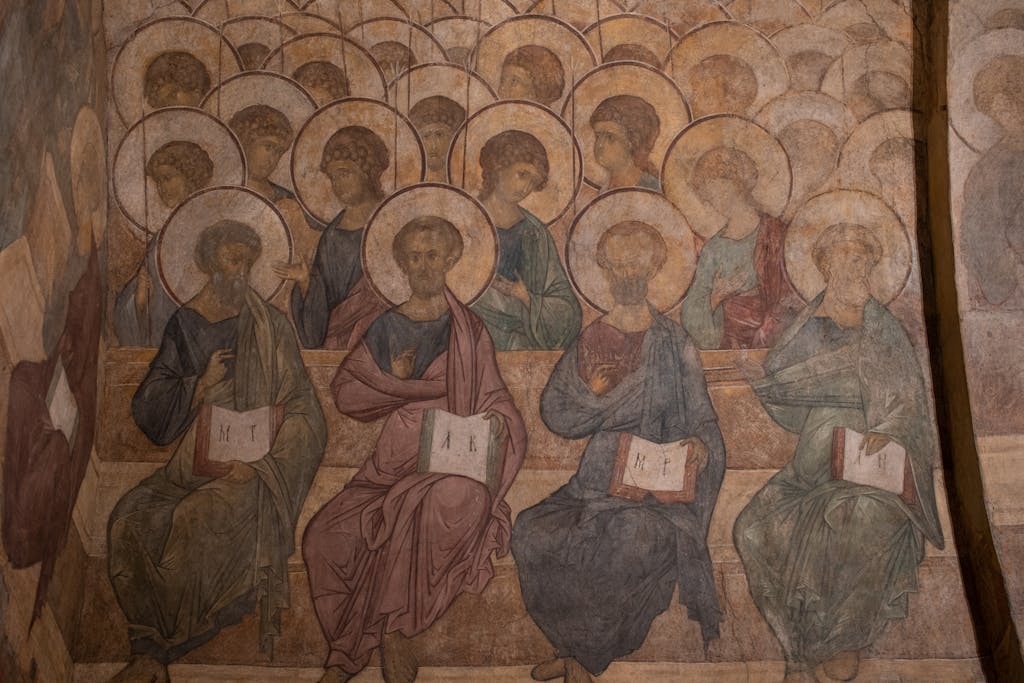
“Now may the God of patience and comfort grant you to be like-minded toward one another, according to Christ Jesus, that you may with one mind and one mouth glorify the God and Father of our Lord Jesus Christ.”
Syndoxia is For
Come and See
Syndoxia is, above all, an invitation: to learn more carefully, to speak more truthfully, and to hope more responsibly.
If the churches are ever to move closer in a way that is faithful, then the work begins not only in official dialogues, but also in the minds, hearts, and habits of ordinary Christians. This site is one small contribution to that work.
To be syndoxic is not merely to be friendly. It is to seek, however imperfectly, a way of being together in truth, in praise, and in the hope of one day standing more fully of one accord.
“But also for those who will believe in Me through their word; that they all may be one, as You, Father, are in Me, and I in You; that they also may be one in Us, that the world may believe that You sent Me.
John 13
And the glory which You gave Me I have given them, that they may be one just as We are one: I in them, and You in Me; that they may be made perfect in one, and that the world may know that You have sent Me, and have loved them as You have loved Me.”